

Logic Lane

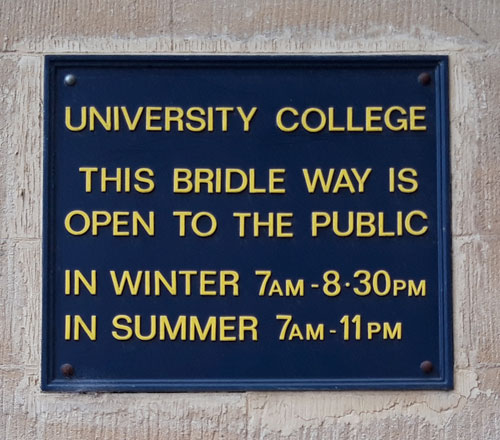
Logic Lane runs south from the High Street down to Merton Street, between University College’s 1903 Durham Building to the east and the older main part of the college to the west. Today it is a bridle way belonging to that college, with gates at each end that are locked at night.
It was known as Horseman or Horsemull Lane in the thirteenth and fourteenth centuries, when there was a horse-mill here. It had acquired the name Logic Lane by the seventeenth century, apparently after a school of logicians at its north end, although William Tuckwell, writing about the name changes of Oxford streets in his Reminiscences of Oxford, implies that name was older: “Only Logic Lane, quoted in the Spectator, as commemorating mediaeval combats, not always of words alone, between Nominalists and Realists, no one was profane enough to change.”
The controversial college bridge over the lane
With thanks to Robin Darwall-Smith, archivist of University College, for some of the information
The postcard below, produced by Davis's of Cornmarket in c.1905, shows Logic Lane (looking north towards the two domes of The Queen's College) with University College to the left and its new Durham Building to the right. The bearded man pointing to a post in the lane that was to prove to be of crucial importance is James Franck Bright, who was Master of University College from 1881 to 1906,

The text on the postcard reads:
THE GAME OF BRIDGE |
||
THIS LITTLE BRIDGE |
HERE STANDS |
|
£2,700 |
AND £300 |
|

The town & gown dispute over this bridge
The Durham Building of University College had been erected immediately to the east of Logic Lane in 1902. It had a tall metal fence on the Logic Lane side (shown in the above postcard), and as this was locked at 9pm each nigh it meant that the students who lodged in the Durham Building could not get in or out of the main part of the college after that time.
The College therefore decided to erect a bridge over the lane to link the two parts of the college, but after it submitted the proposal to Oxford Corporation later in 1902, a town-and-gown dispute ensued:
- Oxford Corporation declared that they would only grant permission for the bridge's construction in return for a rent of £5 a year, justifying this charge on the grounds that it had an ancient right of fee farm over all the soil not in the hands of private owners. (It had rented this right from the Crown, but then bought the rights outright in 1787.)
- University College claimed that Logic Lane was not a public highway, since for at least 200 years it had kept a post in the lane (shown prominently in the above cartoon) to make it impassable to traffic without the permission of the College.
The College refused the Corporation's conditions, claiming that it had no right to charge a quit rent on this land.
The Corporation would not budge either, and on 18 October 1902 had the post dug up and removed.
Right: the bridge viewed from the
south, matching the above cartoon
After an unsuccessful attempt to reach an out-of-court settlement, University College took the Corporation of Oxford to the High Court of Justice (Chancery Division), and a very long law report on the case can be found in The Times of 5 July 1904. The plaintiffs (the Master and Fellows of University College) made three claims
- They were the owners of the soil of Logic Lane and were allowed to build a bridge over it to connect their buildings
- The lane was only a public highway for foot passengers and horses, not for vehicles
- They were entitled to maintain a post in the lane to stop vehicles entering.
The defendants (Oxford Corporation) stated that they and not the college were the owners of the lane but were willing to approve the plans for the bridge on condition that the college paid them an annual rent of £5 in perpetuity.
The Judge (Charles Swinfen Eady) summed up the case thus:
The evidence of the ownership of the soil was overwhelmingly in favour of the plaintiffs [University College]. The result was that the soil of the lane was vested in the plaintiffs and that they had a right to maintain the post. There would therefore be a declaration (1) that the plaintiffs were the owners of the soil of the lane so far as it was bounded on both sides by their land; (2) that the plaintiffs were entitled to maintain the post: and (3) that the lane was a public highway for foot-passengers and horses, but not otherwise. The plaintiffs would be entitled to build the bridge upon satisfying the necessary statutory requirements.
Oxford Corporation had to pay costs of £2,700 (roughly £271,761 today).
University College duly built the bridge in 1905 at a cost of £300. It was designed by Harry Wilkinson Moore (who a few years earlier had also designed the adjacent Durham Building).
