

Nos. 48–51: Blackwell’s Bookshop

Blackwell’s main bookshop is comprised of four old shops in Broad Street: Nos. 48, 49, 50, and 51 (running from right to left in the above picture).They are in St Mary Magdalen parish. All four are Grade II listed buildings: the pair of houses on the left (51 and 50) date from the early eighteenth century (List Entry No. 1047351), while the pair on the right (49 and 48) were rebuilt and only date from 1936 (List Entry No. 1047352). Most of Blackwell’s cannot be seen from the street, as its vast basement extends under Trinity College’s quadrangle.

Nos. 48 and 49 became dangerous when their immediate neighbours to the east were demolished to make way for the New Bodleian Library in 1936, and they also had to go.
The right-hand half of the present shop was rebuilt to match the left-hand side. It includes the large area of Bliss Court, whose remaining tenants were rehoused.
Bliss Court was painted by J. A. Shuffrey in c.1907 (OXCMS: 2002.74,87, pictured on p. 473 of Lauren Gilmour and Margaret Shuffrey, J. A. Shuffrey 1859–1939: An Oxford Artist’s Life Remembered).

Above: the front of John Chaundy’s shop at No. 49 shored up during the demolition process.
Right: Nos. 48–51 as they were before the right-hand pair of shops had to be rebuilt
(Both old pictures reproduced by kind permission of Sue Chaundy)
Nos. 48 and 49 (demolished)
There were given to the parishioners of St Mary Magdalen by George Owen in the sixteenth century, but they sold them to Trinity College in about 1920.

No. 48 (on the right of the pair)
In 1829 the widow Susanna Seckham (right) set up business here as a dealer in china. The 1841 census shows her living here with her stepson Charles Seckham, her daughters Jane and Susannah Seckham, and their servant.
Mrs Seckham was still here at the time of the 1851 census with her daughter Jane Seckham and their servant, and the situation was similar in the 1861 census.
Susanna Seckham died here a year later on 12 May 1862.
By 1866 Elizabeth Rose, a widowed china & glassware merchant, had taken over this shop at No. 48. The 1871 census shows her as a widow of 46 living here with her son Edward, who was an architect's clerk, and two lodgers. She was still here with Edward, now a building surveyor, at the time of the 1881 census.
In 1890 the hairdresser and perfumer William Bartlett London moved into No. 48, and the 1891 census shows him living here with his wife Mary and their six children. By the time of the 1901 census he was described as a stationer & subpostmaster here. The 1911 census shows him still in this eight-roomed house with his wife and his son John 23) and daughter Bessie (31) who both assisted him in the shop.
From 1913 to 1937 the City Typewriter Co. and the Carfax School of Shorthand were at No. 48.
It became part of Blackwell's Bookshop in 1939
No. 49 (on the left of the pair)
The 1841 census shows the stationer Mary Ann Mallet living here with a 12-year-old girl called Mary Ann Westaway and three lodgers.
On 29 April 1843 John Daly announced in Jackson's Oxford Journal that he had taken over this shop from Miss Mallet and would continue in the same business as stationer & perfumer.
The 1851 census shows the staymaker Charles Lobb (57) and his wife Mary (62) (who had previously been at 22 Broad Street) living here with their servant. Mary died here on 26 December 1851 aged 64.
There is no listing for this house in the 1861 census, where 1 Bliss Passage is wrongly numbered 49 Broad Street.
The 1871 census shows John Chaundy (36), described as a carver & gilder, living here with his wife Maria and five sons, plus a general servant. He was still here with Maria and their sons at the time of the 1881 census, when he was described as a print seller and lay clerk. Maria died here at the age of 47 on 26 March 1882, and John Chaundy married his second wife Sarah Pates on 27 March 1883. He died at the age of 56 on 23 January 1890.
The 1891 census shows John's second wife Mrs Sarah Chaundy (35), described as a printseller, heraldic painter, carver, & gilder, living at No. 49 with her son Theodore (2) and her stepsons Edred (17) and Owen (18), plus a general servant. At the time of the 1901 census she was here with her son Theodore (12), and her stepson Owen Chaundy, who was also described as a printseller. The 1911 census shows that she was still here in this eight-roomed house with her stepson Owen.

Bliss Court
In the middle of the four shops was a passage leading to Bliss Court, where in 1881 fifty people lived crammed in nine houses stacked beside what is now the right-hand side of Blackwell’s.
The passage to the court shows up clearly in the picture (right) of John Chaundy’s picture shop (reproduced with kind permission of Sue Chaundy). In 1881 the eponymous W.H. & J. Bliss, painters & plumbers, occupied Bliss Court behind, along with John Parr, a tailor, and Charles Mathews, an engraver.
At the time of the 1921 census there were six occupied houses in Bliss Court: four were headed by charwomen, and the other two by a retired domestic servant, and a woman who had been deserted by her husband and worked as a ladies' toilet attendant
Below Bliss Court in 1916
(Historic England CC72/02263)
Nos. 50 and 51
No. 50 (on the right of the pair)
At the time of the 1841 census the plumber John Bradfield lived at No. 50 with his wife Sarah and eight of their children, plus three lodgers and a servant. He was still here at the time of the 1851 census with his wife and five grown-up children (two of them now also described as plumbers).
On 21 January 1860 the following advertisement appeared in Jackson's Oxford Journal, advertising the auction of the freehold of this property:

No. 50 Broad Street is listed as unoccupied in the 1861 census. The following year the painter and decorator Edward Haynes took this shop over. His wife Mary Ann died here in November 1862 and he married his second wife Harriet in 1864. He died here on 20 February 1871 at the age of 49, and the 1871 census shows his son Henry James Haynes, a bachelor of 21 described as a master painter employing five men and one boy and the head of the household, living here with his 27-year-old widowed stepmother Harriet, his four half siblings, and his three-year-old half-brother, plus a general servant.
On 1 January 1879 this shop was bought by Benjamin H. Blackwell. At the time of the 1881 census he was aged 32 and living here with his widowed mother Ann Blackwell, plus a boarder and and one servant: he was described as a “bookseller master employing one apprentice and one boy”. At the time of the 1891 census he was not at home, and his wife Lydia (32) was here with her children Dorothy (3) and Basil (2), plus a 17-year-old servant girl.
No. 50 was recorded as unoccupied in the 1901 census, and is not listed in the 1911 census.
No. 51 (on the left of the pair)
The advertisement below from Jackson's Oxford Journal of 26 May 1753 indicates that the house was occupied by Mr Shilfox until that year:
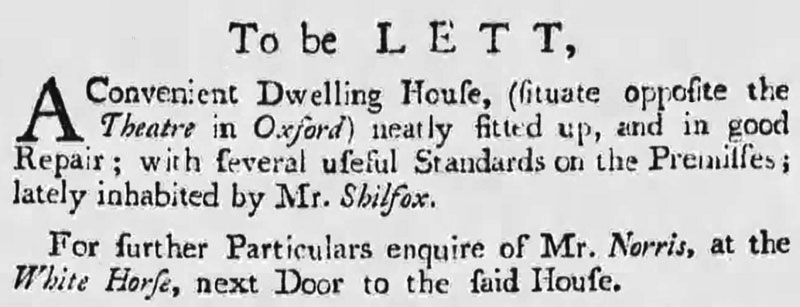
This was occupied by Messrs Law & Son, tailors to 1842 and at the time of the 1841 census the tailor John Prior (56) lived over the premises with Elizabeth (48) and John (7).
On 14 May 1842 a forthcoming auction of No. 51 was advertised in Jackson's Oxford Journal:
All those eligible situated FREEHOLD PREMISES, in which a very extensive and lucrative business has been carried on for many years by the late Messrs. Law and Son, tailors; containing, on the ground floor, an entrance lobby, spacious shop, and convenient front counting house; a drawing room and dining room, with china closet, on the first floor; two bed chambers on the second floor; and two ditto and closet over; a good kitchen scullery, wine and beer cellars, in the basement; detached wash-house, with workshop above; two-stall stable, small garden, and other conveniences; joint use of passage from the street, pump of good water, &c. &c.
At the time of the 1851 census No. 51 was occupied by John Lockwood, a master tailor employing six men, and his wife, their five young children, and a general servant. He died on 23 March 1854, and his wife Johanna Lockwood took over the shop. The 1861 census describes her as a widow of 51 and a tailor employing five men living here with her three children and a servant.
On 28 September 1861 Jackson's Oxford Journal reported on premises for the Churchmen's Union that had just been built behind this shop:
OXFORD CHURCHMEN'S UNION.—The new building which has been recently erected in Broad-street for the use of this Society, will be opened on Monday next with a conversazione and promenade entertainment. The premises are situated at the back of Mrs Lockwood's, and comprise a spacious reading room, a chess or class room adjoining, and a large lecture and music hall, and over the class room a room for the Committee.
Johanna Lockwood was still listed here at No. 51 in the 1871 census, described as a tailor, with her three grown-up children and a general servant. The Churchman's Union building behind was marked as unoccupied, and there was another family called Mitchell living in “Lockwood Passage”. Johanna Lockwood died in 1879 and her daughter Miss Mary A. Lockwood continued to run his business, and at the time of the 1881 census was living here with her two-year-old nephew and an undergraduate boarder. Charles Townsend lived in the Churchmen's Union at No. 51a with his wife and his niece.
When Blackwell's expanded into No. 51 in 1887, Miss Lockwood moved to No. 53. The 1891 census has no listing for No. 51, which was probably considered to be part of No. 50 above, and the Churchmen's Union at 51a was listed as unoccupied.
The 1901 census shows Charles Bell (29), the Assistant Keeper at the Ashmolean Museum, living here with his servant. The house is not listed in the 1911 census.
Blackwell’s
Blackwell’s began life in just one of its present four shops: No. 50 (second from the left). Benjamin Harris Blackwell, had been a secondhand bookseller at 46 St Clement’s Street since 1845, before coming the first City Librarian. He died at the age of 41 on 9 January 1855 when his son Benjamin was aged just six, and the latter was apprenticed to Charles Richards, a bookseller at 104 High Street, at the age of 13.
Benjamin Henry Blackwell bought the freehold of 50 Broad Street and opened this shop on New Year’s Day 1879. In 1887 he expanded into No. 51 next door to the left, and in 1919 took over No. 49 to the right.
In 1936 Blackwell’s managed to get a building lease of the site of 48, 49, and Bliss Court (which ran between 49 and 50) at an annual rent of £155, for eighty years from Trinity College, and rebuilt the two shops to match those on the left.
The Norrington Room measuring 10,000 square feet and with three miles of shelving was created under the south-east corner of Trinity College and was named after Sir Arthur Norrington, President of Trinity. It was opened in 1966, and for many years was listed in the Guinness Book of Records as the single largest room in the world selling books.
On 13 March 2007 the lease of Nos. 50 & 51 was purchased by G. M. Trustees Ltd of Guernsey (ON47218).
In February 2022, after 143 years of family ownership, Waterstone's purchased Blackwell's.
|
Some of the occupants of 48, 49, 50, and 51
Broad Street listed in directories and newspapers |
|||
|
48 |
49 |
50 |
51 |
|
1829–1862: 1866–1889 1890–1912: 1913–1937 |
1841–1843:
1843–1846+: 1852: 1861: 1866–1915: |
c.1816 to late 1850s: 1862–1876: 1879–1882: |
to 1763: Mr Shilfox To 1842: Messrs Law & Son, Taiilors 1846–1884: 1846: Henry Lockwood |
|
1887–1918: |
|||
|
1919–1937: |
|||
|
1939–present: |
|||
There, in the Broad, within whose booky house
Half England’s scholars nibble books or browse.
Where’er they wander blessed fortune theirs:
Books to the ceiling, other books upstairs;
Books, doubtless, in the cellar and behind
Romantic bays, where iron ladders wind.
John Masefield