

Nos. 1–3: Now The Store Hotel
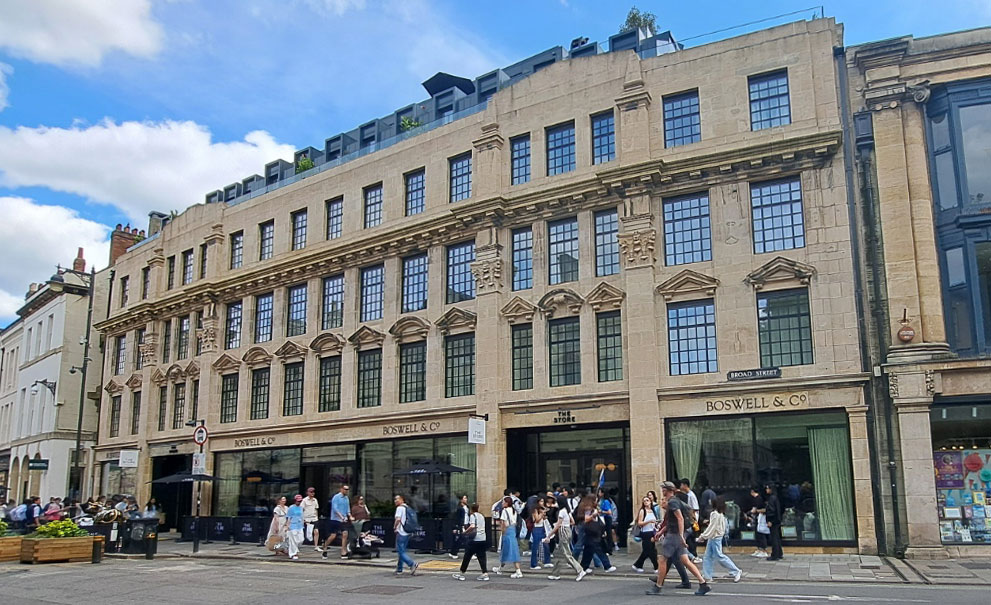
The above photograph shows the new Store Hotel soon after it opened in the former Boswell House in 2024. It has retained the name of Boswell & Co above the windows.
The first five shops of Broad Street were in St Michael-at-the-Northgate parish. They were completely demolished in 1928 to make room for Boswell House. Planning permission was granted in March 2021 (20/02480/FUL) to convert the whole of Boswell House at 1–5 Broad Street into a hotel.
The three former shops at Nos. 1–3 Broad Street prior to 1928
No. 1 Broad Street
The 1841 census lists the cabinet maker Richard Embling at 1 Broad Street with his wife and servant, but as the listing for 2 Broad Street describes it as “a house of business not slept in”, and the pub which should be No. 2 is numbered 3 Broad Street, it is possible that Embling was in fact in the building on the corner of Cornmarket.
On 2 September 1854 the cabinet maker William Herbert announced in Jackson's Oxford Journal that he had added the shop here at 1 Broad Street to his premises at 31 Cornmarket Street, and these premises are still combined today (first with Boswell's and now with the Store Hotel). On 18 October 1856 Herbert announced in Jackson's Oxford Journal that he was retiring from business and was selling all his stock. Herbert, who had served as Sheriff of Oxford in 1858, took his own life at his private residence, Summertown Farm, on 23 May 1859, and three months later on 20 August another cabinet maker, William Baker, announced that he had purchased both Herbert's business and stock in trade, and would be chiefly conducting his business here. The 1861 census which has the modern numbering lists 1 Broad Street as unoccupied.
In 1865 Baker’s built an additional showroom.
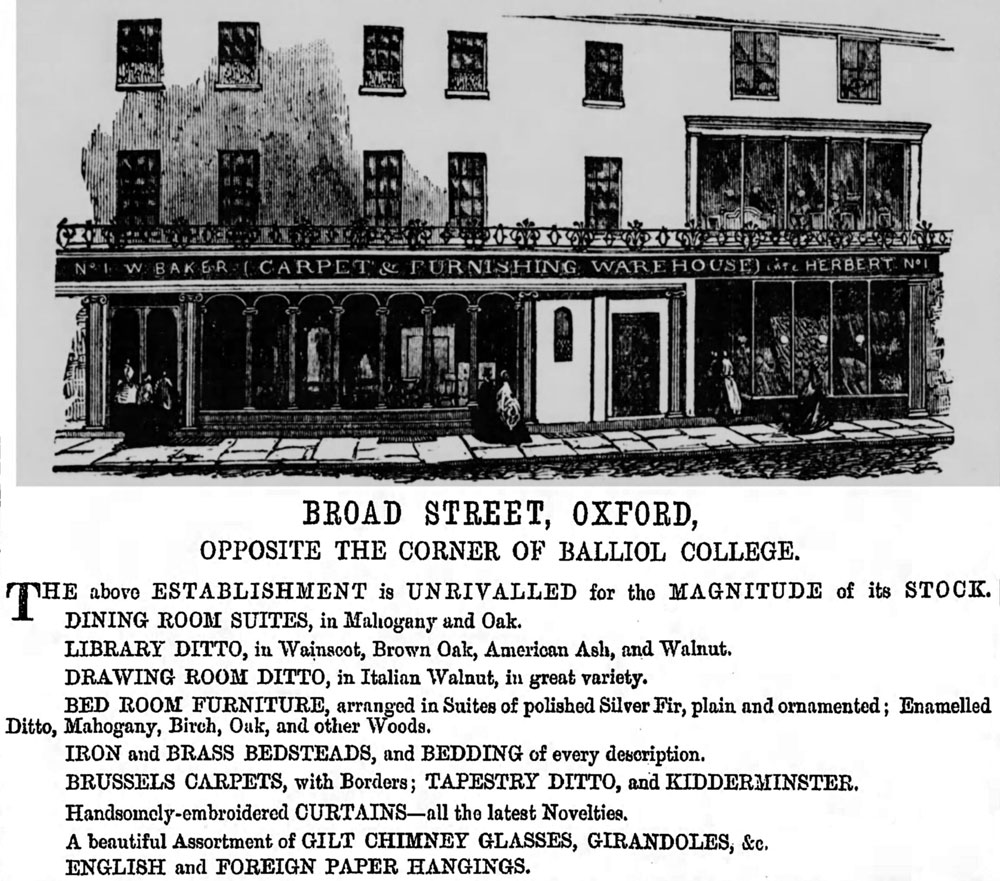
The advertisement below, published in Jackson's Oxford Journal on 9 November 1867, shows the former large shop at 1 Broad Street when it was William Baker's carpet & furnishing warehouse (late William Herbert, as stated on the right). “No. 1 W. BAKER” can be seen over the door on the left, and “LATE HERBERT NO. 1” on the right.
The 1871 census shows two households living upstairs here: Thomas Haskins, a clerk, with his wife and five children plus a servant, and Elizabeth Perry, a widowed annuitant, with her servant. The Hoskins family still occupied the living quarters at the time of the 1881 census, and an annuitant called Elizabeth Perry was listed in a separate household at that address.
See below for details of the lodging house over 1 & 2 Broad Street from c.1891 to c.1911
From 1882 to 1887 William Baker was in partnership with Harry Neville Prior, who had a furniture shop in Queen Street and was married to Martha Wallis Williams, the sister of Baker's wife Eliza Ruth Williams.
In 1882 Baker & Prior built a new four-floor warehouse at the rear of 1–3 Broad Street, converting the upstairs of the original shop to the Ship Hotel: care was taken to preserve the Martyrs’ Tower (one of the bastions of the old city wall which ran through the premises), and it still survives behind the former Boswell’s department store.
Photographs from the 1890s indicate that as well as the warehouse at the rear, William Baker occupied the whole of the ground-floor area later occupied by Boswell’s.
On 14 October 1893 William Baker announced his retirement from active management of his business in Jackson's Oxford Journal, and he died in 1902, but the shop at 1 Broad Street continued to operate here under his name until 1914, when it moved into the new building on the corner: for more details on its later history, as well as more biographical information on William Baker, see the page on William Baker House.
No. 2 Broad Street (North Star pub)
The North Star pub dated from the eighteenth century, and in 1828 the landlord was a Mr Wentworth.
An auction of pubs by Mallam's that was advertised in Jackson’s Oxford Journal of 1 May 1830 included: “That well accustomed PUBLIC HOUSE, known by the sign of the NORTH STAR, situated in Broad-street, in the City of Oxford; containing a front tap room, bar, kitchen, scullery, cellaring, a small yard, dining room, four bed chambers, &c.; held by lease under the City of Oxford for 40 years from Michaelmas, 1829.
On 13 October 1832 the following advertisement appeared: “TO be LET, with immediate possession,—The NORTH STAR PUBLIC HOUSE, situate at the top of Broad-street, in the City of Oxford.—Apply to Mr. James Wickens, Sun Inn, Corn Market.”
The 1841 census shows Richard Taylor, described as a victualler, living at the North Star pub with his wife Elizabeth. He died near the beginning of 1844, and when Elizabeth Taylor married the excise officer J. S. Powell on 25 June 1845 she was described as the relict of the late Mr. Taylor, of the North Star, St Michael's.
On 27 February 1847 notice was published of a forthcoming auction of "all the household furniture and public house requisites belonging to Mrs Gittins” at the North Star
At the time of the 1851 census the North Star pub was occupied by John White and his wife and four young children. The numbering of Broad Street was unsettled at this point, and for a short period its address was given as 3 Broad Street.
By 1854 the landlord was John Marsh, and the 1861 census shows him living here at the age of 39 with his wife Elizabeth, his son John Abram Marsh (13), and his niece Ann Marsh (13). John Marsh died on 20 May 1865 following an attack by two customers who objected when he told them not to play their banjo and tambourine because his sick wife was asleep upstairs (inquest reported at length in Jackson's Oxford Journal of 27 May 1865). His wife Elizabeth died in 1868, and on 6 June that year their son John Abram Marsh announced that he was taking over his parents' pub. Jackson's Oxford Journal reported that at the application for the renewal of the licence on 3 October 1868 the Proctor stated that “the house was a place of refuge and retreat for a very considerable number of prostitutes. He could describe it, from the facility with which they retreated into it, as nothing else than a common harbour for prostitutes.”
Although the licensed was refused in 1868, at the time of the 1871 census John Abram Marsh was the licensed victualler living here with his wife Sarah, their daughter Elizabeth, and a boarder.
In March 1872 the licence was transferred from John Abram Marsh to Mrs Mary Harris, widow.
On 1 September 1877 the landlord, A. K. Stowell, who said he had kept the North Star pub for two years, failed to get a spirits licence.
By 1880 the publican was the widow Mrs Eliza Smith, and the 1881 census shows her living here with her two sons. The pub closed soon after that census.
This report in Jackson's Oxford Journal on 14 October 1882 indicates that Messrs Baker & Prior (at 1 Broad Street on the corner) had expanded into the former North Star pub:
Alterations and repairs have been carried out to the old North Star publichouse for Messrs. Baker and Prior, of Broad-street. The new front was manufactured by Messrs. Baker and Prior from drawings by Mr. Rogers, art designer to the firm. The general alterations were carried out by Mr. J. Horn, from plans prepared by Mr. Codd.
Directories from 1884 to 1887 duly list Baker & Prior at both 1 & 2 Broad Street, but by 1889 Baker had broken his partnership with Prior and was back occupying just No. 1 again, and Robert Buckell occupied No. 2. He remained in the old pub building until 1891.
From 1893 the tobacconist Edward Marshall Staniland was listed as a tobacconist at 2 Broad Street, at the same time as there was another tobacconist at No. 3, and he continued to operate here until his shop was demolished in 1928. Below is a photograph of Staniland's shop (Historic England BB70/03366):
This photograph shows on the right an ionic column that may match the columns on the drawing of William Baker's shop shown above.
Lodging house upstairs at 1 & 2 Broad Street
Neither Baker nor Staniland lived over their shops, and the upstairs was run as a university lodging house.
At the time of the 1891 census the Misses Sarah & Eleanor Collins were the lodging-house keepers living over 1 & 2 Broad Street, and in 1901 Eleanor Collins was running it on her own. The 1911 census shows Eleanor Collins (82) living in the seventeen-room accommodation with her niece and companion Elizabeth Collins (58), plus a housekeeper and servant girl. No boarders were in residence, probably because the census was taken in the university vacation. Eleanor Collins died in November 1911 and her lodging house closed.
No. 3 Broad Street
There is a confusion of numbers in the 1851 census: the pub at No. 2 is wrongly given the number 3. Then the tea dealer Rebecca Fairbairn is listed with her servant at No. 4. which seems to be this house.
In the 1861 census No. 3 next to the pub is listed as unoccupied.
At the time of the 1871, 1881, and 1891 censuses the tobacconist William Charles Gardiner or Gardner, was listed at 3 Broad Street, with his wife and daughters.
No one is listed as living here in the 1901 and 1911 censuses.
In 1914 this was E. M. Liddell's berlin wool depository.
Demolition of 1–5 Broad Street
This photograph shows the demolition of 1–5 Broad Street taking place in 1928:
- On the left is part of No. 6 Broad Street which survives today
- Then come two large matching dwellings partly demolished at the top (presumably Nos. 5 & 4)
- Then to the right are the demolished remains of Nos. 3, 2, and 1
- Out of sight on the corner is William Baker's new shop of 1915, which survives today
The 1929 Boswell House (now the Store Hotel)
Boswell House was built by E. Organ & Son in 1929, and was owned by Oxford City Council. The original six-storey building comprised a department store for H. Boswell & Co. Ltd, including offices and a restaurant upstairs and two additional small ground-floor shop units (4 & 5 Broad Street) to the left.

The above drawing shows the 1927 plans for the “City Drug Stores” produced by A. S. G. Butler, who acted as consulting architect on behalf of the Oxford Preservation Trust. The Trust’s Second Annual Report 1927–1928 explains why it had become involved in the project:
Broad Street. Some years ago the City Council let out on building lease to Mr. Pearson a large section of the southern frontage at the west end of Broad Street, opposite the eighteenth-century part of Balliol College. Mr. Pearson’s intention is to build on this site a number of shops with offices in the upper storeys, and his architects (Messrs. North, Robin & Wilsdon, of 35 Maddox Street, London, W.1) prepared plans, skilfully designed in their interior disposition, to meet the purpose which Mr. Pearson had in view. These plans came before the Town Planning Committee of the City Council for consideration, and the Committee felt that, in view of the importance of the site, the question of the design of the elevation was one of capital importance.
(Pearson had bought the shop from Henry Boswell in 1890, but retained the name.)
Boswell’s department store moved into the large premises at Nos. 1– 3 in 1929. Until the mid-1950s, however, the part of Boswell's to the west was occupied by a separate business numbered 4 (with the shop that later became No. 4 numbered 4A and 4B).
Boswell House incorporated the Martyrs’ bastion of the city wall.
The original Boswell's shop at 50 Cornmarket Street had been in operation since 1798 and just sold luggage. In the 1890s the business passed to Arthur Pearson, who retained the name. His new shop in Broad Street was originally described in Kelly's Directory as “1, 2 & 3 Boswell & Co. portmanteau makers”, but later in the 1930s the description was “Hardware merchants”. From 1952 it was listed thus: “Hardware & kitchen equipment, refrigeration engineers, leather & travel goods, cutlery, silverware & fancy jewellery & household linens”.
Pearson already owned the Oxford Drug Company at 31 Cornmarket Street, but originally ran the two shops separately. It was only in 1958 that an opening was made to join the two buildings, making an L-shaped shop around William Baker House on the corner. The two shops remain united today, forming Oxford’s largest independent department store. Boswell’s of Oxford is still owned by the Pearson family.
The advertisement below shows that in 1961 you could get a three-course lunch at The Kemp upstairs in Boswell House for 4/6

Boswell’s department store was due to close permanently on 4 April 2020, but was forced to shut down earlier because of the CVD-19 outbreak.
Vimeo: 58 audio memories of people connected
to the former Boswell's department store
The photograph below shows Boswell House when it was a department store at Nos. 1–3 with separate ground-floor shops at Nos. 4 & 5 to the east

|
Businesses that have occupied the main part of Boswell
House to the west |
||
1929–2020 |
Boswells of Oxford |
|
Upstairs |
||
1934–1964 |
Kemp Hall Cafeteria (”The Kemp”) |
|
1968–1976 |
Vintage Car Restaurant |
|
1980 |
Quills |
|
By 1983–1995 |
Chit-Chat Restaurant |
|
1996–1999 |
Soprano Restaurant |
|
1999–c.2004 |
Restaurant du Liban |
|
2004–2020 |
||
Boswell's and Pearson's in Cornmarket
The two predecessors of the 1928 Boswell's department store
(1) Boswell’s at 50 Cornmarket Street: Luggage maker & seller (1738–1929)
Francis Boswell originally started selling travelling goods in 1738 at 50 Cornmarket Street (on the west side, just north of Frewin Court). He rebuilt the shop with its neighbours in 1874, and the business remained in the Boswell family until 1890, when Henry Boswell sold it to Arthur Pearson, who kept the old name. Until 1928 Boswell’s remained just a small shop at 50 Cornmarket, described in directories as “Portmanteau makers”.
For more details, see page on 50 Cornmarket Street
(2) Oxford Drug Company at 31 Cornmarket Street (1912–2020)
Arthur Pearson had bought Alderman James Stanley Lowe’s shop at 31 Cornmarket Street back in 1882, and ran his own ironmonger’s shop there until 1912, when he moved his premises to George Street. He then had No. 31 Cornmarket Street rebuilt as the Oxford Drug Company.
For more details, see page on 31 Cornmarket Street
Boswell's closed down in 2020.