

21 Cornmarket Street: Northern part of Cheng Yu Tung Building
There was a pub on this site from at least the mid-seventeenth century to 1901. It was in the parish of St Michael-at-the-Northgate Church, as is the present building today.
The pub here was called the Globe from 1657 until the late seventeenth century. In 1696 John Meadford paid tax on nine windows on a building in St Michael’s parish, likely to be this pub.
In 1772 a survey of every house in the city was taken in consequence of the Mileways Act of 1771. According to H. E. Salter, 21 Cornmarket was then in the occupation of Mr Brown, and had a frontage of exactly 10 yards.
White Hart pub/hotel (prior to 1900)
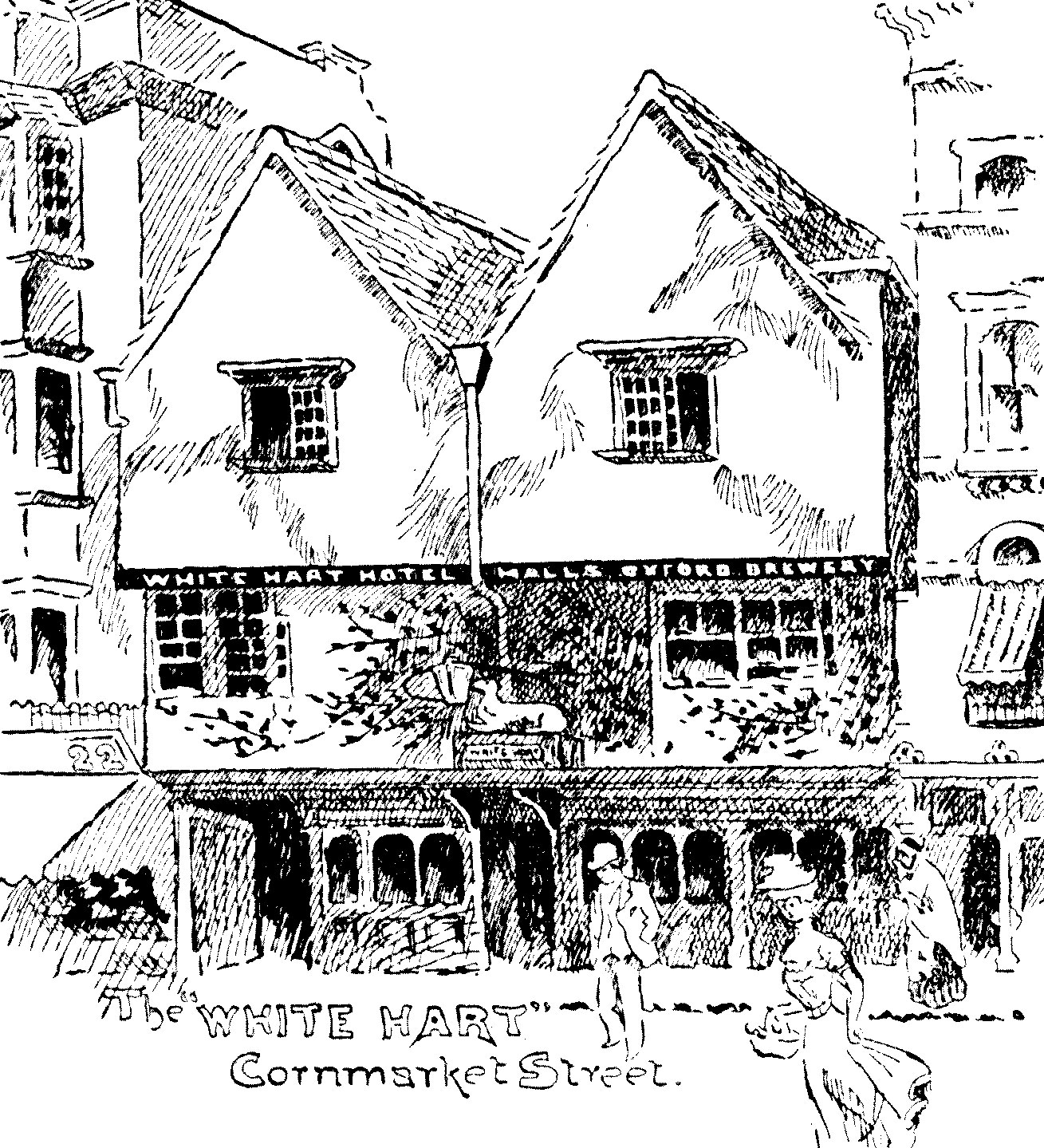 Above: Drawing of the White Hart Hotel, published in Jackson's Oxford Journal on 15 July 1899.
The article states that the building was a stone and plaster structure then held to be 400 years old
Photograph of White Hart Hotel immediately before its demolition
In January 1765 the landlord of the White Hart was Townsend Pitman.
On 6 January 1798 Jackson's Oxford Journal advertised the forthcoming auction of:
All that FREEHOLD DWELLING HOUSE, with roomy Stabling, Granaries, excellent Cellaring, and other Appurtenances thereunto belonging, known by the Sign of the White Hart, in the Corn Market. The above Premisses have lately undergone a thorough Repair, and several very judicious Improvements made to make it more commodious, and as an old-established House is very desirable, being well situated for Trade and the weekly Markets. Immediate Possession will be given after the Sale, if required.
Tobias Tallant was the landlord of the White Hart Inn until 1816.
In 1823 the pub here was described as the White Hart & Greyhound, and in the 1841 census it was named as the Greyhound: the landlord John Walker was then living here with Margaret Walker and four or five other people, plus their servant.
From 1846 onwards it was always simply the White Hart.
From the Oxford Police Occurrence Book, Saturday 12 August 1871 (recorded by G. Bennett, Inspector):
PC 32 Alfred Purnell reports Elizabeth Luker, Landlady of the White Hart P.H., Corn Market Street, for leaving a Cab without a Horse standing in front of the above house for 25 minutes (viz.) from 10.10 till 10.35 a.m. on Saturday the 12th inst.
Mrs Luker has on several occasions lately been cautioned as to the before mentioned Cab being left standing in front of her house without a Horse. – Complaint of the same has also been made to the Police by an inhabitant living close by, but who does not wish to attend before the Magistrates as Witness.
The pub was the venue for the annual dinner of many organizations, e.g. the Oxford Licensed Victuallers Association (1874 and 1899), the Amalgamated Society of Journeyman Tailors (1878), Worcester C.S.C.C. (1890) Cherwell Rowing Club (1893), General Association of Licensed Trade (1893), and Oxford Freemen (1894).
On 18 March 1899 the prosperous grocer Francis Twining bought the White Hart Hotel in Cornmarket for £8,000 at auction, and shortly afterwards it was sold on to John Buol, who decided on a complete rebuild.
The statue of a white hart that can be seen above the central entrance of the pub is believed to be the same one that was erected above the first-floor window of Buol's (below), although in the drawings they are looking in different directions.
Buol's building (1900–1939)
In 1900 the White Hart was replaced by a much taller four-storey building designed by Stephen Salter. This was a hotel and restaurant for the Swiss-born confectioner John Buol, who already had premises in Scarborough and Brighton, and at 15 Broad Street, Oxford. The postcard below, with the date 1900 inscribed near the top of the building, was produced at some point between 1902 and 1912:

The photograph below dating from about 1905 shows the new building at No. 21. To the left is Andrews at No. 22, clearly named and numbered, and to the right No. 20, then the beginning of Orpwood's saddle shop at No. 19.

Jackson's Oxford Journal of 15 July 1899 published a drawing of the new Buol's building, which it said combined “the harmonious effect of the Elizabethan style with the very prosaic business of a public hotel”. It went on to describe the layout in details:
The basement will comprise large cellars, bakery, servants' hall, and cold storage, all paved with marble terrace, and extending the entire length of the premises. On the ground floor there will be a spacious cafe and public bar, with side entrance, billiard saloon, lavatory and other offices, while as near the centre as possible the proprietor will have a comfortable box commanding all points. The first floor is to consist of a large dining saloon, 62 feet by 28 feet (to serve also as a ball-room), with a polished secret-nailed oak floor on an under floor, which the architect believes will constitute the best dancing floor in the city. Abutting on the dining hall will be found a spacious lounge, paved in mosaic, and possessing a delightful balcony overlooking Cornmarket-street, the windows of which, being removable, will allow the summer breezes to penetrate the whole of the apartment. Everything in this new, up-to-date a la mode cafe is to savour of the “Continong;” and the second floor will contain another spacious dining saloon (62 feet by 28 feet), convertible into smaller rooms by means of iron shutter partitions. Sleeping accommodation will be represented by 20 bedrooms, all well lighted and with ornamental fireplaces. Patent sound and fire-proof partitions are to be used; the floors will be of wood block (fireproof mostly), consisting of steel joists filled with breeze block concrete, and the halls and landings will have hot water heating installed. The new “White Hart” is the design of Mr. Stephen Salter, F.R.I.B.A., whose family name is not unfamiliar in Oxford. Mr. Salter (of the firm of Davy and Salter, of Maidenhead, the Isle of wight, and High-street), is a native of this city, and he has endeavoured to reconcile the new erection with the chief features of domestic architecture, as it should be represented in a city of colleges, hoary with age. As a building with four storeys above the ground floor, it cannot but be pretentious, but a building of these dimensions might become a very ghastly object in the hands of a draughtsman devoid of the true tastes of the antiquarian. Mr. Salter has, however, avoided this possibility, and has produce an up-to-date building which combines the harmonious effect of the Elizabethan style with the very prosaic business of a public hotel.
The following report appeared in the same newspaper on 13 October 1900:
THE “WHITE HART,” CORNMARKET-STREET.—A striking alteration has been made in the appearance of Cornmarket-street by the demolition of the old “White Hart” hostelry, with its quaint two-gabled front, and the erection on the site of a handsome and lofty structure to be used as a hotel and restaurant by Mr. Buol. of Scarborough, Brighton, and Oxford. The basement comprises large cellars, bakery, servants' hall and cold storage, extending the entire length of the premises. On the ground floor there is a spacious café and public bar, with side entrance, billiard saloon, lavatory, and other offices, while near the centre is the manager's box, commanding all points. The first floor consists of a large dining saloon, 62ft. by 28ft. (to serve also as a ball room), with a polished secret-nailed oak floor on an under floor. Abutting on the dining hall is a spacious lounge, paved in mosaic, and possessing a balcony overlooking Cornmarket-street. The second floor contains another spacious dining room, 62ft. by 28ft., convertable into smaller rooms by means of iron shutter partitions. There are 20 bedrooms, all well lighted and with ornamental fireplaces. The architect is Mr. Stephen Salter, F.R.I.B.A., and the builders Messrs. Kingerlee and Son.
Buol's Hotel and Restaurant is the tall building on the right of the postcard below, prominently marked BUOLS on the roof.


Buol advertised his new premises as “the very finest dining hotel and restaurant in the city”.
For a drawing of these premises on a bill-head, and also an advertisement showing that by 1901 Buol also had branches in Brussels, Scarborough, Southport, Liverpool, and Cambridge, see Michael L. Turner and David Vaisey, Oxford Shops and Shopping, p. 33, illustrations 68 and 69.
The earlier Buol’s restaurant which opened in 1893 at 15 Broad Street continued to run in parallel with this one.
Right: Advertisement for the Hotel & Restaurant Buol
that appeared in Alden’s Oxford Directory of 1906
At the time of the 1901 census John George Buol (40) lived here at his Cornmarket Street premises with his wife Felise and six of their children (the first five having been born in Scarborough in Yorkshire, and the youngest in Switzerland. Also living with them were two Swiss nephews who were pastry cooks and confectioners, and seven members of staff. By 1911 he was living at his new premises at 17 King's Parade in Cambridge, where he died on 13 August 1917 at the age of 56. His effects came to over £21,641.
By 1919 Buol's Hotel at 21 Cornmarket Street had become the Dujon Restaurant (owned by Dudeney & Johnston Limited, a chain of grocers and caterers).
1939–1960
The restaurant was demolished in 1939 to make room for an extension to Marks & Spencer Ltd, which then occupied Nos. 18–20 to the south. The statue of the white hart ended up at Cowley Library

1960–2019
In 1960 Milward & Sons Ltd was granted permission to demolish and rebuild this 1939 shop (planning application 60/09941/A_H).
Shortly afterwards Jesus College was granted permission to replace Nos. 13–20 to the south with Northgate House.
In 2019 the 1960 building was demolished along with Northgate House to the south to make way for a large new development by Jesus College. The Cheng Yu Tung Building was opened in July 2022.
Right: The modern building that stood on this site from 1960. This was demolished along with Northgate House to the south in 2019
Occupants of 21 Cornmarket Street listed in directories etc. |
||
1823–1899 |
White Hart (or White Hart & Greyhound) Inn Innkeepers (subject to nineteenth-century university wine licences): Robert Brown (1777) |
|
Rebuilt in 1900 as a restaurant |
||
1901–1926 |
Hotel Restaurant Buol (John George Buol) to 1916 Dujon Restaurant (formerly Buol’s) (Dudeney & Johnston Limited) by 1919 to 1925 Buol's Restaurant |
|
1928–1938 |
Stewart’s Restaurant |
|
Rebuilt in 1939 as an extension to the original, smaller Marks & Spencer shop to the south |
||
1939–1960 |
Part of the original Marks & Spencer group of old shops at 18–20 Cornmarket |
|
Rebuilt by Milward's in 1962 at the same time as the new big block for Marks & Spencer block at Nos. 13–20 to the south was erected |
||
1962–1980+ |
Milward & Son, Footwear specialists |
|
1984–2017 |
North end of Next clothes shop |
|
2017–2019 |
Vacant, then demolished by Jesus College in 2019 |
|
21 Cornmarket Street in the censuses
1841
John Walker (35), the inn-keeper at the “Greyhound Inn”, lived here with Margaret (4), Mary Anne (20), Margaret (15), and Eliza (12). He had five servants (three female and two male) and two guests.
1851
William Manning (46) was the innkeeper here, but the pub is not named. He lived with his wife Sarah (36) and his daughters Adelaide (17), who was a governess, Catherine (10), Sarah (6), and Margaret (1). They had two servants.
1861
The widow Mrs Sarah Manning (47) lived at the “White Hart Inn” with her daughter Catherine (21). There was a 17-year-old visitor staying with them, and they had two house servants.
1871
Elizabeth Luker (45), a widowed licensed victualler, lived here at the White Hart with her children William (26), Louise (23), Fanny (21), Isaac (18), a compositor, Walter (15), a waiter, and John (13), as well as her granddaughter Elizabeth Alexander (eighteen months) and her widowed mother-in-law Ann Luker (73).
1881
John Lyne (60), innkeeper of the “White Hart”, lived here on the premises with his wife Elizabeth (57) and their son John Luker (24), a compositor. They had two general servants, and there were two guests, both commercial travellers.
1891
John James Lynes (70), inn keeper, lived here at the White Hart with his wife Elizabeth (66) and a barmaid and ostler.
Rebuilt as a restaurant in 1901
1901
John George Buol (40), the Swiss-born proprietor of the Buol's restaurant chain, lived over this branch with his wife Felise (42) and their children Marguerite (17), Charles (16), Louis (14), Edelweiss (13), Henry (12), and Felise (3), and his nephews Contat Diserens (24) and Louis Diserens (20), who were both pastry cooks and confectioners. Six servants were also living with them (a cashier, housekeeper, two roommaids, two waitresses, and a confectioner).
1911
Theophile Grandvoinet (38), a Swiss-born cook/confectioner, lived here at Buol's with his wife Josephine (38), who assisted him in the business, and his children George (9) and Edelweiss (4), plus his sister Marie Grandvoinet (27), who acted as their housekeeper. Three servants lived with them (a cellarman, house porter, and domestic nurse).