

62–65 Cornmarket Street: HSBC Bank

This building on the corner of Queen Street was was designed by Henry Thomas Hare and built in 1896/7. It is Grade II listed (list entry 1186063). Until recent years it was owned by Oxford City Council, but they have sold it to Goldmoney, who are redeveloping the nearby Clarendon Centre.
The bulk of the building to the south was taken over by the Midland Bank in 1914, and the bank's original entrance is to the left. In 1986 the bank expanded to include the section on the right with the present grand doorway.
The former shops on this site were in the parish of St Martin's (Carfax) until that church was demolished in 1896. The present building was then in the parish of St Martin's & All Saints until All Saints Church closed in 1971, and is now in the parish of St Michael-at-the-Northgate.
The four former properties on this site to 1896, including the Sun Inn
In the late eighteenth century Isaac Board, a saddler, had a fourth share in these four properties, which he had bought from William Denton. Following Board's death in 1794 they were divided up: his widow Sarah received No. 62, and Thomas Booth and William Carter the Nos. 63, 64, and 65.
- No. 62: This was a narrow shop with a passage to the pub at No. 63 behind on the left. Arthur Frederick Rose bought it from the draper William Oliver on 10 December 1879 for £995, and the City of Oxford bought it from Rose for £2,500 on 20 April 1896.
- No. 63 was the Sun Inn (also known as the Sun Vaults and the Sun Wine Stores), which was here from at least 1605, set back from the road. Thomas Morton was the landlord here until 1775. On 5 February 1896 City of Oxford bought these premises from Thomas Arthur Carr for £19,000.
- No. 64: C. Bowen, who opened a mercer’s shop here in mid-1837, named this building Victoria House in honour of the new queen who had just succeeded to the throne.
- No. 65: This was a small house adjoining the old St Martin's Church with the churchyard behind. It belonged first to Osney Abbey and then to Christ Church, and was acquired by the City of Oxford on 25 March 1895 in return for six acres in Sidelings and £1,000. From 1817 to 1850 it was the office of Jackson's Oxford Journal
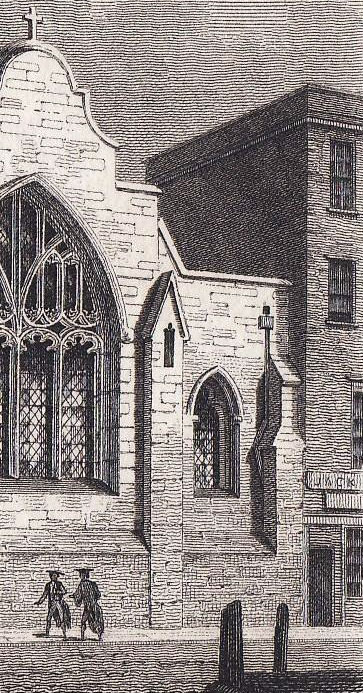
Jackson's Oxford Journal
at 65
Cornmarket
William Jackson had founded a weekly electioneering newspaper which became Jackson's Oxford Journal in May 1753. He died on 22 April 1792, but his newspaper continued until 2 October 1909. and then became the Oxford Journal Illustrated.
In 1795 John Grosvenor (1742–1823) became the editor: he was also one of the four surgeons at the Radcliffe Infirmary, but initially reckoned that he could do all the editorial work during his breakfast hour each morning. In 1817, however, he resigned from the Infirmary to work full-time on the newspaper.
In 1816 Jackson's Oxford Journal was bought by its printers, Grosvenor & Hall. From that date the former building here at 65 Cornmarket was its printing office. Initially it adjoined the medieval St Martin's Church, and the engraving on the right, dating from c.1819, shows a glimpse of the printing office with the letters “JACK…” visible over the door. This church was demolished and replaced in 1820, and the office then adjoined the new church until that too was demolished in 1896.
By 1828 the publishers of the newspaper were Jonathan Lowndes and Charles Haldon. The printer was Henry Hall of Barton Abbey, Steeple Barton, whose family founded Hall's Brewery in Oxford.
In the 1840s, the following information appeared at the end of the back page of Jackson's Oxford Journal:
Printed by and for HENRY HALL (residing at Barton, in the county of Oxford), at his Printing Office, adjoining Carfax Church, Corn Market, in the Parish of Saint Martin, Oxford; and published at the Printing Office aforesaid by CHARLES HALDON, of No. 24, St. John-street, in the Parish of St. Giles, and JONATHAN LOWNDES, of No. 98 Holywell-street (both in the suburbs of the City of Oxford), Booksellers and Stationers.
(Henry Hall lived at Barton Abbey, Steeple Barton.)
From 1810 to 27 September 1862 the price of the newspaper was 5d., but this was reduced to 4d. from the edition of 4 October 1862 and to 3d. by 19 May 1866.
Jonathan Lowndes ran his stationery shop here at the newspaper office. His publishing partner Charles Haldon died in 1847, and in 1848 Jonathan Lowndes went into partnership with his son Jonathan William Lowndes.
During the seven days after the publication of the edition of 25 September 1847 Jonathan Lowndes and the Jackson’s Oxford Journal Printing Office both moved from 98 to 97 Holywell Street.
The printing office remained here at 65 Cornmarket until January 1850, when it moved with Lowndes to 100 Holywell Street, and thereafter this building in Cornmarket was just the publishing office. The rubric at the end of each newspaper edition then read:
Printed by and for HENRY HALL, (residing at [Steeple] Barton, in the County of Oxford), at the Printing Office, No. 100 Holywell Street, in the Parish of Holywell, Oxford; and published at No. 65, Corn Market Street, adjoining St. Martin’s Church, in the City of Oxford aforesaid, by JONATHAN LOWNDES and JONATHAN WILLIAM LOWNDES, of the said Parish of Holywell.
On 15 April 1854 the newspaper doubled in size from four to eight pages, but the price remained at 5d.
From 3 January 1863 the price of the newspaper was 3d. (stamped 4d.), but its cost was reduced to 2d. at the beginning of 1886.
Henry Hall died at Barton Abbey on 17 November 1862, and from then until 1871 the paper was printed for the Trustees of Henry Hall.
Jonathan Lowndes died on 26 January 1867. His son Jonathan William Lowndes (d.1888) took over as sole publisher of the newspaper.
From 1871 it was described as being printed for the Proprietor (unnamed). The following appeared at the end of each edition in the 1880s:
Printed for the PROPRIETOR, at the Printing Office, No. 100, Holywell Street, in the Parish of Holywell, in the City of Oxford, by THOMAS LUCAS, of No. 20, Beaumont Buildings, in the Parish of St. Giles; and Published at 65, Corn Market Street, adjoining Saint Martin's Church, by HUGH HALL, of the Parish of Holywell, in the aforesaid City.
From 1888 to at least 1895 it was still printed at 100 Holywell Street, but the printer was now James Talbot (of 40 Princes Street and later of 10 Hurst Street). The office remained at 65 Cornmarket Street, as shown below:
 65 Cornmarket Street, next to the rebuilt St Martin's Church, with OXFORD JOURNAL OFFICE
over the door.
65 Cornmarket Street, next to the rebuilt St Martin's Church, with OXFORD JOURNAL OFFICE
over the door.
To the right is
Frank East's draper's shop clearly numbered 64,
and then comes the passage to the Sun at No. 63 behind (with “Wickens Wine Vaults” over the door)
This photograph by Henry Taunt is reproduced with kind permission of PictureOxon
By January 1899 Jackson's Oxford Journal had been bought by the Oxford Times Company and the rubric in the newspaper read:
Printed for the Proprietors by the Oxford Times Co. and published at No. 13, Castle-street, Oxford.
By the end of that year their printing office had moved to Red Lion Square.
The Sun Inn/Sun Vaults/Sun Wine Stores at 63 Cornmarket Street
On 11 June 1809 A. Hughes announced in Jackson's Oxford Journal that he had taken over the Sun Inn in Cornmarket, and that it had wines and liquors of the first quality, good beds and excellent stabling, and a good Ordinary (postal courier) on Saturdays at 1pm.
James Wickens senior was the licensee of the Sun Inn prior to 1839, and he was followed by James Wickens junior from 1839 to 1860. The following advertisement appeared in Billings Directory for 1854:

The flagon on the left below is inscribed:
J. WICKENS / WINE & SPIRIT MERCHANT / SUN INN / OXFORD
and the one on the right (probably of a later date) reads:“
THE SUN” / WHOLESALE / Wine & Spirit Stores / 63, CORN MARKET / OXFORD

James Wickens junior's wife Elizabeth died at the age of 37 in 1843, his son Frederick at the age of 25 in 1859, and James himself died after a short and severe illness at the age of 57 on 25 July 1860. The business was taken over by his surviving son Leyson Henry Wickens,
On 24 August 1861 Jackson's Oxford Journal reported thus on the rebuilding of the Sun Wine Vaults at 63 Cornmarket, designed by S. L. Seckham for Leyson Henry Wickens and built by Joseph Castle:
Another instance of this [ tradesmen meeting the requirements of their increasing business] has just been manifested at the Sun Wine Vaults in Corn Market-street, belonging to Mr. L. H. Wickens. A large and thriving business has been carried on there for many years, and to such an extent has it increased that it has been found necessary to take down and re-build the whole of the premises. The style which has been adopted is the Tudor, and it has been fully carried out not only in the exterior and interior, but in all the fittings and minutest details. The ground floor consists of a spacious bar, fitted up with great taste and with modern appliances, and connected with it are a spirit room and office. On the first floor are several elegant apartments, one of which leads to a conservatory. The cellaring is very extensive, and fitted up with every convenience, and, by means of some very ingenious machinery, casks are raised or lowered with a degree of ease and celerity which is surprising.
Leyson Henry Wickens at the age of 29 in October 1861, just two months after the Sun Wine Vaults opened.
The Sun was then run by the Rose family. Jackson's Oxford Journal reports in detail on 3 December 1881 about the opening of the Sun Vaults Billiard Saloon here.
In 1896 the original shops at Nos. 62, 63, 64, and 65 Cornmarket Street were demolished as part of the Carfax Improvement Scheme, which also saw the demolition of most of St Martin's Church to the south and the three shops in the old Crown Inn building to the north.
The Sun Vaults behind, however, survived with a new entrance, and are pictured in the Oxford Journal Illustrated of 17 January 1912. They were still open in 1923, but on 8 October 1924 the Oxford Journal Illustrated stated that they had been empty for some time and had been purchased by the Midland Bank to extend their premises. There is a photograph of the vaults being demolished in that newspaper on 18 February 1925.
The present bank building since 1897
This present building was built in 1896/7 and is owned by Oxford City Council. It was designed by H. T. Hare as two shops plus an entrance to the right leading to the old Sun Vaults. The shop on the corner to the south at Nos. 64/65 had large windows facing both Queen Street and Cornmarket, while the one to the north at No. 63 was smaller. The number 62 was no longer used.
In 1897 the tailor Frank East moved into the larger shop to the south, and the Sun Wine Vaults to the shop to the north.
- Photograph of c.1900, showing the new building from St Aldate's Street.
In 1914 the London City and Midland Bank (later renamed the Midland Bank and now HSBC) took over the Metropolitan Bank and closed the latter's branch at 61 Cornmarket (adjacent to this site). In the same year they moved into Frank East's former shop at 64 & 65 Cornmarket Street, and has remained there to the present day
The photographs below show the southern part of the new building (left) when it was Frank East’s draper’s shop and (right) after the Midland Bank had taken it over. The wall lantern in the photograph on the left advertises the Sun Billiard Rooms down the side passage:

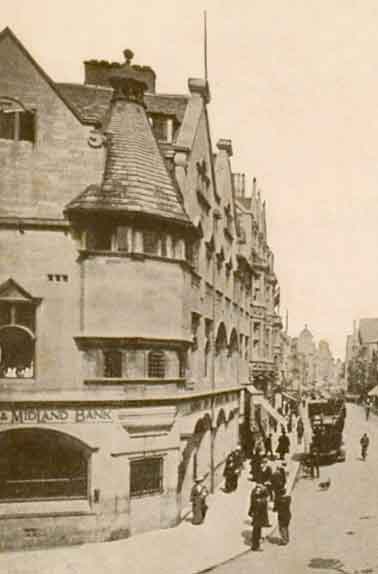
The photograph below (Historic England BB73/00536) shows Frank East's shop at No. 64 on the left, then the entrance to the Sun:
Carfax Assembly Rooms (63 Cornmarket)
In 1925 the Carfax Assembly Rooms, designed by J. R. Wilkins, were built by Organ & Son to the right of the Midland Bank for Messrs Weeks & Co., replacing the Sun Vaults (see drawing in the Oxford Journal Illustrated of 19 August 1925, p. 14). This is presumably the firm of George E. Weeks & Co., which had run the City Restaurant at 4 Cornmarket since 1909 and a baker's & confectioner's shop at 15 Cornmarket since 1905. The assembly rooms opened on 9 November 1925, and on 11 November 1925 that newspaper published a photograph of a dance in the “new Carfax Assembly Rooms”
The downstairs part of the assembly rooms was small and used for meetings, while the upstairs room where dances were held was larger. They were reached via the wide arch that was once the entrance to the Sun Vaults but is now the main entrance at the right-hand side of the expanded HSBC Bank.
On 25 May 1936 Oswald Mosley, the leader of the British Union of Fascists, held a meeting at the Carfax Assembly Rooms, and Hugh Trevor-Roper wrote to his mother that protesters were set upon by Blackshirt “stewards” armed with truncheons, adding:
Great damage to the Blackshirts was done by one of the dons of Christ Church [Frank Pakenham, later Long Longford], who, being struck over the head by a Blackshirt with a steel chain, was roused to a berserk fury.
In the 1960s the Oxford University Jazz Club met at the Carfax Assembly Rooms, and the Beatles performed here in February 1963.
In 1959 it cost 2s 6d. to go to a dance here, and Eddie Turton who came from Kidlington was the resident band at “the Carfax”, as it was known.
In 1968 the Oxford & District Co-operative Society, who then owned the Carfax Assembly Rooms, closed them down. They used them as a carpet store for a short while, and then sold them to the Midland Bank.
In 1971 a change of use from shop, restaurant, and hall to shop was approved (planning application 71/19093/A_H).
Expansion of the Bank
In 1986 the Midland Bank expanded into the premises to the north to use it for offices (86/00771/NFH), and then changed it to banking use in 1988 (88/00990/NFH).
In 1999 the Midland Bank was renamed HSBC (Hongkong & Shanghai Banking Corporation).
The sale of the Bank building
In February 2023 the HSBC Bank was granted planning permission for change of use of one of the units in the Cheng Yu Tung Building in Cornmarket from retail to commercial banking (22/03058/FUL), but in the end it was Barclays Bank that moved there.
In April 2025 Oxford City Council sold Nos. 64 & 65 (the south part of the HSBC Bank) to Goldmoney, the owners of the nearby Clarendon Centre (who already owned the north part of the bank at Nos. 62 & 63). The bank intends to continue to operate in its original premises.
The FORMER houses on the site 62–65 Cornmarket Street listed in directories etc. to 1896 |
||||
Date |
No. 65 (left) | No. 64 (middle) | No. 63 (behind No. 64) | No. 62 (right) |
1817 |
Jackson’s
|
? |
The Sun (aka the Landlords Later landlords (subject to University wine licences): 1779: William Davis
1823: Richard Gurden 1830:
James Wickens sen. ROSE: 1890: M. F. E. Bush, mgr |
The hair cutter Charles Chaundy had these premises from 1830 to late 1845 |
1839 |
Charles Bowen |
|||
1843 |
Mr Chilton |
|||
1843–1846 |
Thomas Eldred |
|||
1848– |
Harman John Howland |
Boffin the baker |
||
1852– |
W. & S. Oliver Joseph Blake |
William Sumersford |
||
1861– |
||||
1872 |
Phillips Bros, |
|||
1879 |
Frank East |
A. Shepherd |
||
1890 |
Not listed (nor are |
|||
* Proprietors: Jonathan Lowndes (1872): T. F. Plowman (1880); Hugh Hall (1890) Other people listed in the Jackson’s Oxford Journal premises were:
|
||||
The PRESENT building at 62–65 Cornmarket Street listed in directories etc. from 1898 |
|||
Dates |
64 & 65 (left) |
Premises behind |
No. 63 (right) |
1898–1911 |
Frank East |
Sun Wine & Spirit Stores Sun Vaults public house Managers: |
Probably part of the Sun Vaults (After 1925 it was a small shop to the right of the entrance to the new Carfax Assembly Rooms with a kiosk in the passage) |
1914 |
London City & Midland Bank Ltd
Renamed |
||
1921 |
|||
1927–1947 |
CARFAX ASSEMBLY ROOMS plus Gridiron Club from 1927–1947 YMCA from 1927 to 1947 Ministry of Labour in Co-op from 1949 to 1966 Orchid Rooms: |
Stephanus P. Ora |
|
1949–1967 |
Oxford & District |
||
1968 |
No listing |
||
1970 |
Oxford & District |
||
1972 |
Chaussures Ravel |
||
1973 |
No listing |
||
1976 |
Vacant |
||
1986–present |
Midland Bank |
||
The former shops at 62–65 Cornmarket Street in the censuses
1851
No. 62:The stationer Henry Sumersford (21) lived here with his sister Martha (26) as his housekeeper
No. 63: James Wickens, the landlord of the Sun, was obviously away on census night, as the only occupants were Frederick J. Wickens (16), described as the son of the head of the household, and a barmaid and a general servant.
No. 64: The linen-draper Harman J. Howland (31) lived over his shop. He was described as the employer of two men and two women, and these four lived on the premises with him. They had one female servant.
No. 65: The trunk-maker Thomas P. Pavier (35) lived here with his wife Eliza (33).
1861
No. 62: William Sumersford (26), a coachman, lived here with his sister, Martha Sumersford, as his housekeeper. Both were unmarried.
No. 63: The Sun: John Slatter (41), a wine merchant’s clerk, lived here with a porter.
No. 64: William Oliver (46), linen draper lived here with his wife Eliza (42) and children Clara (5) and Horace (4). He was described as the employer of sixteen hands, and half of them (four shopwomen and four draper’s apprentices) lived over the shop with their master. The household had three female domestic servants.
No. 65: A mason’s labourer, Edward Simms (33) lived here with his wife Ann (39), who was the housekeeper for the offices below.
1871
No. 62: William Sumersford (26), now a stationer, lived over his shop with his sister Martha (39).
No. 63: The Sun Vaults: Eliza Rose (37), the housekeeper of the head of the household (presumably the current landlady Charlotte Rose) lived here with a cook and the hotel manager, Richard Wellington.
No. 64: Two servants, seven shop assistants, a clerk, and an apprentice lived over Frank East's drapery store.
No. 65: John Archer (42), a general labourer, was the lodger here with his wife Jemima (36), described as a housekeeper. Four draper's salesmen also lived on the premises.
1881
No. 62: Now the Burton Ale Stores, the living accommodation is listed as unoccupied.
No. 63: The “Sun Wine Vaults” at No. 63 were occupied by the widow Mrs Eliza Rose (69), described as head of the household and presumably the owner of the business. Living with her were Edward Stokes, described as her servant, who was a “Manager Wine Merchant”, and a female general servant.
No. 64: A draper’s assistant, Thomas Baker (26) was the head of the household over Shepherd’s tailor’s shop. Eight other young draper’s assistants (three male and five female) and one draper’s apprentice also lived in the household, and they had just one 16-year-old girl serving as a domestic servant. (Arthur Shepherd (47), their employer, lived in Woodstock Road with his wife and four children.)
No. 65: John Archer (53), a general labourer, still lived here with his wife Jemima (46), who was the housekeeper for the offices on the ground floor.
1891
No. 62 & 63: Sun Wine Vaults: Martin Bush (32), a wine & spirit merchant's manager, lived here with his wife Emily (31) and their children Emily (8) and Dorothy (6). They had two general servants.
No. 64: Thirteen draper's assistants boarded here, looked after by two domestic servants.
No. 65: George Phillips (24), a solicitor, lived here with two servants (both described as caretakers).
Rebuilt in 1896/7
1901
Nos. 62 & 63:Josiah Holder (49), a wine merchant, lived here with his son-in-law Percy Parker (28), who was his assistant in the business, his daughter Ada Parker (28), who acted as his housekeeper, and his grandchildren Grace Parker (5) and Donald Parker (1). A barmaid lived with them, and they had two domestic servants.
Nos. 64 & 65: Ernest Wilson (38), a draper's assistant, lived over Frank East's draper's shop with ten boarders (seven other draper's assistants, one draper's apprentice, a milliner, and a dressmaker), plus two domestic servants.
1911
Nos. 62 & 63: Paul Loder (51), publican, lived in five rooms here at the Sun Vaults with his wife Carrie (31) and his son Fred (22), who assisted in the business, and their general servant.
Nos. 64 & 65: Ernest Edward Wilson (48), the unmarried manager of Frank East's drapery establishment, lived in nine rooms over this shop with ten members of his staff: two buyers, five shop assistants, a housekeeper, and a domestic servant.