

130A: Chiang Mai Kitchen (former Kemp Hall)

Kemp Hall is on the west side of the passage that runs along the left-hand side of No. 130 High Street (formerly known as Carter's Passage, named after the fishmongers who were at No. 130 from 1808 to 1930). It is sometimes spelt as Kempe Hall.
The building is numbered 130A, as the house at 130 High Street and Kemp Hall were originally two parts of the same property.
The original Kemp Hall dated from about 1500, but the present five-gabled building was erected in 1637 by Alderman William Boswell, who lived at 130 High Street in front. The stone mantles inside date from that year, and the building has a seventeenth-century fireplace.
It is a Grade II* listed building (List Entry No. 1145872) and has belonged to Oxford City Council since 1868.
It was in the parish of All Saints until that church closed in 1971, and is now in the parish of St Michael-at-the-Northgate Church.
Right: Kemp Hall, looking north towards the High
Below: The date 1637 in white lettering over the door

Anthony Wood offered two theories as to the origin of its name:
- (1) that it was named after Alderman Richard Kent and should in fact be named Kent's Hall; or
- (2) it was an early university hall named after John Kemp, Fellow of Merton College from 1395 and later Archbishop of Canterbury.
The former is now generally accepted.
For a brief history of Kemp Hall and all its leases up to 1817, see H. E. Salter, Oxford City Properties (Oxford Historical Society, 1926), pp. 132–4.,
William Boswell only enjoyed the new Kemp Hall for a year, as he died in 1638. He left it to his son, Dr William Boswell. In 1682 it was passed on to Miss Jane Boswell (Dr Boswell's niece), and then in 1687 to Thomas Boswell.
In about 1700 Kemp Hall was sold to Lord Harcourt.
By 1730 it was owned by Francis Heywood.
In 1731 Dr Radcliffe presented Kemp Hall along with other properties to Brasenose College, to compensate for the land they lost in connection with the building of the Radcliffe Camera.

Above: Kemp Hall, looking southwards from the High Street (engraving published in the Monthly Supplement of the Penny Magazine of the Society for the Diffusion of Useful Knowledge on 31 December 1835). The alleyway was at this time known as Carter’s Passage, after the fishmonger at No. 130. The building inscribed AD 1611 that can be seen at the end of the alleyway was the Town Hall until 1752, but it was was burnt down at Christmas 1834.
1840 to 1868
It is difficult to identify who occupied Kemp Hall in Carter's Yard during this period. The 1841 census lists the bookseller John Gooch and the bookbinder John Sanders at the end of the list for the south side of the High Street, and these are a possibility. Hunt's Directory for 1846 list the baker John Keeley and the bookbinder W. H. Salter in Carter's Yard.
It is possible it was unoccupied during this period, as in 1868 it was described as having been a disused and partially dismantled building for a long time.
Police Station at Kemp Hall, 1869–1897
Until the end of 1868 the City of Oxford had been jointly policed at night by constables of the University and during the day by those of the City's Watch Committee, whose station since at least 1848 had been an office on the corner of Queen Street and St Aldate's. On 1 January 1869 the new Oxford City Police Force came into operation, and in readiness for this Oxford City Council had bought Kemp Hall in 1868. For a short while the new police force was based in a committee room in Oxford's Town Hall, but on 20 March 1869 it was reported that the council had accepted the tender of Thomas Baker at £172 10s. to convert Kemp Hall into a police station, and the article below published in Jackson's Oxford Journal just a month later on 24 April 1869 show that the work was nearly finished:
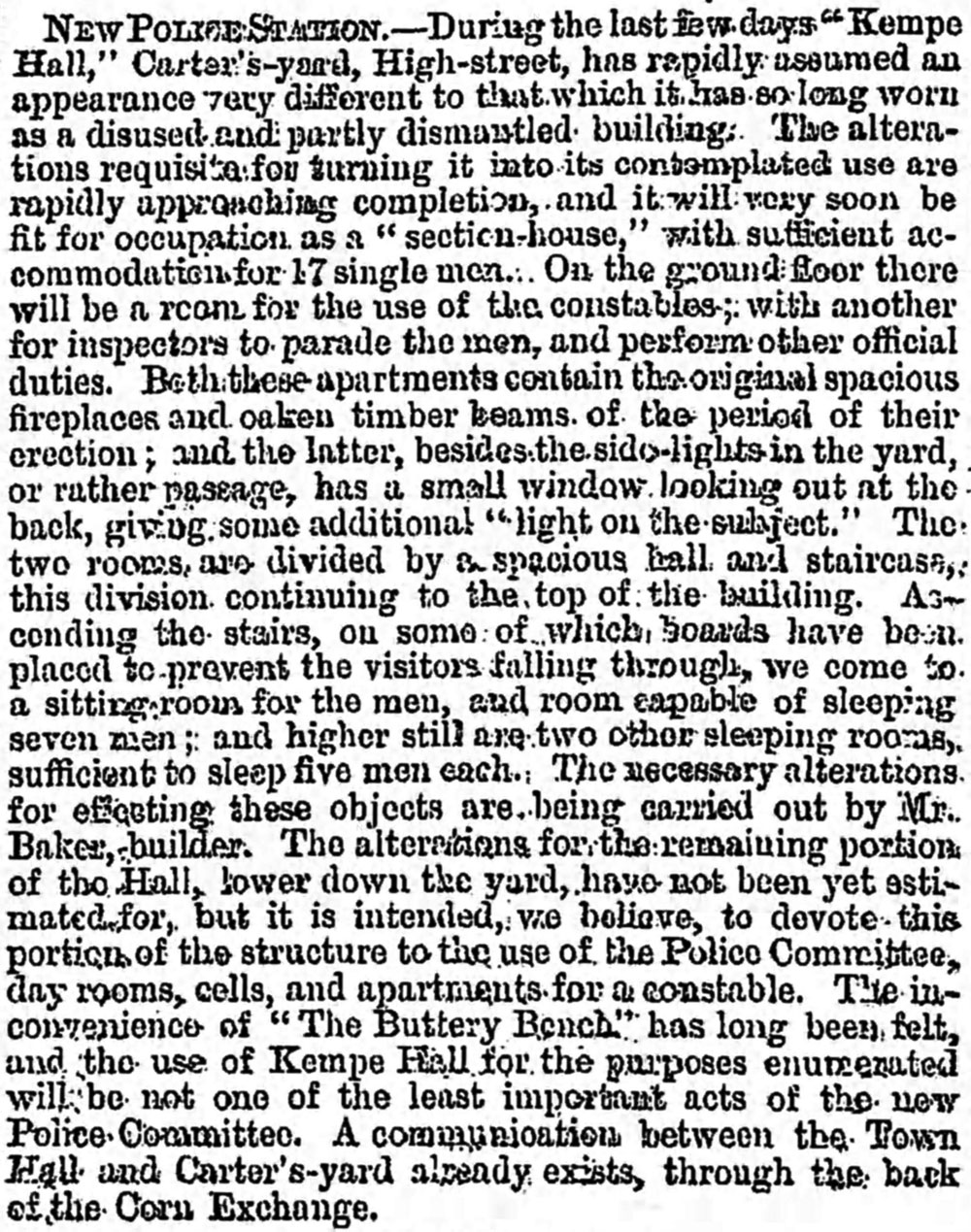
Jackson’s Oxford Journal on 24 September 1870 reported thus on the move:
THE NEW POLICE STATION.—The business of the Police Station in Oxford has now been transferred from Carfax to Kemp Hall, at the end of the passage adjoining the premises of Mr. Carter, fishmonger, High-street, and in future this will be the head quarters of the force. In addition to the ordinary advantages of a Station, a suite of rooms has been provided for thirteen of the single men of the force, who live on the establishment. In order also to obviate the necessity of conveying prisoners from the cells through the main street to the Police Court, a passage has been constructed from the Hall by the walls of the Corn Exchange, and so to the Court. One Inspector, Mr. Barrett, lives on the premises. The new offices are not yet completed, as a better approach than the narrow passage from the High-street has yet to be formed. In his recent visit of inspection, Col. Cobbe expressed himself satisfied with all the internal arrangements; and though perhaps the offices are not so public as could be wished, they are yet superior in their internal economy to the old place on Carfax.
Very full details of the layout of the police station are given in Jackson's Oxford Journal on 15 October 1870, p. 6.
The 1881 census shows P.C. Samuel Sealdwell (27) as the head of the “household” at Kemp Hall. Thirteen other police constables and a cook, all described as lodgers, also spent census night there, as well as just one prisoner called Harry Hamp.
At the time of the 1891 census the police station was occupied by one married constable and his wife, and twelve unmarried ones. .
The photograph below taken by Henry Taunt (Historic England CC54/00319) shows Kemp Hall Police station, probably in 1896:
Three more Historic England photographs of Kemp Hall Police Station taken by Henry Taunt
When the new Town Hall complex was finished in 1897 the police moved to a new purpose-built station at the back of the building in Blue Boar Street, but it appears that unmarried officers continued to live in Kemp Hall, and in 1937 the alleyway leading to Kemp Hall was still known as Blue Lamp Alley. In 1938 the force moved to their next home in St Aldate's.
- Wikipedia: History of Oxford City Police Force
- Victoria County History of Oxfordshire, Volume 4 (City of Oxford): Police Service
Kemp Hall Press
From 1906 to 1925 the building was occupied by the Kemp Hall Press. It was then threatened with demolition, but was saved by the Oxford Preservation Trust.
Cafés and Restaurants at Kemp Hall (Chinese, Indian, French, and Thai)

Kemp Hall first became a place to eat in 1928, when Mrs Daisy Hoare opened tea rooms here. By 1930 both she and her business had gone up in the world: she was Mrs D. Hoare MBE, and the tea rooms were now the Kemp Hall Restaurant, with the telephone number 3458. This continued until at least 1938.
In 1943 this was the Stowaway Café, described as Anglo-Chinese and run by S. R, Crawley. This was still listed here in 1960.
In 1962 there was an Indian restaurant here, the Moti Mahal. This survived until 1966.
In 1966 André Chavagnon opened a restaurant here: La Sorbonne upstairs, and the less expensive Casse Croute downstairs. It was the best restaurant in Oxford, and people who dined here included Princess Anne, Diana Princess of Wales, Edward Heath, and Paul McCartney. It closed in 1992. (Chavagnon's chef in the early days was none other than Raymond Blanc, now the owner of the famous Manoir au Quat’Saisons.)
Since then Kemp Hall has been the Chiang Mai Thai restaurant.
Right: Advertisement in Kelly's Directory for 1967
Occupiers of 130A High Street (Kemp Hall) from 1870(confusingly the building is sometimes numbered 129A) |
|
1870–1897 |
Kemp Hall Police Station |
1902–1904 |
Darbishire & Howarth (Oxford Geographical Institute), Map makers |
1905–1925 |
Fox, Jones & Co printers (Kemp Hall Press) |
1928–1937 |
Kemp Hall Restaurant (Tea rooms in 1928) (Mrs Daisy Hoare) |
1939–1941 |
No listing for 130A |
1943–1960 |
Stowaway Cafe, Anglo-Chinese (S. R. Crawley) |
1962–1966 |
Moti Mahal, Indian Restaurant |
1967–1992 |
La Sorbonne, French restaurant |
By 1995–present |
Chiang Mai Kitchen, Thai Restaurant |
