

The casket tomb of Lewis Theodore Pilcher (1889–1893)

Lewis Theodore Pilcher, the four-year-old boy shown as a sleeping angel on this tomb, was born in the Marylebone district in 1889.
His father Giles Theodore Pilcher was born in Camberwell, Surrey in 1849 after his own father, the haberdasher Jeremiah Giles Pilcher, had already died. Giles was educated at Harrow and then Corpus Christi College, Oxford, gaining a Second in Classics in 1872. He was ordained Deacon in 1875 and Priest in 1876, and served as Rector of Letcombe Bassett in Berkshire from 1880 to 1881. He then lost his faith, and in December 1883 he was a Member of the Society for Psychical Research.
His mother Sophia Margaretta Lewis was born in the Machynlleth district of Wales near the beginning of 1853, the daughter of the Revd John Lewis. She obtained a B.Sc. from Bedford College, London in 1883.
On 20 December 1884 Lewis's parents were married at Paddington parish church: his father was described as being a gentleman of 37 Cromwell Houses, Kensington, and his mother was living at 15 Oxford Terrace.
By the time of the 1891 census they had moved to Gomershal in Yorkshire with Lewis (aged two), who was their only child. They had four servants there, including Lewis's nurse Elizabeth Sibley.
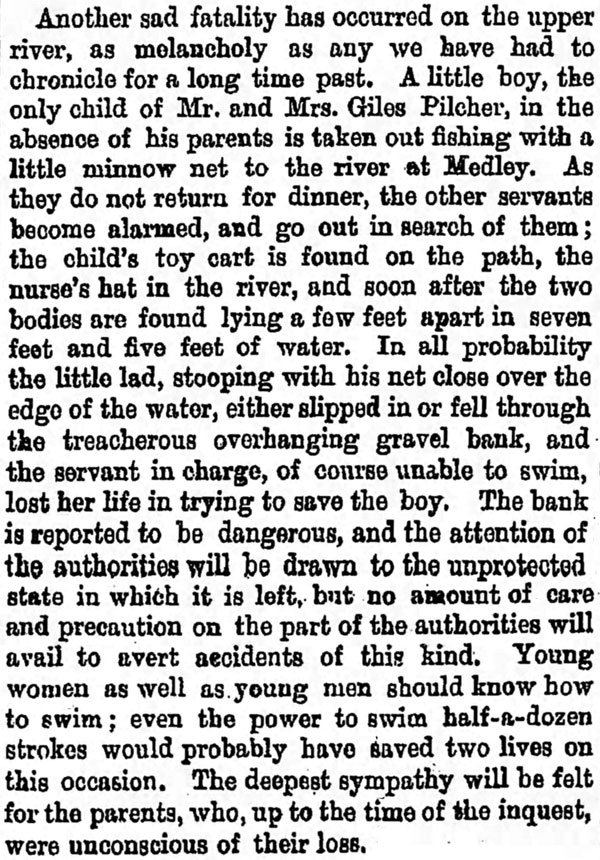
In May 1893 Lewis (now aged four years and two months) had come down from Yorkshire with his nurse Elizabeth Sibley (30) to stay with his paternal grandmother at 3 Norham Gardens. His nurse took him out to fish for minnows in the Thames near Medley, but it appears that he fell into the water and that his nurse entered the river to try and save him. Both were drowned.
The double drowning was reported in Jackson’s Oxford Journal on 3 June 1893:
The child and his nurse were buried near each other in Holywell Cemetery (Plot B/111).
His parents, who had no other surviving children, became key figures in women's suffrage: more information.
His grandmother Anna Clarissa Pilcher was still living at 3 Norham Gardens in Oxford when she died at Tenby on 21 August 1899.
In about 1906 his parents moved to Treen, Frith Hill, Godalming, Surrey. His father Giles Theodore Pilcher died there at the age of 85 in 1934, and his mother Sophia Margaretta Pilcher on 13 February 1937.
The canopied tomb of Henry Beaumont Coles Bird (1845–1856)
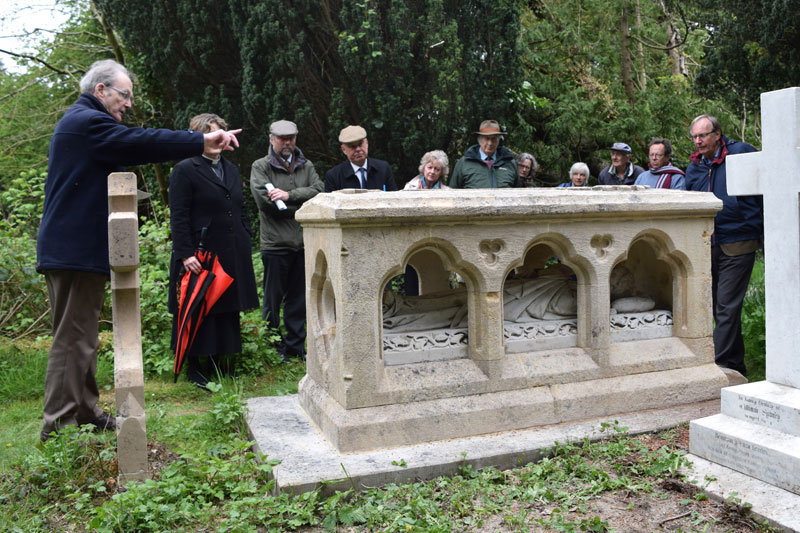 Ceremony at the tomb following its restoration in 2017
Henry Beaumont Coles Bird, the boy whose statue lies within the canopy of this tomb, was born in the Rectory at Donnington, Herefordshire on 22 January 1845 and baptised by his own father on 26 March. He was the sixth and youngest child of the Revd Roger Bird and Lucy Brooks Bank Bloxham, who were married in Warwickshire on 28 July 1830.
By the time time of the 1851 census Henry's father had been appointed Rector of Lanteglos in Cornwall, and Henry (6), described as a “scholar at home", was living in the rectory there with his parents and older sisters Edith, Lucy, and Mary, and their four servants.
Soon after that census Henry became a chorister boarding at Magdalen College School in Oxford. He died of typhoid fever at the school at the age of 11 on 28 October 1856 and was buried in Holywell Cemetery. An elaborate canopied tomb designed by J. C. Buckler and carved by Thomas Earp of Lambeth was erected over his grave, and G. V. Cox in his Reminiscences of Oxford describes his burial and expresses surprise at the grandeur of the tomb:
1856. Nov. 7. A remarkable funeral took place (viz. that of a young chorister of Magdalen College choir, named Bird) at the burying-ground of St. Cross. The boys of the school, about forty in number, followed the hearse to the cemetery, where they were met by a surpliced choir of thirty. The Burial Service was sung with great feeling and thrilling effect. N.B. The monument soon after raised to the poor boy’s memory – upon a scale rather large and grand for its little occupant – provoked the following expression:–
On approaching the large tomb of a little boy.
‘I saw the tomb and cried, with deep surprise,
“Surely some great one ’neath that structure lies.”
I read, and found a little “Bird” at rest,
A bird too humble for so large a nest.’
By 1861 Henry's father was Rector of Ightham in Kent. He died there on 2 October 1866, and his mother died in Marylebone on 19 November 1871.
Oxford Mail, 29 April 2017: “Historic tomb to 11-year-old chorister restored after more than 160 years”
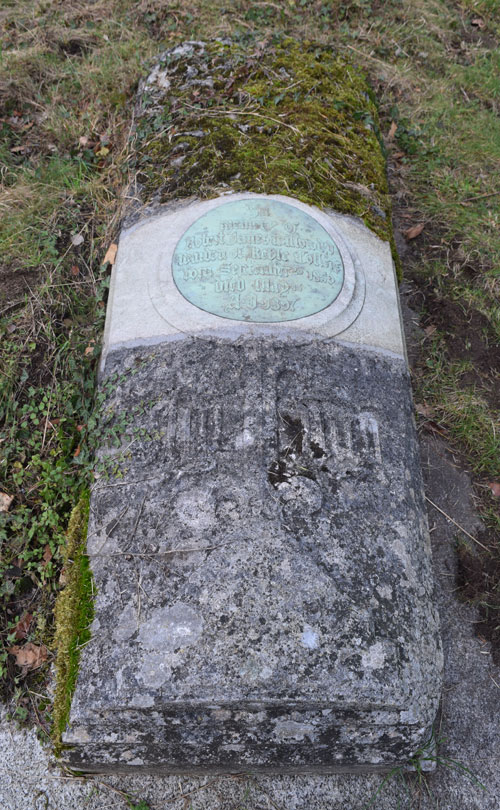
Grave of Robert James Wilson
(1840–1897)
This vault where a a Warden of Keble College is buried is interesting because it demonstrates the toxicity of lead.
- The top part of the slab covering the burial vault is covered with so much moss that it blends into the background
- The section in the middle looks almost like new, as the rain that washes down each side of it has been contaminated by the circle of lead.
- The section at the bottom has weathered normally and is an ancient shade of grey.
The inscription on the lead circle reads:
In
memory of
Robert James Wilson D.D.
Warden of Keble College
Born September 20 1840
died May 15
A.D. 1897
Robert James Wilson was the author of The Catholic Church and the Church of Rome and joint author with Canon Liddon of The Life of Dr Pusey.
He was Vicar of Wolvercote from 1875 to 1879, Warden of Radley College from 1879 to 1888, and also Vicar of Radley from 1880 to 1893. In 1889 he was appointed Warden of Keble College, a post he held until he died at the college following a brain haemorrhage on 15 May 1897.
Wikipedia: Robert Wilson
The First World War wooden cross of Ronald Poulton (1889–1915)

This wooden cross set into the wall of Holywell Cemetery originally stood in Flanders on the grave of Lieutenant Ronald William Poulton-Palmer (originally Ronald William Poulton), one of the greatest rugby players of all time, who was killed in Ploegsteert Wood at the age of 25 on 5 May 1915. He lived with his parents at Wykeham House, 56 Banbury Road (now occupied by the Oxford University Careers Service).
The cross reads:
R.I.P
LT R. W. POULTON-PALMER
2/4 ROYAL [BERKS]
KILLED
IN
ACTION
15.5.15
For more information see the Oxfordshire Blue Plaque to Ronald Poulton and his father
Photographs of Holywell Cemetery held by Historic England
Dean John William Burgon was buried in 1888. This photograph taken by Henry Taunt in 1911 shows his grave and a wall memorial consisting of a bust beneath a canopy (Historic England HT12339):
More Historic England photographs of Holywell Cemetery can be seen here, and they can all be embedded on web pages in the same way as the one above.