

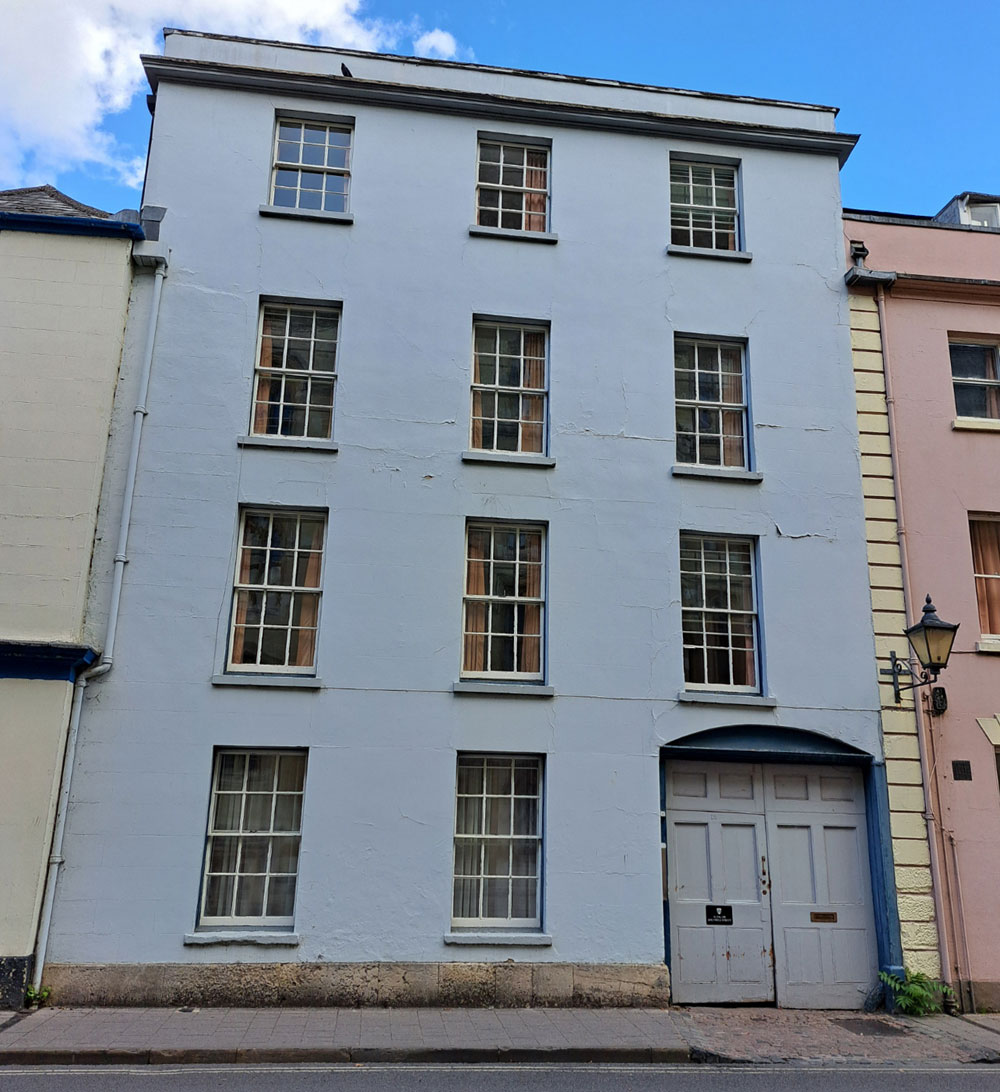
19 Holywell Street was refronted in the eighteenth/nineteenth century. It has no doorway on the street front, but is accessed via the coachway to the east. It is owned by Merton College.
It is a Grade II Listed Building (1087089), with the following description:
No 19 SP 5106 NE 6/209 12.1.54. II GV 2.
House. Refronted in C18-C19. Four-storeyed stuccoed (?brick) on a stone plinth with a moulded eaves cornice and a small parapet. There is a coachway on the East and no front doorway on the street front. Three C18-C19 sash windows on plain reveals in the stone cills. At the back is a staircase projection.
This house was famous for its knucklebone floor. Herbert Hurst described it at length in a talk he gave to the Oxford Architectural & Historical Society (reported in Jackson's Oxford Journal on 3 March 1894:
The floor of the front room of No. 19, Holywell, was about 16ft. by 15ft. 6in., not quite rectangular, giving an area of 255 square feet, and containing, by a computation based on these large rubbings, 24,460 ends of bones; those next to the knuckle. Some one who knows a little of osteology will greatly oblige by saying whether that number is to be divided by 2, 4, or 8 to obtain the number of animals that contributed. The bones were halved and embedded, broad ends upward, in fine gravel, and, when fixed in position, a mixture of thin lime and finer gravel appears to have been floated over the whole to give solidity and keep the surface light in colour. Whether hob-nails and street dirt, or rough sand and rubbing-stone were used to smooth the surface could not be decided. In one place, left of the hearth, the projections of the bones were left untouched. The surface, however obtained, was equal to that of Roman Mosaic without the monotony of its square tesserae; it was pleasant to tread upon, not so cold as stone, and much more durable than wood. The workmanship generally was most skilful, but the south portion had, at some time, been disturbed or had been left in a rough state for after modification. The borders, letters, and figures were of calves’ bones, or those of small oxen; the dividing lines were smaller, and the filling in was of mutton bones, or of lamb, and a few of deer. It was in the singularly compact arranging of the last of these, rather than in the plan or design, that the beauty of the floor consisted. But we cannot say that we have the complete design before us, since the room may have been wider to the right than at present. In the initials the R is probably the surname of the occupier, and W and E the Christian names of the husband wife. The dates, 1701 and 1702, are easily recognized. The only surname at all reasonable is that of Robins, but Edward was lessee under Merton “in the thirteenth year of Charles’s reign.” It may, of course, have happened that the same family lived there till 1701, but the houses had changed their numbers, and there is nothing as yet certain upon the point....
We found the bone floor under another one of oak, and beam which supported the oak boards had on it some painting of Charles’ time, as it seemed from the medium used.
The image below (Historic England HT09968) shows the plan that Hurst made of the floor
Hurst also described how 19 Holywell Street was occupied by the butcher John Pinfold in 1829:
Mr. Frederick King … has sent me word that the same house was inhabited about 1829 by the Pinfolds, and that when the renowned Durham Ox (for which 2,000 l. had been offered) chose to break its thigh while being exhibited at the second Crown Inn, in the Corn Market, John Pinfold was summoned to kill and dress it.
John Pinfold died here at the age of 73 on 15 February 1846 and was followed by a farmer and butcher.
By 1881 George Carter, the Headmaster of New College School, lived at No. 19, and he remained here until at least 1901.
19 Holywell Street in the censuses
1841
The 1841 census for Holywell does not give house numbers, but it is possible to deduce where people listed that year lived by examining directory entries between 1839 and 1842 and later censuses
John Pinfold (60), a butcher, was the head of the household here and lived with a family called Stephens (later spelt Stevens: see below): Richard Stephens (50) was a farmer, and with him were Ann (50), Elizabeth (20), and John (20) and George (15), both of whom were butchers.
1851
George Stevens (30), an unmarried “Purveyor employing 5 men and Farmer of 170 Acres and employing 98 men”, lived here with his widowed father Richard Stevens (75), who was an annuitant, plus one house servant and one trade servant.
1861
John Stevens (47), a butcher, lived here with his wife Hannah (41) and his children Avis (11), George (9), Jane (5), and Alfred (3). They had three servants (a cook and two housemaids).
1871
Hannah Stevens (57), now a widow, lived here with her children John (22), who was an engineer, Hannah (21), and George (19), who was a medical student. They had two general servants.
1881
George Carter (39), the Headmaster of New College School, lived here with his wife Emily (38) and his children Ernest (13), Arthur (11), Francis (9), and Florence (7). The family had one housemaid.
1891
George Carter (49) was still living here with his sons Arthur (21) and Francis (19), who were now students, plus a 14-year-old boarder. His wife was away on census night.
1901
George Carter (59) was once again living here and was with his wife Emily (57) and his unmarried daughter Florence (27). They had two servants (a cook and a housemaid).
1911
Edward J. Giles (54), a draper’s manager, lived here with his wife Julia (46) and his sons Reginald (13) and Basil (3). They had two undergraduate boarders and one servant.
1921
William Richard Timb (45), lived here with his wife Annie (45): they were both described as Balliol College caretakers/lodging-house keepers. An Indian army officer and four students were boarding with them.
1939 Register
The retired commercial traveller Oscar R. Webster was listed here with his wife Constance, who was a boarding house keeper, and their son Geoffrey, who was a chemistry student. Seven people were lodging in the boarding house.
Occupants of 19 Holywell Street listed in directories etc. |
||
1758 |
Mr Potts (likely to be the John Potts who married Mary Osborne at St Cross Church on 2 January 1752, who was definitely living in Holywell in 1771, and was buried in St Cross churchyard on 9 January 1794) Frontage: 9 yds 2 ft 6 in |
|
1772 |
||
1830–1846 |
John Pinfold |
|
1846–1876 |
John & George Stevens, butchers in 1846 |
|
1881–1900 |
George Carter, B.A., |
|
1905 |
Edward James Giles |
|
1914–1916 |
Oxford University Elementary Training College |
|
1926–1936 |
Girls’ Friendly Society & Hostel |
|
1938–1976 |
Oscar Robson Webster |
|
Today |
Merton College annexe |
|