


26 Holywell Street probably dates from the seventeenth century, but has been altered. Together with No. 25 it forms the Warrington Building of Harris Manchester College.
It is a Grade II Listed Building: List Entry Number 1369377, with the following description:
No 26 SP 5106 NE 6/204 12.1.54. II GV 2.
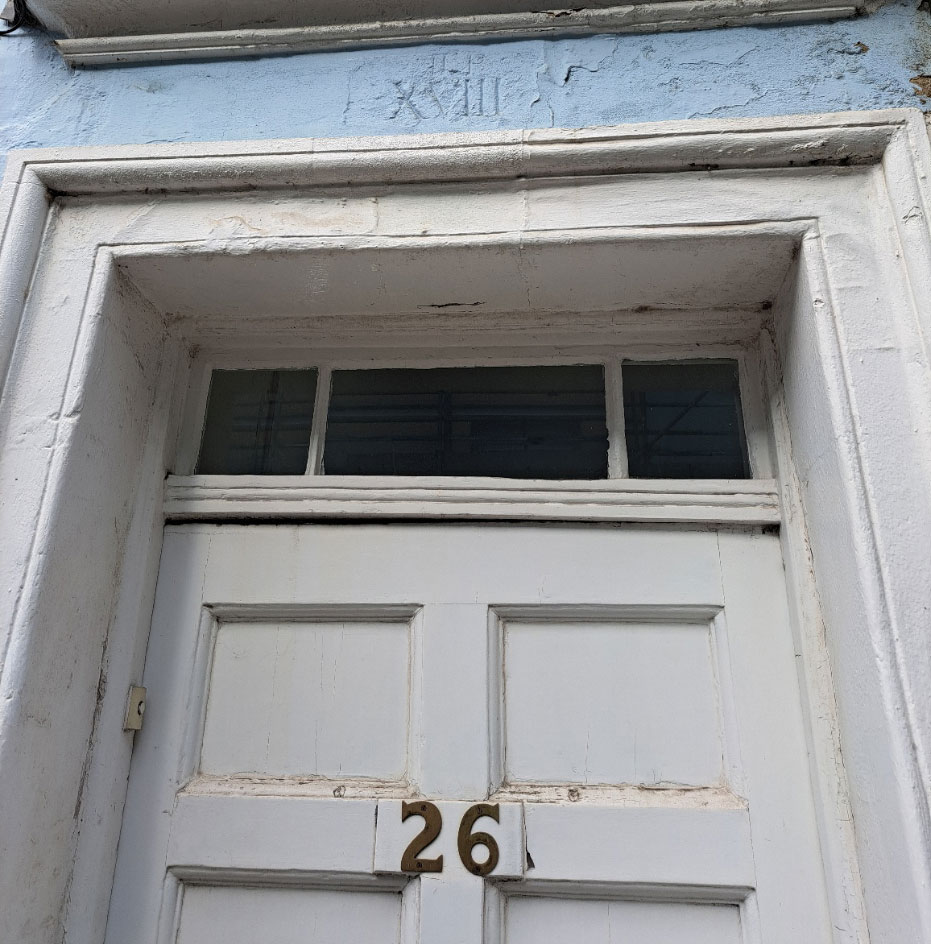
House. Probably C17 in origin but has been altered. Three-storeyed stuccoed timber-framing on a stone plinth with cellars and a band at the first floor. The front doorway has an ancient stone frame and architrave. First floor has double sash windows in plain reveals and having stone cills and glazing bars.
This house has “H.P. / XVIII” inscribed on the lintel, indicating that before Holywell Street was renumbered in 1836, the present No. 26 was numbered 18 (with the “H.P.” above the roman numeral presumably standing for “Holywell Parish”):
At the time of the 1772 Survey of Oxford this house was occupied by Mr Dodd, who was presumably the Charles Dodd, the cook at New College whose household goods and furniture at his house in Holywell were advertised for sale in Jackson's Oxford Journal on 19 July 1777 prior to his move to the Wheatsheaf Inn in the High Street.
The school at 26 Holywell Street
There was a school at this house from the 1840s to 1868, with a number of different owners
Boarding School (1846–1847)
Jabez Horne is listed as having a boarding school here in Hunt's Directory for 1846 and the Post Office Directory of 1847
Commercial Boarding and Day School (1851–1853)
This boys' school took boarders and was run by Alfred King. He died aged 29 on 23 August 1853.
Boarding and Day School for Girls (by July 1853)
This was run by Mrs King, the widow of the previous schoolmaster
Merton House School for Young Ladies (1859–1861)
This school was run by Miss Arthur. The following advertisement for the girls' school was placed in Jackson's Oxford Journal on 22 January 1859:
Merton House School for Young Ladies.
The object of this School is to give a sound and useful education, based on careful religious and moral training, with the best advantages for the acquirement of Music, Singing, the Modern Languages, and other accomplishments, on moderate terms. Strict attention is paid to health, and the domestic arrangements ensure the comforts of an orderly well-regulated family. The Pupils will resume their studies on the 25th inst.—For further particulars apply to Miss Arthur, 26, Holywell Street.
Hope House Academy (later shortened to The Academy) (1861–1868)
This boarding & day school for boys was run by Alfred S. Barling, who had previously been teaching at home at 39 Holywell Street. On 18 May 1861 the following advertisement appeared in Jackson’s Oxford Journal:
NOTICE OF REMOVAL:
Hope House Boarding and Day School, 39, HOLYWELL, Oxford.
Mr Barling begs respectfully to inform parents and guardians that the increasing number of his pupils have compelled him to take to larger and more convenient Premises, situate in Holywell-street (No. 26), where his pupils will have the advantages of a large and well-ventilated school-room and a good recreation ground. The Principal will have pleasure in forwarding prospectuses.
A Second Master will be required after Midsummer.In subsequent advertisements Barling advertised the school at 26 Holywell Street as providing both classical and commercial education, with the best quality and unlimited food. Fees were £30 per annum, or £27 for those under 12 years of age (including books, Latin, and drawing). He boasted that it had a large playground contiguous to the University Parks.
On 28 November 1868 Barling announced that he planned to move his school to “more commodious and healthful Premises” at Carlton Lodge on the Iffley Road.
The building then became a university lodging house.
By the beginning of the twentieth century Nos. 25, 26, and 27 were part of Manchester College and were called Addis Hall.
26 Holywell Street in the censuses
1841
The 1841 census for Holywell does not give house numbers, but it is possible to deduce where people listed that year lived by examining directory entries between 1839 and 1842 and later censuses
John Freeman Wood (40), a surgeon, lived here with Juliana (35), who was probably his wife and Frances (25) who may have been his sister; and Juliana (11), Margaretta (9), Harry (7), Frederick (4), Frances (3), and Emma (1). They had three female servants.
1851
No. 26
Alfred King (27), a schoolmaster, lived here with his schoolmistress wife Sarah (25) and their daughter Elizabeth (4). They had one house servant, and three boys aged between 7 and 9 boarding with them.No. 26½
James Reeves (33), a college servant, lived here with his wife Ann (30) and their son William (1). They had one servant.
1861
Miss Sarah Arthur (46), a schoolmistress, lived here with Clara Fischer (28), a governess, and seven female pupils aged between 9 and 20. They had two servants.
1871
Frederick Middleton (42), a college servant, lived here with his wife Frances (44) and their children Frederick (14), Eliza (12), William (10), Faith (8), Frances (7), and Frank (5).
1881
Frederick Middleton (52), now described as a college bedmaker, still lived here with his wife Frances (55) and their children Frederick (24), who was a clothier & outfitter, Jane (22), Faith (18), Frances (17), and Frank (15), who was an auctioneer & surveyor.
David Margoliouth, a Fellow of New College, lodged with them.
1891
Frederick Middleton (62) still a college servant, continued to live here with his wife Frances (64) and their children Faith (27) and Frances (26), and his mother-in-law Mary Surrage (102).
1901 and 1911
Nos 25 and 26 were part of No. 27.
Occupants of 26 Holywell Street listed in directories etc. |
||
1772 |
Mr Dodd |
|
1839–1842 |
John Freeman Wood |
|
1846–1847 |
Jabez Horne, gentleman's boarding school |
|
1851–1854 |
Boys' School (taking boarders) run by Alfred King (with James Reeves, college servant, at No. 26A in 1851, and |
|
1859–1861 |
Merton House School for Young Ladies (Miss Sarah Arthur) |
|
1861–1868 |
Gents’ Boarding School (A. S. Barling) |
|
1871–1896 |
Frederick Middleton |
|
1899–1976 |
No listing. Nos 25 and 26 were part of No. 27 in 1901 census. |
|
1901–1905 |
Addis Hall (with No. 25) |
|
1915–1976 |
No listing |
|
Today
|
Part of Harris Manchester College |
|