


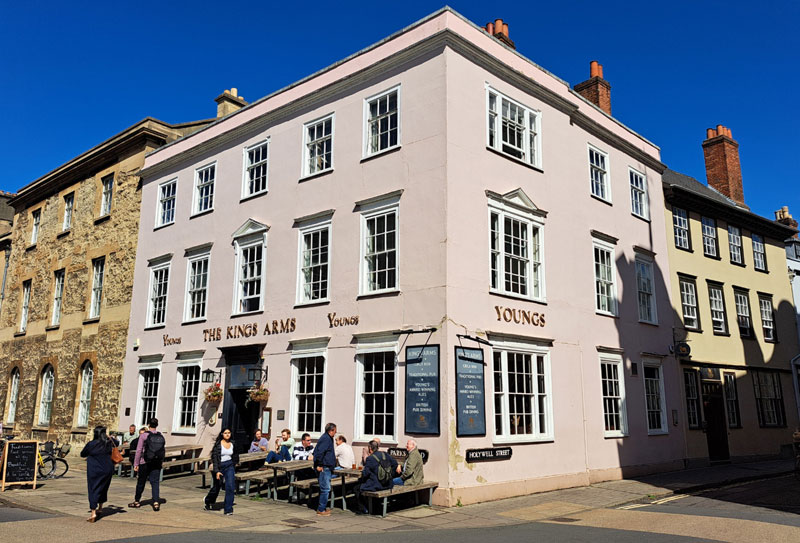
The King's Arms at 40 Holywell Street (formerly a hotel as well as a pub) goes around the corner into Parks Road, and its main entrance is there. It was rebuilt in the late eighteenth century.
It is a Grade II Listed Building (1335897), with the following description:
No 40 (King's Arms Hotel) SP 5106 NE 6/188 12.1.54. II GV 2. RCHM 196.
Corner site on to Parks Road. South elevation. Rebuilt early in C18. Three-storeyed stuccoed timber-framed with cellars. It consists of two buildings and has six sash windows, some of which have reeded architraves and one, in the first floor, is a three-light sash window with a pedimented reeded architrave.
The East building is of lower height and has a bold early C18 modillioned eaves cornice. The West building has a late C18 moulded and dentilled eaves cornice.
The West elevation on Parks Road has the front doorway and five windows similar to those on the South and has an eaves cornice carried round from the West part of the South front. This West front is probably later in date than most of the South.
In the courtyard at the back, the North wing on the West is two-storeyed timber-framed roughcast with four C8 windows in wood frames.
Interior: RCHM p. 180b. Includes an early C18 staircase and 2 C8 fireplaces. Altered 1971.
The inn on this site called the King's Arms dates from 1607, but the present building dates from the early eighteenth century. It is owned by Wadham College.
On 18 September 1607, when a licence was granted to “Thomas Francklyn of Holywell, dwelling at a house called the Augustyn Friers, which is very fit for an inn” to open his inn here with the sign of the King’s Arms on 18 September 1607. This is the present King’s Arms at the north-west end of Holywell Street. The following year, there was plague in Oxford, and it may have struck at this inn, for the council record for 30 July 1608 states:
It is agreed that some two women shalbee procured to goe into Francklin’s howse to bury the mayde that is now dead, and that they shalbee kept with sufficient dyet and mayntenaunce either in that howse or in some cabin that shalbee buylt; and moreover that order shalbee taken for erecting of cabins as necessitie shall requier in place conveinent as may bee gotten.
There is an interesting memorial to Elizabeth Franklin, wife of the first landlord, who died on 31 July 1822, in St Cross Church (now Balliol Historic Collections Centre).
On 20 February 1762 Joseph Payton, until then an ostler at the King's Arms, announced in Jackson's Oxford Journal that he had taken it over and made it more commodious. On 13 February 1773 he was one of the ten city's innholders who announced that because of the great increase in the price of corn, they had to raise the price of carriages as follows: A chaise & pair: 1/- per mile; a chaise & four: 1/6 per mile; a saddle horse: 4d per mile. Latterly he ran the inn with Adams, and on 16 November 1776 Payton & Adams announced that they had taken on the Golden Cross Inn
Richard Ward announced in Jackson's Oxford Journal of 25 January 1777 that he had purchased the King's Arms Inn, and that he would immediately enter upon the same, which would be fitted up in the most commodious manner. He added that it had neat post-chaises.
Less than a year later on 4 April 1778 John Sisill (usually spelt Cecil) announced that he had taken and entered upon the King's Arms Inn, and he remained the landlord here until his death in July 1788. His widow Elizabeth Cecil then took over, and on 24 April 1792 she took out an advertisement in Jackson's Oxford Journal, where she stated that the great part of the King's Arms had been “rebuilt upon a very enlarged Plan, the Whole new furnished”. Then on 11 June 1791 she advertised as follows:
KING’S ARMS INN, OXFORD
ELIZABETH CECIL takes this Method of acquainting her Friends and the Publick, That she has rebuilt and greatly enlarged the above INN; which she has also new furnished and fitted up in the neatest Manner for the Reception and Accommodation of such of the Nobility, Gentry, and Others as shall be pleased to honour the House with their future favours:— She also feels it is her duty most gratefully to acknowledge the kind Patronage she has experienced since the death of her late Husband; the continuation of which she hopes to merit by the most unremitted attention to the Business, and by constantly providing the best Wines and neatest Liquors of every Kind; together with a well Stored Larder, due Continence, and civil Treatment.
N.B. Neat Post Chaises, Post Coach &c. careful Drivers, and fresh able Horses.— NO STAGE COACHES.
On 5 October 1793 William Slaughter announced that he had married Mrs Elizabeth Cecil/Sissill/Sisil and that he was now running it. Elizabeth died on 24 June 1801 at the age of 60, and has a memorial on the wall of St Cross Church.
On 3 October 1801 Charles Cox (formerly a matriculated hairdresser and the father of George Valentine Cox who wrote Reminiscences of Oxford) announced in Jackson's Oxford Journal that he had taken over the King's Arms Inn, and he was still listed as landlord there in Pigot's Directory for 1823.
For the year 1844/5 Eliza Cox and Francis Stone were jointly listed as licensed to sell wine in the precincts of the University here at the King's Arms. In 1847/8 the licence was granted to Eliza Cox and Frederick Stone, and then in 1854/5 the licence was held by Frederick Stone alone. Frederic went bankrupt in 1858, and the contents of the inn had to be sold, including furniture, curtains, nearly 30 mahogany four-post and other beds, fire irons, wash stands, all the china, fine port wine, and two landau flys and four useful horses: for a full list, see Jackson's Oxford Journal for 16 January 1858, p. 4.
In 1864/5 the wine licence at this inn was granted to Samuel Young Griffith, who was owner of these premises and also ran the Angel Hotel in the High Street. He died at the age of 74 on 16 April 1865, and his probate record, where he is described as a hotel proprietor, states that his substantial effects came to under £14,000. On 10 June 1865 his executors placed this advertisement in Jackson's Oxford Journal about the forthcoming auction of the building, which was now described as a hotel rather than an inn, and it had 20 bedrooms and stabling for 30 horses:

In 1870/1 James R. Mallam held the licence of the King's Arms inn, but the 1871 census shows a manager, Alice Littlechild, living here.
The detail below from the 1876 OS map shows No. 40 Holywell Street fully integrated into the main pub building on the corner, with No. 39 nestling into the eastern corner. The wide entrance to King’s Arms Yard is just to the east of No. 39. This yard was painted by J. A. Shuffrey in c.1907 (OXCMS: 2002.74,7, pictured on p. 43 of Lauren Gilmour and Margaret Shuffrey, J. A. Shuffrey 1859–1939: An Oxford Artist’s Life Remembered).

Below: The main entrance of the King’s Arms facing Parks Road
On 7 June 1879 Jackson's Oxford Journal announced a forthcoming auction of the lease of the Kings Arms:
The Old-established and Commodious UNIVERSITY and FAMILY HOTEL, known as
“THE KING'S ARMS,”
(Of which possession may be had on completion of purchase), very conveniently situate at the junction of Broad-street, Park-street, and Holywell-street, containing large club room, coffee room, bars, 5 sitting rooms and 24 bed rooms, housekeeper's room, and all the necessary domestic and culinary offices, with large Stable Yard, extensive Coachhouse, and Stabling for 20 Horses attached.
On 14 May 1881 a similar auction was advertised.
40 Holywell Street in the censuses
1841
The 1841 census for Holywell does not give house numbers, but it is possible to deduce where people listed that year lived by examining directory entries between 1839 and 1842 and later censuses
Frederick Stone (30), the innkeeper of the King’s Arms, lived here with Sarah (20), and Eliza (35), plus thirteen independent people who were presumably guests at the inn, and nine male and four female servants.
1851
Frederick Stone (42), now described as the landlord of the King’s Arms Hotel, still lived here with his wife Sarah (48) and six servants (a cook, housemaid, under-housemaid, kitchen-maid, boots, and ostler).
1861
The head of the household was away, and a waiter, two porters, a chambermaid, housemaid, and a female superintendant, plus one guest (an undergraduate) stayed here on census night.
1871
Alice Littlechild (39), a widow and manager of the hotel, lived here with four servants (a waiter, a boots, and two domestic servants).
1881
Alice Littlechild (49) was still the hotel manageress and lived here with an assistant (who was the hotel bookkeeper), a student lodger, a boarder (a retired horse dealer of 71), and two servants (a chambermaid and housemaid).
1891
Henry Sheppard (29), a printer, lived here with his wife Louisa (26), who was the manageress of the hotel, plus four servants (a barmaid, cook, housemaid, and kitchenmaid). They had one boarder.
1901
Edward George (43), a hotel proprietor, lived here with his wife Jessie (41) and six of the pub’s servants (a waiter, boots, cook, chambermaid, kitchenmaid, and barmaid).
1911
Edward George (54) was still the hotel proprietor here, with his wife Jessie (52) who assisted in the business. Also living with them were a hotel assistant and six hotel servants (a cook, chambermaid, kitchenmaid, porter, and two waiters). Six guests were in residence on census night.
1939 Register
The hotel proprietress Julia Hannah was listed here with the hotel manageresses Marjorie Phillips and Constant Green, and the organizing supervisor of catering Stanley Wilfred Snazelle and his wife Edna, plus a chambermaid, kitchen porter, and hotel hall porter. There appear to have been four residents staying permanently at the hotel.
Occupants of the King's Arms listed in directories etc. |
||
1772 |
Mr Payton |
|
1777–1960 |
King’s Arms Hotel Some landlords
|
|
1966–present |
King’s Arms public house |
|