


Bath Place is today the short passage leading south between 55 & 56 Holywell Street. The Bath Place Hotel and No. 3 are owned by Merton College.
The entire lane from Holywell Street to New College Lane appears originally to have been known as Hell Passage, and in the 1772 Survey of Oxford the passage is listed under Holywell Street simply as “Hell”. The width of its entrance was given as 4 yards 0ft 2in, and it was described as being in the occupation of “Mrs Billing & others”.
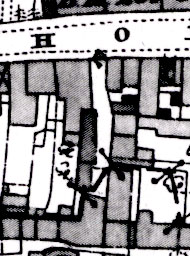
By the mid-nineteenth century the two parts of the lane were given different names:
- The southern part of the passage (which is in St Peter-in-the-East parish) was renamed St Helen’s Passage
- The short straight northern part of the lane in Holywell parish was renamed Bath Place.
The map on the right shows the seven houses of Bath Place in 1876, with the row of houses to the south being in St Helen's Passage.
On 26 February 1842 the following advertisement appeared in Jackson's Oxford Journal, which explains the origin of the name Bath Place at the Holywell end:

The photograph below by Henry Taunt (Historic England 01870) shows the entrance to Bath Place in 1895:
Bath Place was painted by J. A. Shuffrey in c.1907 (OXCMS: 2002.74,13, pictured on p. 42 of Lauren Gilmour and Margaret Shuffrey, J. A. Shuffrey 1859–1939: An Oxford Artist’s Life Remembered).
The seven houses in Bath Place (including the Bath Place Hotel now at Nos. 4–5) as well as the Turf Tavern (formerly the Spotted Cow) are owned by Merton College. They are all Grade II listed, and their list entry describes them as follows:
- 1 Bath Place (west side): 1299843
House Possibly C17 in origin and altered in C18. Two storeys. Plastered timber-framing. Brick stack. C18 windows, those on the ground floor with shutters.
Photograph - 2 & 3 Bath Place (east side): 1369322
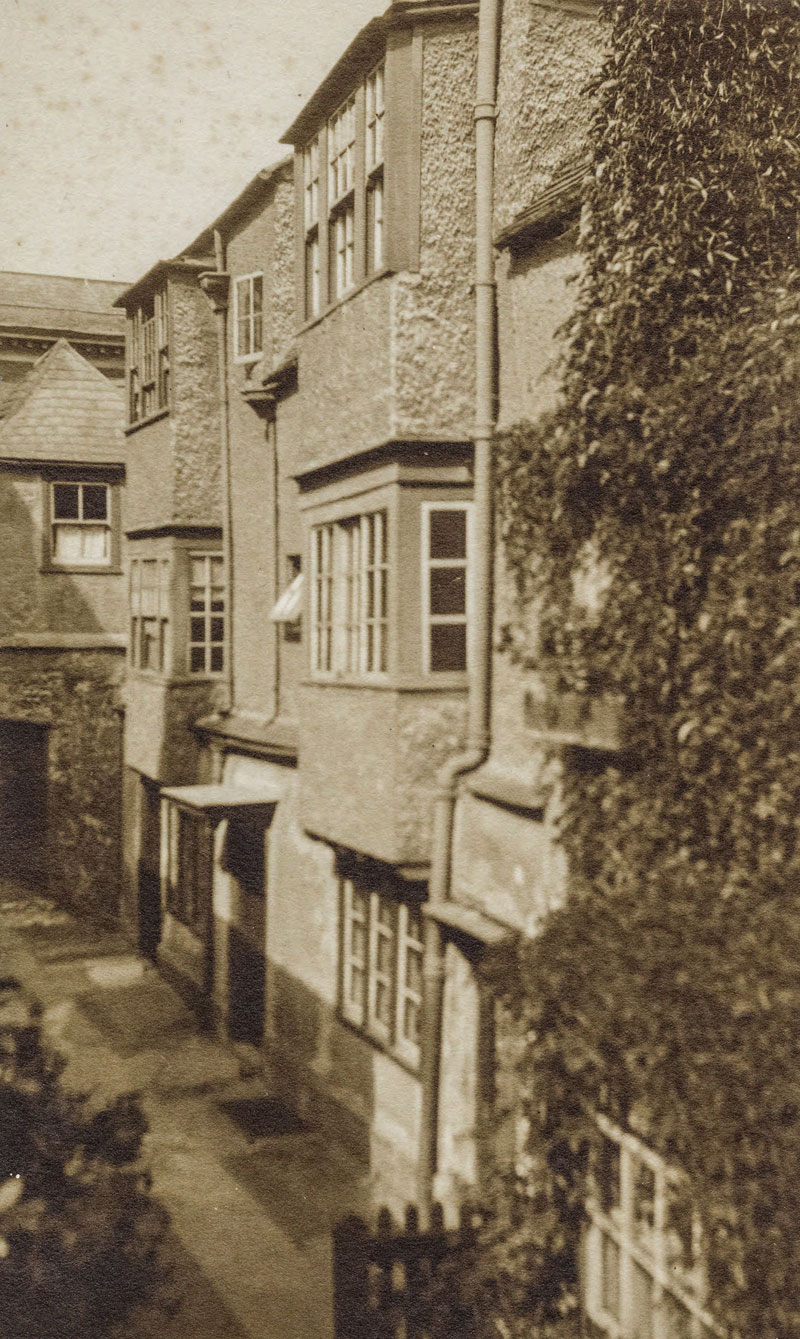
Two houses, one building. C17 in origin but the front altered in C18. Three-storeyed roughcast, partly timber framed and partly stone. The West front has a gable at the South end and in front of this is a C18 boxed-out projection running up the height of the house. At the North end is a similar boxed-out bay. Modern brown tile roof. Some original three-light C18 windows, those on the ground floor having been converted to casements. At the back in a Welsh slate roof is a gabled attic dormer.
Photograph - 4 Bath Place (east side): 1185039
House. Possibly C17 in origin but much altered. Two-storeyed brick and timber-framed roughcast. Brick stacks. Three C18 sash windows in first floor; the ground floor is boxed-out.
Photograph - 5 Bath Place (east side): 1047371
House. Date of original building indeterminate but altered in C18. Two storeys, partly rubble and roughcast. East gable end is roughcast. Late C18 style sash windows, On the South are casement windows and the first floor is stuccoed over a rubble ground floor. Adjoining it on the West is a three-storeyed red brick house with a Welsh slate roof, being once 7 St Helen's Passage, now incorporated as part of No 5 Bath Place.
Photograph - 6 & 7 Bath Place (east side): 1369323
Cottages, one building. Two-storeyed stucco (?on timber framing). Brown tile roof. Central brick stack and another stack on the South gable end. C18 style sash windows. Small plain bracketed flat hoods to two doorways.
Photograph
Historic England photograph by Henry Taunt of the entrance to Bath Place in 1908:
The west side of Bath Place in c.1920 (Picture Oxon 0251520, reproduced with permission of the Oxfordshire History Centre:
Planning applications in Bath Place
No. 1
- In 1959 planning permission (59/08124/A_H) was granted to Merton College for internal alterations to form a bathroom,
No. 2
- In 1951 planning permission (51/01826/A_H) was granted to Merton College for the formation of a bathroom.
No. 3
- In 1971 planning permission (71/24433/A_H) was granted to Merton College for the demolition of outhouses and chimney stack and the formation of bathroom, lavatory, and kitchen plus the installation of two new windows.
Nos. 4 & 5 (now a hotel)
- In 1987 several planning applications were granted relating to the conversion of these houses into a hotel, including 87/01199/L to demolish the existing outbuilding and erect a two-storey building comprising hotel reception and toilets on ground floor and manager's flat on first floor
Nos. 6 & 7 (now part of the Turf Tavern)
- In 1964 planning permission (64/15770/A_H) was granted to Merton College for an alteration to form a bathroom at 6 Bath Place
- In 1963 planning permission (63/13399/A_H) was granted to Merton College for the conversion of a bedroom into a bathroom at 7 Bath Place
- In 1984 retrospective planning permission (84/00300/L) was granted to W. Ellse to convert the two dwellings at 6 & 7 Bath Place into one.
- In 1995 planning permission was granted to Whitbread Severn Inns (94/1702/NFH) to form links between the Turf Tavern and No. 7 Bath Place, and for the change of use of Nos. 6 & 7 Bath Place from dwelling to the pub kitchen on the ground floor, and manager's flat on the first floor.
Bath Place, off Holywell Street, in the censuses
1841
Hard to identify
1851
No. 1: Susannah Hawkins (45), the wife of John Hawkins, the porter at Brasenose College, lived here with her sons John (12) and Oliver (9), and her niece Martha Bellard (14).
No. 2: Jane Godfrey (46), a widowed laundress, lived here with her seven children: Charles (23) was a tailor; Robert (21), William (19), Ebenezer (17), and Henry (15) were all college servants, and John (12) and Jane (9) were at school. They had an undergraduate lodger.
Back cottage No. 1: William Grainger (28), a widowed college servant, lived here with his widowed mother-in-law Susanna Tims (49), his brother-in-law William Tims (17), who was also a college servant, and his sister-in-law Sarah Tims (10).
Back cottage No. 2: Joseph Ward (67), a porter to a wine merchant, lived here with his wife Sarah (52) and their servant.
Back cottage No. 3: Sarah Knibbs (77), a market gardener’s widow, lived here with her granddaughters Harriet and Fanny Knibbs, aged 17 and 15, who were also acting as her servants.
1861
No. 1: William Price (43), a boot-closer, lived here with his wife Eliza (29) and his children Sylvia (10), Eliza (6), and Henry (2) A single lady, Elizabeth ?Boltarth (50) also lives with them: she is described as their daughter.
No. 2: William Grainger (41), a college servant, lived here with his wife Eliza (30) and his children John (6), Emily (4), and Frederick (1). They had one house servant.
No. 3: Richard Swadling (43), a bookbinder finisher, lived here with his wife Mary Ann (40), who was a dress and mantle maker, and his children Frederick (15), Mary Anne (10), Elizabeth (5), and William (2). They had one house servant.
No. 4: Thomas Preston (43), a servant of New College, lived here with his wife Sarah (41) and their children Charlotte (12), Sarah (11), Martha (10), Thomas (8), and Ada (2).
No. 5: Edward Stanton (41), a college servant, lived here with his wife Sarah (36).
1871
There seems to be some switching of numbers here, as the man who lived at No. 1 lived at No. 2 ten years earlier, while the man who lived at No. 2 lived at No. 1 ten years later
No. 1: William Granger (49), a college servant, lived here with his wife Eliza (41) and their children Emily (14), Frederick (11), Lucy (9), Mary (6), and Ada (1). They had one servant.
No. 2: William Bunce (51), a cordwainer, lived here with his wife Charlotte (52) and their children William (23), who was a compositor, John (21), who was a porter, Arthur (18), who was a photographer's assistant, Alice (15), who was a domestic servant, and Susan (13).
No. 3: Sydney Hamshaw (44), a college cook, lived here with his wife Mary Ann (40) and their children Sydney (17), Fanny (14), and Caroline (12).
No. 4: Robert Godfrey (40), a servant, lived here with his wife Jane (23) and their sons Isaac (5), Robert (3), and William (eight months).
No. 5: Thomas Boulton (43), an agent, lived here with his wife Elizabeth (43) and their children Elizabeth (12), Frederick (10), Kate (5), Thomas (3), and Florence (1).
1881
The house listed as No. 6 could have been the one numbered 4 in the previous census
No. 1: William Bunce (61), a master bootmaker, lived here with his wife Charlotte (64) and his two unmarried daughters: Charlotte (30), who was a needlewoman, and Susan (23), who was a machinist.
No. 2: George Hanniss (32), a college bedmaker, lived here with his wife Catherine (27) and his niece Caroline Stockwell (13)
No. 3: William Grainger (59), a college bedmaker, lived here with his wife Eliza (50) and his children Emily (24), a governess, Lucy (19), Mary (16), Ada (12), and Percival (6). They had an undergraduate lodging with them.
Nos 4 & 5: Not listed
No. 6: Robert Godfrey (50), a college bedmaker, lived here with his wife Jane (31) and his children Jessie (14), William (10), Alfred (7), Leonard (2), and Ethel (2).
No. 7: Frederick Sammons (69), a shoemaker, lived here with his wife Mary (65) and his son William (22).
1891
No. 1: Charles Henry Harman (52), a clothes cleaner, lived here with his wife Elizabeth (46) and their children Elizabeth (18), who was a parlourmaid, Rose (13), who was a book sewer, and Henry (11).
No. 2: Not listed.
No. 3: William Grainger (70), a retired college servant, lived here with his wife Eliza (61) and their children Ada (21) and Percival (16). They had a lodger, James Ernest Marsh (30), who is listed separately in the census: he was a Demonstrator in Chemistry.
Nos. 4 & 5: Not listed.
No. 6: Thomas Ody (29), a coachman, lived here with his wife Polly (34) and their daughter Hilda (5), plus their lodger.
No. 7: John Bunce (40), a painter, lived here with his wife Jane (37) and their children Edith (11), George (9), and Alfred (4).
1901
No. 1: Charles Harman (63), a clothes cleaner who worked from home, lived here with his wife Elizabeth (56) and his three grown-up children: Lily (26) was a machinist of underclothing; Rosa (23) was a book folder; and Henry (21) worked with his father as a clothes cleaner.
No, 2: John G. Walklett (41), a house decorator, lived here with his wife Mary (41) and his children Francis (14), Elsie (10), Olive (7), and Marjorie (3).
No. 3: George Greening (61), a domestic coachman, lived here with his wife Emma (64), his daughter Evelyn (24), and his grandson Cyril (8).
No. 4: Listed as not in occupation.
No. 5: Thomas Hunt (64), a retired corn chandler, lived here with his wife Matilda (53) and his son Thomas (21), who was an undergraduate.
No. 6: George Beetles (44), a domestic coachman, lived here with his wife Emma (39).
No., 7: Arthur Joyce (33), a postal letter carrier, lived here with his wife Elizabeth (32) and his children Arthur (8), Albert (6), Ethel (3), and Alice (under 1 month), and his sister-in-law Emma Fenemore (13).
1911
No. 1: Henry Harman (31), a clothes cleaner, lived here with his wife Mary Ann (25)
No. 2: Alice Emily Butler (37) was looking after this “lodging house”.
No. 3: Walter Herbert Luker (28), a single college servant, lived here with his two unmarried sisters: Minnie Florence (26) acted as his housekeeper, and Violet Beatrice (21) worked as a barmaid.
No. 4 & 5: No listing
No. 6: Henry Mott (48), a house painter, lived here with his wife Frances (41) and their children Henry (10), Alfred (6), and Eveline (2).
No. 7: Arthur James Joyce (42), a postman, lived here with his wife Elizabeth (41) and his children Albert (16), Ethel (13), Alice (10), and Harold (3).
1921
No. 1: The clothes Henry Harman (41) was still here with his wife Mary Ann (36). He stated that he worked on his own account here at home.
No. 2: Alice Emily Butler (47) was still the lodging-house keeper here, but there were no boarders on census night.
No. 3: Isaac Luker (70), a widowed retired printer, lived here with his unmarried daughter Violet (32).
No. 4 & 5: No listing.
No. 6: Miss Olive Phyllis Walkett (22) lived here with her sister Marjorie (24), neither of whom had an occupation, and their six-year-old niece.
No. 7: The postman Arthur James Joyce (52) still lived here with his wife Elizabeth (51) and his children Alice (20), who was a shop assistant with J. Smith, dyers & cleaners in Cornmarket Street, and Harold (13), who was still at school.
1939 Register
No. 1: Two retired laundresses, Sara Davidson and Jessie Hewitt, were listed here with a shop assistant.
No. 2: Hans A. Hammelman, a research working in law and student at the Middle Temple, was listed here with his wife Elspeth and a widow Sarah Gibbs.
No, 3: Two ladies of private means, Miss Violet Luker and the widow Mrs Minnie Allaway, were listed here with the latter's daughter.
Nos. 4 & 5: The lodging-house keeper Miss Eva M. Walklett and Miss Olive P. Walklett were listed here with seven lodgers.
No. 6: The public service vehicle driver Francis McKenna was listed here with his wife Muriel, who was the caretaker of the flats at 56 Holywell Street, and their two children
No. 7: The college servant John Butler was listed here with his wife Irene and their young son.
|
Some occupants of Bath Place, Holywell Street listed in directories etc. |
|||||||
Year |
1 |
2 |
3 |
4 |
5 |
6 |
7 |
1841– |
Houses not given numbers, but the following are listed in Bath Place, Holywell Street: |
||||||
1899 |
Charles Henry Harman (clothes cleaner) |
Frederick William Franklin |
George Greening |
Charles Brooks (with No. 2 in 1914) |
Godfrey William Price Jones |
John Jenkins |
Arthur James Joyce |
1914 |
See No. 4 |
Isaac Luker
His daughter (with Michael Walker in 1966 only)
|
John Walklett |
||||
1930 |
Bert Clark Bertie Clark by 1945 |
Thomas E. Richardson |
John Walklett Miss Olive Walklett Miss Olive Walker's lodging house was |
Frank McKenna Francis McKenna by 1941
Mrs F. McKenna from 1964 |
Mrs Wiles |
||
1935 |
Tom Gibbs Mrs Gibbs |
Thomas Akers |
|||||
1941 |
No listing |
||||||
1943 |
John Joseph Butler |
||||||
1945 |
Thomas E. Ellis |
||||||
1952– |
Mrs Davidson |
||||||
1958 |
No listing |
Mrs M. C. Barnes |
|||||
1960 |
|||||||
1962 |
Mrs B. M. Cawte |
||||||
1964 |
K. Whiteley |
Miss A. Congdon |
|||||
1966 |
Cockcroft |
Kenneth Ellworthy |
R. A. Ellse |
No listing |
|||
1967– |
No listing |
David M. Holmes |
No listing |
||||
1970 |
No listing |
Alan W. Johnston |
|||||
1972 |
Hugh Crago |
R. M. Courakis |
No listing |
||||
1973 |
Julian Leslie |
Bernard Hurley |
|||||
1976 |
Jeremy E. Cook |
Timothy M. Cox |
|||||
Now |
Bath Place Hotel |
Part of Turf Tavern |
|||||