

The first block of New College on the eastern side of Holywell Street is the second phase of George Gilbert Scott’s building (1875–7). It runs westwards after the house at No. 69 and finishes with a tutor's house in five-storey tower. The five houses at 70, 71, 72, 73, & 74 Holywell Street were demolished to make way for it.
(See the first phase (75–86 Holywell Street) built in 1872–3 for more information about the design.)
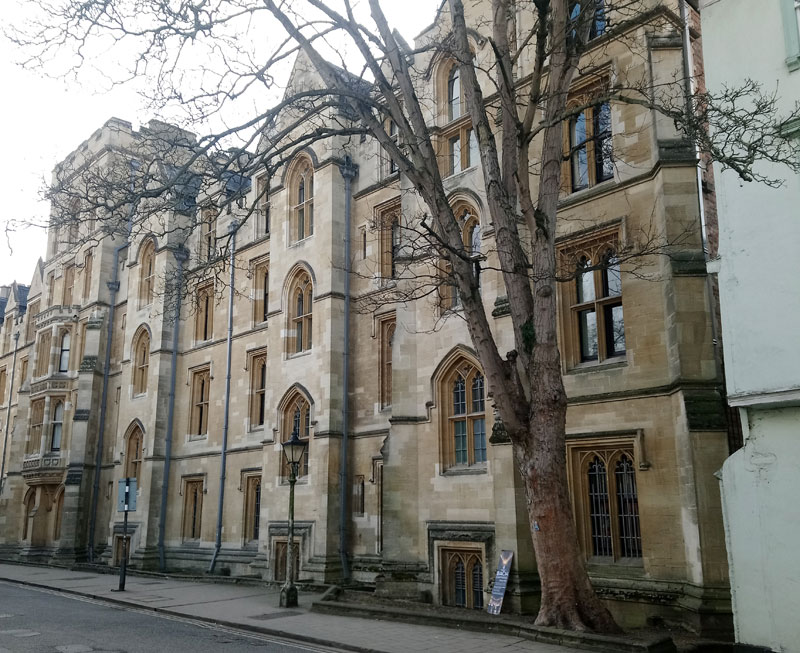
This range is jointly Grade II listed (1300697) with the the New College range to the left by Basil Champneys up to (but not including) the Tutor's house. The relevant part of the description reads simply: “West block built 1875 to designs of Sir Gilbert Scott in Taynton and Milton stone (see The Builder XXX, 829).”
Jackson’s Oxford Journal reported on 10 October 1874 that the five houses on this site, which included the former Golden Ball public house at No. 71, were being demolished:
FURTHER EXTENSION OF NEW COLLEGE. —Five more houses in Holywell-street, Nos. 70 to 74, are now in course of demolition to make way for further buildings at New College. The materials of these houses, which were very old, were disposed of by auction on Tuesday last by Messrs. Galpin and Son, and realized scarcely 90l., about 20l. of that being for the lead.
Then on 21 October 1876 it reported:
The extension at New College, which has occupied the past three or four years, is rapidly approaching completion, at least for the present. The new block which has been added to that which was completed for occupation twelve months since in Holywell-street provides rooms for twenty undergraduates, with a fellow's residence at the west end. The buildings are fronted with Milton and Taynton stone, and the length of the front is 273 feet, with a depth of 33 feet, and a height of 75 feet, to the ridge There is some exceedingly well executed carving on both the College and Holywell fronts, and between the new and the old parts of the College a quadrangle of grass plots and gravelled paths has been laid out. Further extensions are contemplated. Messrs. Jackson and Shaw, of London, have carried out the designs from plans of Sir G. Scott, and Mr. H. Roome is the clerk of the works.
70–74 Holywell Street in the censuses to 1871
1841
The 1841 census for Holywell does not give house numbers, but it is possible to deduce where people listed that year lived by examining directory entries between 1839 and 1842 and later censuses
No. 70
Does not appear to be listed.
No. 71
William Ball (35), the publican of the Golden Ball, lived here with Phoebe (20), and Phoebe (1). They had one female servant and four lodgers.No. 72
John Slatter (55), a grocer, lived here with Mary (50) and Clara Ann (10), plus Emily Farrant (5).No. 73
Thomas Fairfax (20), a college servant, lived here with Maria (20).No. 74
Mary Green (35), independent, lived here with Ann Green, two lodgers, and one female servant.
1851
No. 70
Richard Gillman (33), a shoemaker employing three men, lived here with his wife Mary (32) and their children Emily (12), George (9), Mary (6), Rose (3), and Richard (1). They had one servant.
No. 71: “The Golden Ball Publick House”
Thomas H. Gilder (71), carpenter & publican, lived here with his wife Jane (61) and their children Richard (38) and Harriet (30).No. 72
Mary A. B. Sims (37), a shoemaker’s wife, lived here with her son James (7)No. 73
William Pratt (52), a butler at Magdalen Hall, lived here with his wife Elizabeth (57) and their daughters Charlotte (30) and Elizabeth (19), who were both dressmakers, and their son Charles (17), who was a clerk to a watchmaker.No. 74
Martha Wells (60), the widow of a college cook, lived here with her son Thomas (23), who was a cook at Brasenose College, and her daughters Sarah (20) and Frances (17). They had a house servant.
1861
No. 70
Richard Gilman (42), a Bristol-born boot & shoe maker, lived here with his wife Mary Ann (41) and his children George (18, a boot & shoe maker), Mary Ann (16, a bookkeeper), Rosa (13), Richard (11), Charles (9), Clara (6), Alice (3), and Henry (10 months). A boot & shoe maker living with them in the house is described as Gilman’s “servant”.No. 71
Robert Fowler (51), a carpenter, lived here with his wife Leliza (56) and his sons William (23, a cordwainer) and George (21, a college servant).No. 72
Charles Crapper (45), a clothes cleaner, lived here with his wife Lavinia (45) and his children Charles (17, a servant), Henry (14), John (11), William (7)No. 73
William Ogden (31), a carpenter & joiner employing one man and two boys, lived here with his wife Susan (36), who was a milliner employing one woman. They have an apprentice milliner boarding with them, and a servant girl of 14.No. 74
Two families lived in this house: (1) Martha Wells (72), a widow, with her granddaughter Fanny (7) and a servant; and (2) Robert Pole, (45), a landholder, with his wife Charlotte (4) and his son-in-law John Beall, who is described as a gentleman.
1871
No. 70
Wiliam Wells (26), a frame maker, lived here with his wife Mary Ann (25) and his daughter Sarah (13).No. 71
Robert Bruce (40), a whitesmith, lived here with his wife Hannah (39) and their children John (14), Elizabeth (13), Jane (10), Robert (8), and Joseph (6).No. 72
Charles Crapper (55), a clothes cleaner, still lived here with his wife Lavinia (55) and his children John (21) and William (17), who were also working as clothes cleaners. They had one lodger.No. 73
Benjamin Hart (37), with no occupation listed, lived here with his wife Eliza (32) and their children Mary Ann (8), Ernest (6), and Harry (3). They had one servant.No. 74
Martha Wells (82), a retired widow, lived here with her granddaughter Fanny Lucas (17) and one servant.
––––––
The five-storey tower forming part of this block was a tutor's home, and was occupied as follows:
1881
The tutor himself was away, but the house was occupied by his wife Edith M. Papillon (33), and his son Edward (7). Also in the house on census night were Papillon’s father-in-law Charles B. Dalton (70), who was a clergyman without cure of souls, and his brother-in-law Charles B. Dalton (27), who was a solicitor’s managing clerk. The family had two servants (a housemaid and a parlour maid).
1891
No entry.
1901
Percy B. Mattheson (42), a college tutor, lived here with his wife Elizabeth (39). He had three servants (a cook, parlour maid, and housemaid. His mother and sister-in-law were visitors on census night.
1911
Three senior members of New College, all bachelors, lived here: John S. Townsend (42), Professor of Physics, and Henry Henderson (30) and Horace Joseph (48), both Fellows and Tutors.
Occupants of 70–74 Holywell Street listed in directories etc. |
|||||
No. 74 |
No. 73 |
No. 72 |
No. 71 |
No. 70 |
|
1772 |
Mrs Tipping |
Mr White |
|
Mr Clark |
Mr William Billing |
Frontage: |
Frontage: |
Frontage: 6 yds 0ft 9in |
Frontage: |
Frontage: |
|
1841, 1846 |
Miss Mary Green |
Thomas Fairfax |
John Slatter |
GOLDEN BALL: James Cater (1839) William Ball Isaac Richards (1846) Thomas Gilder (1851) Robert Fowler (1861) William Hounslow |
No listing. |
1851 |
Mrs Martha Wells |
William Pratt |
Mary Simms |
Richard Gillman |
|
1861 |
Mrs Susan Ogden |
Charles Crapper |
|||
1866–1871 |
Mrs Hart + Benjamin Hart |
J. F. Green |
|||
1872 |
Mrs Webb |
Miss Strange |
PRINCE OF WALES |
W. H. Wells |
|
1875 |
No listing. These five houses were demolished at the end of 1874 |
||||
Nos. 70–74 |
Part of New College |
||||