

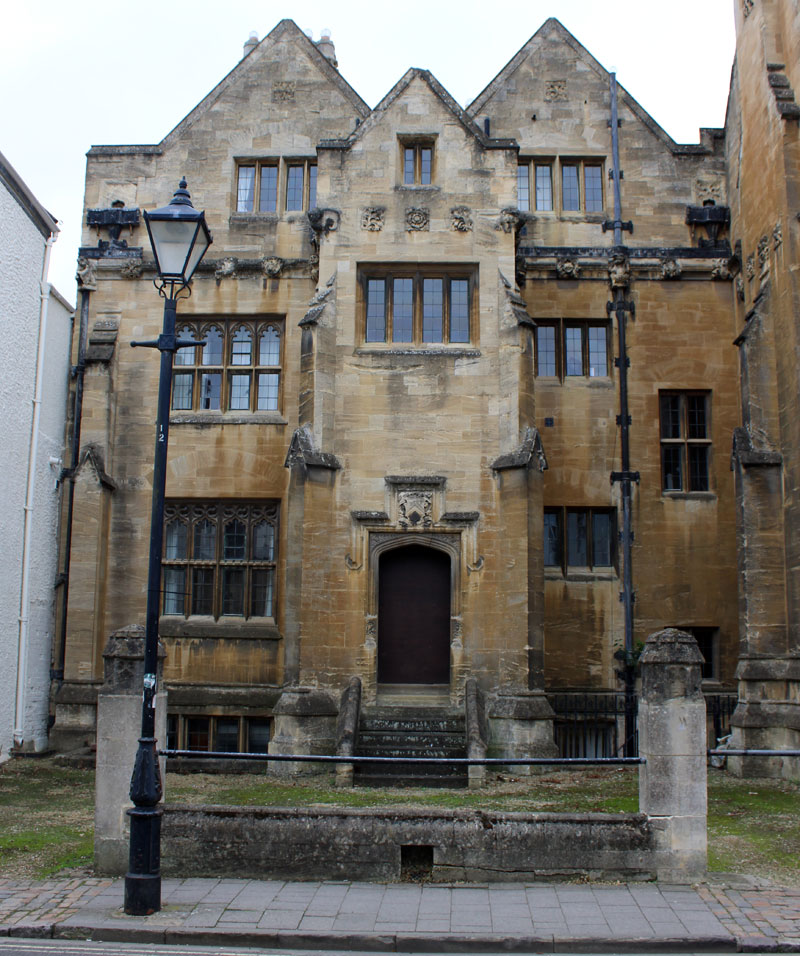
This tutor's house and the staircase to the west linking it to the Pandy Building is part of New College. It was designed by Basil Champneys. and built in Taynton and Milton stone in 1887. It is the easternmost part of the second phase of the massive development of New College’s new buildings, and is set back from the road, partly to protect the college from the view of the adjoining cottages but also to prevent the cottages from overlooking the college.
It is a Grade II Listed Building (1046690), with the following short description:
Tutor's House (to the East of Pandy) SP 5106 SE 9/242L II 2. Built 1885 to designs of Basil Champneys in Taynton and Milton stone, together with the staircase to West of it. Three storeys and attic.
Six seventeenth- and eighteenth-century houses at 90–95 Holywell Street were demolished to make room for this large house, including the Horse & Jockey pub at No. 90 on the right of the group. Miss Catherine Lloyd, who was the daughter of Charles Lloyd, a former Bishop of Oxford and lived next door to the surviving house to the east, No. 96, wrote in “Outrage in Holywell Street”: “6 old houses demolished by greedy New College to make way for a useless married Tutor’s house!” There is more information about her here on the page about her family grave in St Sepulchre's Cemetery.
Jackson's Oxford Journal of 17 October 1885 reported as follows on the development:
NEW COLLEGE.
The extensive additions which have been made at this College, in Holywell-street, during the past few years, are now being supplemented by the erection of another block, the College having acquired during th present year five houses—Numbers 90 to 95—which were speedily demolished, and the site cleared. The present block is being built in quite as substntial a manner as the older buildings and much after the same style, and it will give accommodation for six sets of rooms, besides which there is a tutor's house set back from the front a few feet. The extreme length of the “staircase” block is 34ft. 10in., and of the whole 43ft. 2in. There will be in the basement two rooms for servants, two sitting rooms and a bedroom (on the ground floor), and similar sets of rooms will be made on the first and second floors. The tutor's house will contain drawing, dining, dressing, bath, and three bed rooms. The style is Perpindicular [sic] Gothic, the windows have cinquefoil bends, without labels, and in the tutor's house the window heads are traceried. The entry to the tutor's will be by a Tudor arch, with carved spandrils and bosses at the finish of the labels. The frontage to the street is diversified by the window lights being double, treble, and quadruple, and the gables at the finish of each bay will terminate with a handsome crocket. Two oriels, on the first floor, are surmounted by embattled cornices, and the chimneys throughout will have moulded tops, while the staircases will be eight feet in width throughout. The partition walls on each floor will be opened by two-light transomed windows, with cinquefoil traceried heads, and there will be an arcading on back of thee ground floor landings on the south front. In the tutor's house the grand staircase will be eight feet wide, divided by wooden balustrading over the quarter spaces, and is parallel. The building is being executed in Taynton stone, with brick divisions nine inches thick; the stops in all the staircases will be of York stone, and the roof will be covered with Colley Weston slates. The architect is Basil Champneys, Esq., of 19, Buckingham-street, Stroud; the builder is Mr. Estcourt of Gloucester, and the clerk of the works, Mr. W. H. Williams.
Former houses on this site
William Fletcher held the lease of No. 92 under Merton College at the time of his death in 1827, and it was then occupied by Mr Henley.
An auction advertised in Jackson’s Oxford Journal of 24 January 1857 included Nos. 92 and 93 Holywell Street in the middle of this group:
Lot 1. — TWO DWELLING HOUSES, being No. 93, Holywell, in the occupation of Mr. Farrant, containing two sitting rooms and three bed rooms, two closets, kitchen, wash-house, cellar, large garden, &c.; and No. 94, in the occupation of Mr Pratt, containing sitting room, kitchen, and three bed rooms, with wash-house, cellar, yard, &c.
This Property is held by lease under Merton College, Oxford, for a term of 40 years, from October 10, 1854. Quit Rent, 1s. and one bushel of malt; Land Tax, £1 17s. 6d.; present rental, £60.
Twelve years later 92 and 93 were again offered by sale by auction. The advertisement in Jackson’s Oxford Journal of 20 November 1869 reads:
Lot 1. — A Stone-built DWELLING HOUSE, containing spacious entrance hall and two sitting rooms on the ground floor, and four bed rooms above, with capital Garden, No. 92, Holywell-street, Oxford, late the residence of Mr. Ald. Thorp, deceased, and of which early possession may be had; held of Merton College, Oxford, by lease for 40 years, from the 25th of March, 1865, subject to a Reserve Rent of 6d. and a couple of capons, and a Land Tax of 1l. 4s. 6d.
Lot 2 — A DWELLNG HOUSE, containing two sitting rooms and offices on the ground floor, three rooms and closet above, with convenient out-buildings and large garden at the back, No. 93, Holywell-street, Oxford, in the occupation of Mr. Thos. Farrant; held of Merton College, Oxford, by lease for 40 years, from the 10th of October, 1854, at an apportioned yearly rent of 6d. and half-a-bushel of malt, and an apportioned Land tax of 15s.
Lot 3. — The adjoining DWELLING HOUSE, containing sitting room and three bed rooms, detached kitchen and wash-house, with joint use of pump, No. 94, Holywell-street, Oxford, in the occupation of Mr. Wm. Belcher; held by the same lease, and subject to the same rents, as Lot 2, and an apportioned Land Tax of 12s. 6d.
The forthcoming auction of Nos. 93 & 94 Holywell Street was advertised thus in Jackson's Oxford Journal on 31 January 1857:
TWO DWELLING HOUSES, being No. 93, Holywell, in the occupation of Mr. Farrant, containing two sitting rooms and three bed rooms, two closets, kitchen, wash-house, cellar, large garden, &c.; and No. 94, in the occupation of Mr. Pratt, containing sitting room, kitchen, and three bed rooms, with wash-house, cellar, yard, &c.
This Property is held by lease under Merton College, Oxford, for a term of 40 years from October 10, 1854. Quit Rent, 1s. and one bushel of malt; Land Tax, £1 7s.; present rental, £36.
90–95 Holywell Street in the censuses
1841
The 1841 census for Holywell does not give house numbers, but it is possible to deduce where people listed that year lived by examining directory entries between 1839 and 1842 and later censuses
No. 90
Robert Fowler (30), a carpenter, lived here with Louisa (35), William (3), and George (19 months).No. 91
John Harris (40), a servant at Lincoln College, lived here with Sophia (40), Elizabeth (20), John (19), Thomas (17), Sophia (15), Samuel (14), Ann (13), Henry (11), George (7), and Charles (5), plus one lodger.No. 92
Nathaniel Harrison (35), a college servant, lived here with Susannah (30), Mary (10), James (8), Nathaniel (5), Edward (3), and Henry (1).No. 93
Thomas Farrant (45), a servant of New College, lived here with his wife Jane (40) and his children Charles (10), Thomas (9), Charlotte (7) and Edward (3). They had one lodger and one female servant.No. 94
Charlotte Simmons (50), a sempstress, lived here with Harriet (20); Thomas (15), who was a compositor; Robert (11); and Sarah (10). Another woman called Mary Paine also lived here with Sarah (8 months).No. 95
Ann Foreman (45), a clear starcher, lived here with Eve Foreman (45), a dressmaker.
1851
No. 90
Robert Fowler (43), a journeyman carpenter & publican, still lived here with his wife Louisa (45) and their children William (13) and George (11).No. 91
Nathaniel Harrison (46), a college servant, still lived here with his wife Susana (44) and their children Mary (21), Nathaniel (15), Edward (12), Henry (11), and Louisa (3).No. 92
John Harris (54), a college servant, still lived here with his wife Sophia (56) and his children Sophia (24), Samuel (23), who was a cook, Henry (20), who was a college servant, George (17), who was a clerk, and Charles (14), who was still at school. They had one servant.No. 93
Thomas Farrant (56), a widowed college servant, still lived here with his children Thomas (18), who was a college servant, Charlotte (16), and Emily (14), and his unmarried sister-in-law Susan Dowse (51), who acted as his housekeeper.No. 94
Richard Walter (47), a carpenter, lived here with his wife Sophia (48) and his children Sarah (10) and Henry (5), and his nephew John Clark (15).No. 95
Ann Foreman (65), a laundress, still lived here with her sister Eve (66). Both were unmarried.
1861
No. 90
Joseph Thompson (38), a painter & publican, lived here with his wife Rhoda (40) and his children Rhoda (5), Martha (4), and Tom (2). An Islington-born organ builder, John Smith (35) was lodging with them.No. 91
James Farrant (43), a gardener, lived here with his wife Lucy (40) and his children Ellen (15), Eliza (12), James (10), Mary (9), Henry (6), Robert (4), and Grace (3).No. 92
William Thorp (a widower of 75), described as “Alderman and Justice of the Peace”, was living here with his widowed sister Susannah Folker (67) and her daughter Emma (28). They had one servant.No. 93
Thomas Farrant (a widower of 64), a coal merchant, lived here with his children Thomas (29) and Emily (24). They have a 15-year-old servant girl.No. 94
Described as uninhabited.No. 95
Eve Foreman (80), an unmarried fundholder, lived here with her 50-year-old companion Elizabeth Gunston.
1871
No. 90
Joseph Thompson (48), now described as an inn keeper, still lived here with his wife Rhoda (48) and their children Rhoda (15), Martha (14), Tom (12), and J. T. Thompson (7).No. 91
James Farrant (52), a gardener, still lived here with his wife Lucy (50) and his children James (20), who was a clerk, Harry (16), who was a college servant, Robert (14), and Grace (12).No. 92
Samson Francombe (35), a college butler, lived here with his wife Sophia (32) and their children Sophia (3), Samson (2), and Margaret (nine months). They had a 15-year-old servant girl.No. 93
Thomas Farrant (a widower of 77), still described as a coal merchant, continued to live here with his daughter Emily (24: should be 34), who was a dressmaker. They employed a 15-year-old servant girl.No. 94
Thomas Preston (54), a servant of New College, lived here with his wife Sarah (50) and their children Thomas (19), who was an artist, and Ada (11).No. 95
William Tollit (32), a journeyman tailor, lived here with his wife Emma (26) and his children William (8), Sarah (6), Percy (4), and Lillie (1).
1881
No. 90
William Cotterill (28), a carpenter & licensed victualler, lived here with his wife Agnes (30) and son Hubert (3).No. 91
Described as uninhabitedNo. 92
Sampson Francombe (45), a college servant, still lived here with his wife Sophia (43) and his children Sophia (13), Samson (12), Margaret (10), Henry (9), Archibald (6), and Lancelot (4). They had one general servant.No. 93
Emily Farrant (44), a single woman described as a coal merchant, lived here with her brother, Edward (43), who was her manager and one general servant.No. 94
William Castle (79), a college servant, lived here with his wife Mary (62).No. 95
William Tollitt (40), a tailor, lived here with his wife Elizabeth (30) and his children William (18 and a tailor), Sarah (16), Percy (14 and a compositor), Lilly (11), Louisa (2), and Reginald (three months).
All six houses were demolished by 1887 and replaced by the current Tutor's House
1891
New College House. The Revd Hereford B. George (53), a college tutor, was living here with his wife Alice (46) and their son Arthur (19), who was a Second Lieutenant of Militia. They had one servant (a cook).
1901
The tutor who lived in this house was away, and it was occupied by his three servants (a cook and two parlour maids).
1911
The tutor who lived in this house (described as having 15 rooms) was away, and it was occupied by his four servants (a cook, parlourmaid, housemaid, and kitchenmaid).
Occupants of 89–95 Holywell Street listed in directories etc. |
||||||
No. 95 |
No. 94 |
No. 93 |
No. 92 |
No. 91 |
No. 90 |
|
1772 |
Mrs Franklin |
Mrs Dawney |
Mr Pepall |
Mr Henly |
Mr Rawlins senior |
Mrs Dod |
Frontage: |
Frontage: |
Frontage: |
Frontage: |
Frontage: |
Frontage: |
|
1841 |
Ann Freeman Mrs Eve Foreman, |
William Simmons Charlotte Simmons (by 1841) |
Thomas Farrant Described as Coal merchant from 1861 |
James Hooper |
John Harris |
HORSE & JOCKEY Landlords 1830–1839 1840: John Fowler (carpenter) 1841–1852: Robert Fowler 1861: William Cotterill 1861–1875: Joseph Thompson 1876: 1884: |
1851 |
Richard Walter (1851) Mr Pratt (1857) |
|||||
1861 |
Miss Adams |
Uninhabited James A. Farrant |
||||
1866 |
William Belcher |
|||||
1871 |
No listing |
No listing |
Sampson Francomb or Francombe |
|||
1872– |
William Tollit (moved to 15 when house demolished) |
William Castle |
John Ring Miss Ring in 1884 |
|||
1884– |
W. Porter |
|||||
1889– |
Rooms attached to New College |
|||||
1894 |
Revd Hereford Brooke George, M.A. |
|||||
1896– |
John Baron Moyle, C.C.L. |
|||||
1926– |
Not separately listed: treated as part of New College |
|||||
Present |
Part of New College |
|||||