

104: Sanders of Oxford

No. 104 dates from the sixteenth/seventeenth century, but has an early nineteenth-century bay front. It is a Grade II listed building (List Entry No. 1369389). It has always been in the parish of St Mary-the-Virgin. The building is owned by Oriel College.
In 1651 Thomas Wood moved from the Salutation Tavern at 3 Cornmarket Street in St Martin's parish taking the tavern's sign with him (causing the former to be renamed the Crown Tavern). Anthony Wood recorded several visits here. On 23 March 1656/7 he wrote:
In the latter end of this yeare [which ended on 24 March 1657 under the Gregorian calendar then used], Davis Mell, the most eminent violinist of London, being in Oxon, Peter Pett, William Bull, Kenelm Digby, and others of Allsoules, as also A. W., did give him a very handsome entertainment in the taverne cal'd The Salutation in S. Marie's parish Oxon, own'd by Thomas Wood, son of ... Wood of Oxon, sometimes servant to the father of A. W.
Thomas Wood was also the lessee of the Oriel Street tennis court behind these premises and ran a dancing school at the Salutation Tavern.
In 1665 John Fulks paid hearth tax on two chimneys at 94 High Street, and Thomas Hands on two chimneys at either 93 or 94.
On 3 December 1677 the City leased to Thomas Dye, a carrier, a piece of ground in St Mary’s parish measuring 12 ft. 9 in. from east to west and 6 ft 3 in. at the east end and 6 ft. 5 in. at the west end. The rents to the city for this encroachment at the front of No. 104 give a good record of the owners.
Initially Thomas Dye had an under-tenant, the widow Dorothy Day. He was still paying for this encroachment in 1693.
By 1715, when Mrs Hambleton (formerly Mrs Dye) made a payment to the City for the encroachment, No. 84 was a coffee house.
The next owner of the coffee house was a Mr Gregory. Then James Horseman was the owner from before 1753 until his death in 1760. The 1772 Survey of Oxford shows Mrs Horseman at both this shop and at No. 105 next door, and she paid for the encroachment in 1781.
Then John Darlington took over the premises, and when he died in 1792 he was described as a Coffee House Keeper in Jackson's Oxford Journal. The next owner was a Mr Smith, who paid for the encroachment in 1799.
The confectioner Thomas Blakeney Sadler (older brother of the aeronaut James Sadler) bought 104 High Street in 1801.
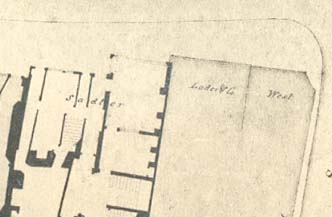
George Jubber paid for the encroachment of No. 104 in 1818, but an Oriel College plan of 1814 (right) shows that the shop was still in the occupation of Thomas Blakeney Sadler, who also had No. 105 next door. The encroachment is presumably the corner that juts out on to the pavement.
Jubber and Sadler were both confectioners, praised by William Tuckwell in his Reminiscences of Oxford, and when Queen Victoria visited Oxford in October 1835 Messrs Jubber & Son were appointed confectioners to Her Majesty. In 1836 George and Henry Jubber dissolved their partnership, and their business was taken over by H. and J. Jubber, George's sons.
Thomas Blakeney Sadler announced in Jackson's Oxford Journal on 23 October 1824 that he was declining business in favour of his son Charles James Sadler the Elder and retired to Rose Hill, where he died in 1829. Charles James Sadler the Elder (1792–1872), sometime Mayor of Oxford, paid the city for the encroachment in 1835 and 1855 and continued to run the confectionery business here.
At the time of the 1841 census Charles James Sadler the Younger (25), the only child of Charles James Sadler the elder, lived here with his wife Elizabeth (24) and eight servants, most of whom doubtless worked in the shop. He gave up the confectionery business here in 1845 and moved away from Oxford. The following notice of a forthcoming auction on the premises of all his household effects, which appeared in Jackson's Oxford Journal on 11 October 1845, shows some of the articles used in the confectionery trade as well as his household furniture:

From 1846 there was a bookshop in this building. At the time of the 1851 census the bookseller Charles Richards lived over the shop with his wife Ann and his children Charles (16), William (15), and Sarah (10), all of whom were described as shop assistants. Henry Taunt, the famous Victorian/Edwardian photographer, worked for Charles Richards for two years in the 1850s, when he was still a boy: he earned about five shillings a week and had to work from 7 a.m. to 9 p.m.
Only the servants were at home at the time of the 1861 census. Around this time William John Richards, the son of Charles Richards, was running the business, and in about 1862 he took on 13-year-old Benjamin Henry Blackwell (who in 1879 was to found Blackwell's bookshop in Broad Street) as his apprentice.
The 1871 census shows William John Richards, described as the employer of two men and three boys, living over his bookshop at No. 104 with his wife Elizabeth and their two children, plus two servants. He was still here in 1881 with his wife and their daughter Eleanor.
In 1884 Emily Jane Sadler, daughter of Charles James Sadler the Younger, put the freehold of 104 High Street up for sale by auction by Mallam's, and the following advertisement appeared in Jackson's Oxford Journal for 22 March 1884:
Lot 1.—The FREEHOLD BUSINESS PREMISES, No. 104, High-street, Oxford, now and for many years occupied by Mr. W. J. Richards as a yearly tenant, at a rental of £100 per annum; comprising an excellent Shop, having a frontage to the street of 13ft., with an extensive wine merchant's cellar in the basement, measuring 60ft. by 10ft., and a Dwelling House and Business Premises, containing eleven rooms, exclusive of kitchen, scullery, larder, knife-house, coal cellar, and two wc.'s; also a HOUSE in the rear of the above, containing rooms now used for workshops, warehouses, and show rooms. Land Tax £3 8s. 4d.; and annual rent to the City for pavement entrance to cellar, &c., of 4s.
Oriel College bought the freehold and continued to let it the premises out to Richards, but he no longer lived over his shop: the 1891 census shows Richard Callaby (45), a lodging-house keeper, living there with his wife and daughter.
William George's Sons were the booksellers here from 1894 to 1906, and the 1901 census shows the bookshop manager Frederick Chaundy, living over the shop with his wife, son, and servant. From 1907 this was Chaundy's Bookshop, and in his book Oxford Illustrated by Camera and Pen Henry Taunt described Chaundy's shop, where he had worked as a boy, as it was in the year 1911:
An Old Book Shop: 104 High Street
Opposite the new buildings of Brazenose College, just before Oriel Street is reached, at 104 High Street, where the shops stand out into the street, will be found an Old Book Shop, one of the interesting places among the many in Oxford. This has been an old book shop now for something approaching a century, and the Author, when a boy some 60 years ago, worked in it, and learned here some of his book lore. It was an old book shop then, but has been extended much farther back and made three times the size to accommodate the vastly increased number of books. An immense stock of second-hand books will be found, with many remainders, and the proprietor, Mr. F. W. Chaundy, lays himself out to secure scarce books or others required. He is Agent in Oxford for the Medici Prints, and has a number of the older Arundel Society’s publications. The variety of stock is very great, and book-lovers and others will find the place a considerable attraction. Among old customers he values the patronage he has received from Messrs. Gladstone, Ruskin, William Morris, Oliver Wendell Holmes, the king of Siam and many others.
At the time of the 1911 census Mrs Mary Anne Euphemia Skinner was a lodging-house keeper in the rooms above this bookshop at No. 104 and those above No. 105.
Chaundy's Bookshop continued until 1923.
The shop has been occupied by Sanders of Oxford since 1927. In Sweet Thames run softly (1940), Robert Gibbings wrote:
… I went on to “The High”, to visit my friend, Mr Sanders, at “Salutation House”. This is as cosy a bookshop as one could desire, retaining that atmosphere of geniality and ease which no doubt existed in the sixteenth and seventeenth centuries, when the House was known as the Salutation Inn. Davenant and Shakespeare almost certainly visited this resort,* and it is on record in the registers of St Mary’s parish that Anthony Wood and Sir Kenelm Digby were carried home from it in a condition which would to-day be described as “tight”. At one time there was a bear-pit behind the house.
* It seems likely that Gibbings has confused the Salutation Tavern at 3 Cornmarket
(where Shakespeare almost certainly stayed) with the new Salutation here at 104 High Street.
The author Brian Aldiss worked as an assistant here from 1947 to 1955.

Left. The underside of the ground floor as seen from Sanders’ cellar, 2003.
The floor is still supported by the same unfashioned parts of trees as it was in the sixteenth century.
Occupiers of 104 High Street |
|
By 1814–1841 |
Charles James Sadler, Confectioner & Fruiterer |
By 1846–1892 |
Charles Richards, Bookseller
and Auctioneer & appraiser (to 1859+) |
1892–1893 |
George Tyrrell, Bookseller |
1894–1906 |
William George’s Sons, Booksellers (old & new) |
1907–1923 |
Chaundy, Booksellers |
1925 |
Dulau & Company, Booksellers & publishers |
1927–present |
Sanders & Co, booksellers (1927–1958) Sanders of Oxford Ltd, booksellers (1960–1966) Sanders of Oxford Ltd., booksellers, prints, drawings & maps (1967–1976) Sanders of Oxford, Rare Prints & Maps |
