

123: Salsas Del Sol / 124: Vacant / 125: Iris Galerie

No. 123 (left), No. 124 (middle) and 125 (right) all share a continuous eaves cornice.
No. 123 is of indeterminate date but the front could be an alteration of the one that was possibly built in the eighteenth century. It is Grade II listed (List Entry No. 1145862)
Nos. 124 & 125 were possibly built in the seventeenth century but were altered and rebuilt in the eighteenth century, and No. 124 has two three-light eighteenth-century sash windows and has a seventeenth century building at the back. These two shops are jointly Grade II List Entry No. 1047259).
These three shops were in the parish of All Saints until 1971, and are now in the parish of St Michael-at-the-Northgate. They are owned by Lincoln College.
Nos. 123 and 124 on the left were the Bear Inn until 1801, when it was divided into two shops.
All three shops were reported in Jackson's Oxford Journal of 19 March 1842 as having been “completely destroyed” by a fire that started at Oxford Post Office at the back of No. 123.
Nos. 123, 124, and 125 are not properly marked on the 1876 map of Oxford, suggesting that major rebuilding work was taking place.
On 23 September 1893 Jackson's Oxford Journal reported on the forthcoming auction of these three shops pursuant to an order of the Chancery Division of the High Court relating to the case of Wolmershausen v. Wolmershausen:
CITY OF OXFORD
Important CORNER BLOCK of FREEHOLD SHOP PROPERTY,
Occupying an unrivalled position for trade, in the heart of the City of Oxford, close to the principal Colleges, and numbered 123, 124, and 125, High Street, and 1 and 2, Alfred Street, consisting of Three spacious Shops, extensive Work, Fitting, and Cutting Rooms, with Chambers and large Club Rooms over, together with the Goodwill of the old-established and well-known business of a Tailor, Robe Maker, Hosier, and General Outfitter, carried on in part of the above Premises, under the name and style of Foster and Co. Portions of the Premises are now let off at rents amounting to £410 per annum. The total annual value of the entire Property being estimated at £860.
No. 123 (currently Salsas Del Sol)
From at least the 1830s to 1864 there was a tailor’s shop here, while Oxford’s main Post Office occupied a front and back room on the ground floor from 1839 until it was destroyed by fire in 1842.
On 29 March 1834 the hatter, woollen draper & tailor Joseph Warne had announced that he had taken over this shop, formerly in the occupation of Mr Shayle. By July 1839 Oxford's main Post Office had also opened at this shop, and Warne became Postmaster.
On 26 October 1839 the tailor, hosier, & hatter John Parsons took over the retail shop, selling “woollens, hosiery, hats, gloves, linens, flannels, &c. &c., and the 1841 census shows him aged about 25 and described as a tailor living over the shop with Humphrey Parsons (16), who assisted him in the shop, and Elizabeth Parsons (30), plus their servant and a shop assistant. Also living over the shop was James Warne junior, William Homberg, and George Northleach.
On the morning of Sunday 13 March 1842 a serious fire started at No. 124, completely destroying the Post Office and rooms above and Parsons’s shop. Parsons, Mr Warne junior, Mr Rainsford, and their servant all “narrowly escaped with their lives, and almost in a state of nudity” from this shop. The Post Office moved to the Town Hall and never returned, but John Parsons remained in this shop.
Possibly as a result of the fire, and certainly by 1851, John Parsons built “The Lawn” for himself in Banbury Road (now part of St Hugh’s College). He continued to run his draper’s business in this shop, but in c.1850 went into partnership with Foster & Co next door.
The 1851 census shows Charles Foster junior living over his pair of shops at 123 and 124 High Street with his first wife Mary Ann and their seven young children, plus a tailor’s clerk, three general servants, a governess, and an errand boy. In about 1860 Foster took over the whole premises when John Parsons went to trade as a wine merchant at 134 High Street.
Charles Foster junior (53) was still living over Nos. 123 and 124 at the time of the 1861 census, when he was described as a tailor & robe maker employing 50 men and 20 women. His advertisement on the front page of the very first edition of the Oxford Times of 6 September 1862 reads:
C. FOSTER & CO.
TAILORS, ROBE MAKERS, &c., &c.
Desire respectfully to acknowledge the great and increasing Patronage with which they have been favoured by the Members of the University and by the Residents in the City and County, and beg to intimate that their large and extending Business enables them to offer for inspection, a larger and more extensive collection of Materials for GENTLEMEN’s CLOTHING, than can be elsewhere presented in the County.Their Stock now includes a great variety of SCOTCH, IRISH, WEST OF ENGLAND, and other NEW FABRICS and PATTERNS, specially adapted for Complete and durable Suits, which are made up in good style and very cheap.
First-rate skill in Cutting, Good Materials, and the Best Workmanship, will be combined with strict moderation in price.
C. FOSTER & CO.
123 & 124 HIGH STREET, OXFORD
Charles Foster junior's first wife Mary died in 1869. On 22 March 1871 he married his second wife Mary Prickett (who had been the governess of the Liddell children at Christ Church) and he immediately moved to 85 High Street to run a wine business. His son John Thomas Foster took over his father's tailoring and robe-making business, and at time of the 1871 census he was living over all three shops at 123, 124, & 125 High Street with his wife Elizabeth and their five children, plus their four domestic servants. John died in a train accident at Wigan on 1 August 1873.
This building is not properly marked on the 1876 map of Oxford and Nos. 123 & 124 were listed as unoccupied at the time of the 1881 and 1891 censuses.
The 1901 census lists No. 123 as a tailor's shop but with no one living there.
Foster's & Co. retreated into this shop when they downsized in 1895, and remained here until 1939.
No. 124 (currently vacant)
See first paragraph above under No. 123 for the early history of this building.
On 8 April 1837 an advertisement appeared in Jackson's Oxford Journal advertising a new establishment just opened at 124 High Street, opposite the Mitre and nearly opposite the market, run by Foster junior and Bailey. It sold linen drapery, silk mercery, hosiery, and haberdashery. After listing many of the specific items sold, including muslins, French and Scotch ginghams, French cambrics and handkerchiefs, shawls, socks, flannels, evening dresses, French flowers and feathers, baby linen, ladies' and children's stays, and straw bonnets, it adds: “N.B. Funerals completely furnished, with a strict adherence to economy.”
Charles Foster junior is listed in Robson's Directory for 1839 as the draper at this shop. The 1841 census shows him living here with his family and various shopmen, milliners, and servants. The following year the fire that started next door at Parsons' premises (see No. 123 above) was said to have completely destroyed No. 124, described as “Mr. C. Foster’s house and elegant shop (fitted up recently at an immense expense)”, and on 9 April 1842 the newspaper published a notice of an appeal to reimburse all the shopmen and women and servants who lost all their personal possessions. It appears that the newspaper exaggerated and much of the shop survived. Charles Foster junior continued to live on the premises after the fire: see above under No. 123.
This building is not properly marked on the 1876 map of Oxford and was unoccupied at the time of the 1881 and 1891 censuses.
On 6 January 1894 Sydney Acott took over Foster's shop at 124 High Street, where he operated as a musical instrument and music seller, but kept on his previous business at 120 High Street, where he sold pianos, harmoniums, and American organs and had his warehouse.
In 1900 the business here at No. 124 was called Sydney Acott, Harris & Co., as shown in this photograph by Henry Taunt (Historic England HT00112):
The 1901 census lists No. 124 as a music shop, but no one appears to have lived there.

Left: This mosaic paving in the entrance dates from the time this was Acott's shop.
The columns and the musical putti in the spandrels of its arch (below) evidently date from 1911, as the two scrolls are dated AD and MCMXI respectively.


In 1950 James Russell's music shop absorbed Acott and moved here, and the firm was henceforth called Russell Acott.
It was latterly known as The Music House (see drawing).
Graham Ansell, the owner of Russell Acott, sold the shop in 1998 to All Bar One (see photograph of its closing-down sale). The Russell Acott shop moved to the Hinksey Business Centre in Botley; and it finally closed in 2011:
- Oxford Mail, 20 January 2011:
“Iconic Oxford music shop packs up after 200 years”
For more information on the history of 124 High Street including maps and photographs of its interior, see the Heritage Impact Assessment listed here in Lincoln College's approved planning application 26/01253/LBC
No. 125 (currently vacant)
The cellar below this shop has some walling that may be medieval.
At the time of the Survey of Oxford, No. 125 was then in the occupation of a Mrs Stevens, and its frontage measured 6 yards 1 foot 6 inches.
William Marshall, a music seller, had this shop from at least 1839 to 1846. At the time of the 1841 census he was living here with his wife Elizabeth, and Louisa Marshall and Henry Marshall, probably their daughter and grandson. It too was damaged by the fire on Sunday 13 March 1842 two doors away at 123 High Street (see above). The newspaper report states: “The roof and upper part of Mr. Marshall’s were also destroyed, and the injury to the lower part, by the attempts made to prevent the encroachment of the fire, was such as will render it necessary to re-build the whole”.
On 8 May 1847 the following advertisement appeared in Jackson's Oxford Journal:
To be LET, in the best part of High-street, Oxford, particularly adapted for a professional gentleman, or those requiring a central situation.—The WHOLE of the UPPER PART of No. 125; containing drawing room, dining room, and six bed rooms, with every other convenience, in perfect repair, having been painted throughout.
At the time of the 1851 census, the premises upstairs were let to Henry Harper (an assistant librarian at the Bodleian) and his wife Cecilia (a teacher of music), with their two children, and Miss Rose Frost, a teacher of dancing, and they had one servant. In Jackson's Oxford Journal of 1 November 1851 Mrs Harper and Miss Frost advertised their dancing and deportment classes in this building.
Around this time James Russell of 5 Turl Street took on No. 125 as a second shop for his music business, and the following advertisement appeared in Billing's Directory of 1854:
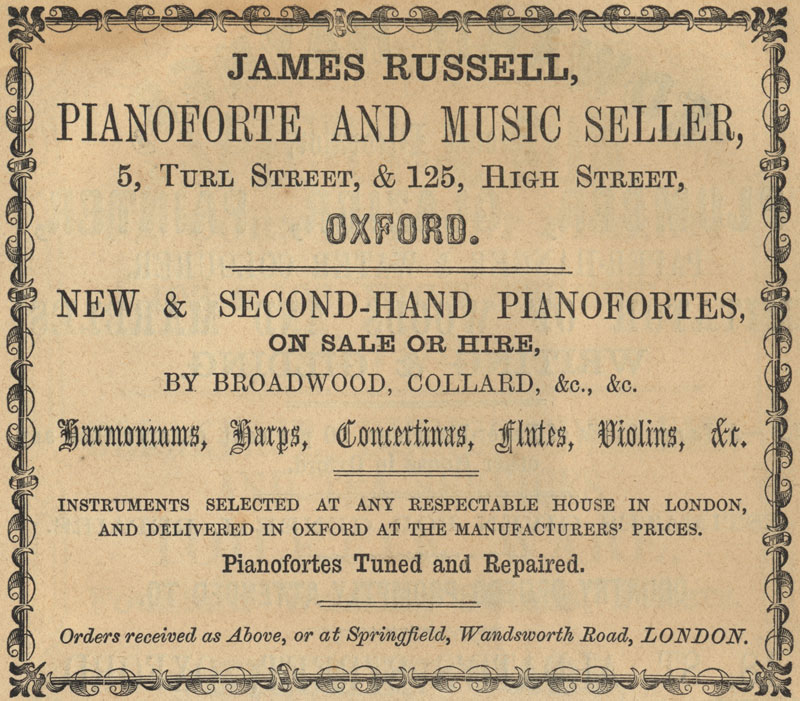
James Russell moved his business from this shop to 120 High Street in about 1866.
At the time of the 1861 census the upstairs living accommodation was unoccupied. The 1871 census shows that Charles Foster at 123/124 next door had expanded into this shop: see above.
No one lived over the wine merchant's shop at No. 125 at the time of the 1881, 1891, 1901, and 1911 censuses.
This photograph (POX0094658) dated February 1946 shows on the left No. 125 when it was occupied by the wine merchants Catle & Co Ltd.
Occupiers of 123, 124, & 125 High Street |
|||
Year |
No. 123 |
No. 124 |
No. 125 |
To 1839 |
Joseph Warne |
Foster jun. & Bailey (1837) Foster
& Co. (merged with Parsons |
William Marshall |
1839–1846 |
John Parsons (also Oxford’s main Post Office from 1839 to March 1842) Parsons & Foster Foster & Co. |
||
By 1852–1866 |
James Russell |
||
1866–1893 |
Foster & Co. |
||
1895–1931 |
Sydney
Acott & Co. later Russell Acott Ltd |
Oxford Wine Company, then |
|
1932–1939 |
Castle & Co Ltd |
||
1941–1964 |
Alkit Ltd |
||
1966–1967 |
No listing: |
||
1970–1972 |
James Walker Goldsmiths & Silversmiths Ltd Hallmark, Jewellers (1972) |
||
1973–1976 |
Check Fashions (photograph) |
||
1980s |
A. B. & J. A. Martin granted permission to make shop self-contained again (81/00363/NFH) |
? |
|
c.1990–1998 |
Jumpers Ltd |
The Body Shop |
|
1999–2006 |
Phase Eight |
All Bar One |
|
2006–2012 |
Jack Wills (Aubin & Wills in 2012) |
||
2013–2015 |
Black Sheep Galleries |
||
2015–2019 |
Whitewall Galleries |
||
2019–2021 |
Vacant |
||
2022–2024 |
Salsas Del Sol |
||
2025 |
Vacant |
Iris Galerie |
|
