

Oriel Street

Oriel Street runs southwards down to Oriel Square from Oxford's High Street, with Oriel College's Rhodes Building now on the corner to the east and 102 High Street to the west. This narrow street was the main route to St Mary Hall and Oriel College until 1873, when the latter created a new road (King Edward Street) to be a grander entrance. Oriel Street is now closed by bollards to through traffic.
The street has always been in the parish of St Mary-the-Virgin.
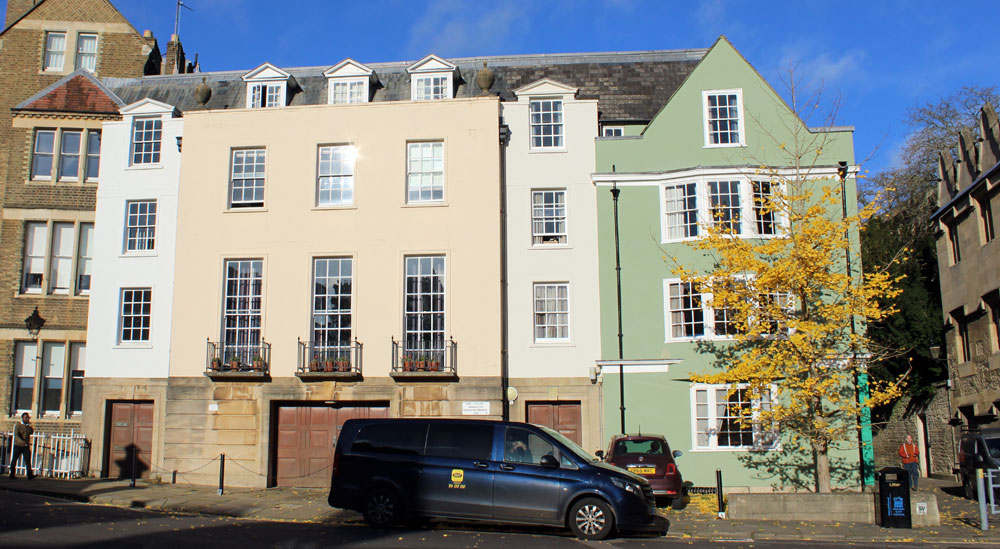
These seven houses to the south facing Oriel Square used to be considered as part of Oriel Street (the narrow road on the right), but are now numbered 1–7 Oriel Square:
Oriel Street has had two other names:
- In the thirteenth century it was known as Shidyerestreet (with other variations such as Scydiard or Schydiard Street).
- In 1577 it was Vinehall Lane.
- By 1762 it had become St Mary Hall Lane (corrupted by undergraduates into Skimmery Hall Lane). It kept this name until the 1830s.
- In 1836 the name Oriel Street came into use, but the old name of St Mary Hall Lane still lingered until 1840.
J. Gilbert said of the name Shydiard Street (in a lecture he gave about Oxford in the fourteenth century, reported in Jackson’s Oxford Journal on 13 February 1886):
The present Oriel-street was then known as Scydiard or Schydiard-street; its derivation is doubtful. Wood ascribes it to the writers on “schedes,” or parchments, a business which must have flourished considerably in Oxford before the advent of printing. Hearne, however, has this, “But I think it is the same with Shieldyard-street, and that therefore the shield makers formerly dwelt there.” He adduces no evidence for this, and it would appear to have been written rather in a spirit of contradiction, as Wood supports his statement by naming owners and dwellers whose names corresponded to their occupation.
St Mary Hall which gave Oriel Street a later name was a medieval academic hall. It was associated with Oriel College from 1326 to 1545 and then functioned independently from 1545 to 1902, when it was incorporated once again into that college.
The postcard below show Oriel Street from the south in about 1905. At this time there was a cabstand with a cabmen's shelter opposite Oriel College.

The 1772 Survey of Oxford lists the following occupants of St Mary Hall Lane (Oriel Street). The measurement of the frontages is shown in round brackets and the later house numbers in square brackets:
- East side (beginning from High Street)
Mr King (13yds 0ft 5in)
St Mary Hall (37yds 2ft 4in)
Oriel College (108yds 2ft 4in)
- West side (from High Street to Bear Lane)
[1 & 2] Mr Towsey (23yds 2ft 6in)
[3] Mr Stevens, passage (1yds1ft 0in)
[3] Mr Horsman (6yds1ft 4in) [Miss Horseman still here in 1846]
[4] Mr Spiers (6yds1ft 2in)
[5] Mr Hayes (7yds1ft 5in) [William Hayes, bookbinder still here in 1846]
[6] Mr Huff (5yds 0ft 2in)
[7] Mr Loder (5yds 0ft 3in)
[8] Mr Faulkner (7yds1ft 7in)
[9] Mr Wyat (3yds 2ft 0in)
[10] Mr Forster (3yds1ft 9in)
[13] Mr Boswell (8yds 0ft 9in)
[14 & 15] Mr Rice (12yds 0ft 8in)
The following businesses are listed under “St Mary Hall Lane” in Pigot’s Directory for 1823/4:
- Booksellers & Stationers: Thomas COMBE
Book Binders: William HAYES
Boot & Shoemakers: John HOLMES
Printsellers, Carvers, & Gilders, & Picture frame makers: John WILLIAMS
Saddlers, &c.: John LODER
Tailors & Drapers: Charles FELDON
Trunk & Packing Case Makers: J. LODER
Hunt's Directory for 1846 lists the following occupants of the west side of Oriel Street, helpfully providing the house numbers:
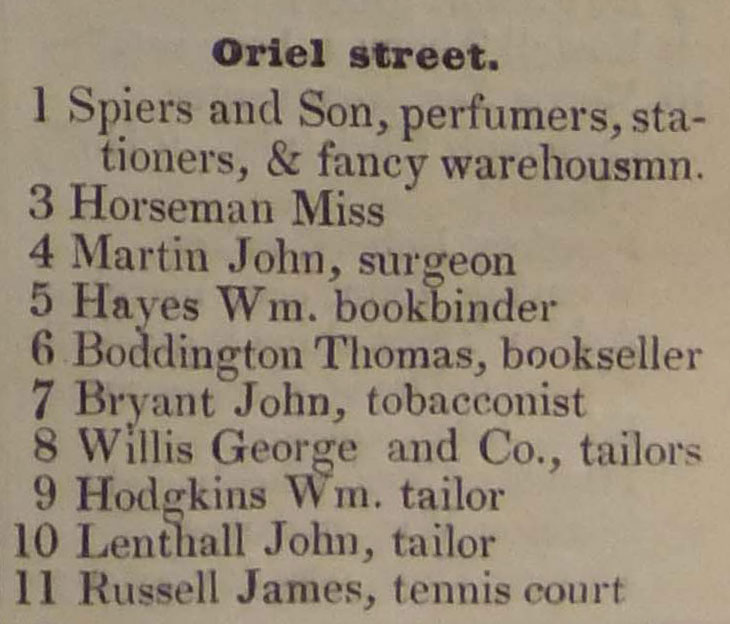
Spiers & Son at 1 & 2 Oriel Street also had the large shop at 102/103 High Street around the corner.
The tennis court and theatre in Oriel Street
There was a real tennis court at the south-west end of Oriel Street (on the site of Oriel College's present Harris Building) as early as 1577. In the following century Charles I and Prince Rupert played tennis here.
In the early nineteenth century John Hardaway was master of the tennis court in Oriel Street, and died there at the age of 73 on 8 February 1812.
Oxford's first theatre opened at this tennis court on the evening of Monday 1 July 1833, and its address was given as St Mary Hall Lane: it ran simultaneously with the tennis court, as it only operated during the vacation. When the theatre moved to George Street in 1836, the tennis court continued to operate as 11 & 12 Oriel Street. James Russell is listed as its proprietor in Hunt's Oxford Directory for 1846, and the 1851 census shows him described as a tennis court keeper and living on the premises with his wife and six children and his niece, plus three servants(a young man who was probably his assistant and another who was a marker at tennis, plus a girl who was a general servant).
On 25 July 1857 Jackson's Oxford Journal announced that “an elegant THEATRE has been erected by Mr. Jones, of Oxford, in RUSSELL'S TENNIS COURT, and that the Theatre Royal would open there on 3 August. Again this second theatre only operated during the vacation, and the tennis court continued to operate during the university ter. On 29 October 1859 the Oxford Journal reported that the Prince of Wales had the previous Tuesday “paid a visit to Russell’s tennis court, in Oriel-street, and played at tennis there for some time”.
This second theatre building closed permanently at the beginning of August 1859, and Russell's termtime tennis court appears to have closed at the same time, as the 1861 census shows James Russell as a billiard-room proprietor living on the Iffley Road.
Listed buildings in Oriel Street |
|
West side, running north to south |
East side, running south to north |
There is a plaque on a house on the west side of Oriel Street that was restored and renamed Carter House after Jimmy Carter, former President of the USA.
The painting below by William Matthison shows Oriel Street in the early twentieth century.

