

95–101: Rhodes Building, Oriel College

Oriel College's Rhodes Building of 1911 was designed by Basil Champneys and built by John Wooldridge and George William Simpson of Frenchay Road. It is Grade II* listed (1046662).
It was paid for by a bequest of Cecil Rhodes, who had been an undergraduate at Oriel. It occupies the whole site between Magpie Lane (formerly Grove Street) and Oriel Street. The college cleared the site by demolishing the seven houses (with shops on the ground floor) at 95–101 High Street. It was opened by the Provost of Oriel, Dr Charles Lancelot Shadwell, on 28 September 1911 (see photographs in the Oxford Journal Illustrated of 4 October 1911).

There is a statue of Cecil Rhodes (above) high up over the central doorway of this building, and an independent commission set up in June 2020 has recommended its removal: more details on this page.
There are six other life-size statues on this building, sculpted in Portland stone by Henry Alfred Pegram. The two shown above each side of the window below Rhodes are of King Edward VII and King George V, chosen because the former died and the latter came to the throne in the year the building was being erected (1910). The other four are former heads of the college: Cardinal William Allen (1532–94, Fellow 1550, Principal of St Mary's Hall); Walter Hart or Lyhert (Provost 1435–46), John Hales (Provost 1446–9); and Henry Sampson (Provost 1449–76). All seven statues are pictured here.
The inscription under the central statue of Rhodes reads: E:LARGA:MVNIFICENTIA / CAECILII:RHODES. As well as acknowledging Cecil Rhodes’ munificence, the large letters in that inscription are a complicated chronogram which, when shuffled, gives the date of the building, MDCCCLLVIIIIII. (Normally the date 1911 in roman numerals would be the much neater MCMXI.)
This building was not generally regarded as an improvement to the street:
- Soon after its completion in 1911, Oriel College's Treasurer L. L. Price noted “most people would I think agree that the compromise … is unpleasant”.
- In his memoirs of 1927, W. E. Sherwood wrote that Oriel had “broken out into the High, … destroying a most picturesque group of old houses in so doing, and, to put it gently, hardly compensating us for their removal.”
- In 1930 Evelyn Waugh went further and suggested blowing the building up.
- In 1965 James/Jan Morris wrote in Oxford: “If you are very old indeed, you are probably still fuming about the façade built in the High Street by Oriel College in 1909, which most of us scarcely notice nowadays, but used to be thought an absolute outrage.”
See Edward Impey, “The Rhodes Building at Oriel, 1904–2011: Dynamite or Designate?”, Oxoniensia 76 (2011), 95–104
(online here as a PDF).
In 2015 a new "origami" roof was added to the Rhodes Building to create an extra floor.
The seven shops on this site at 95–101 High Street that were demolished by Oriel in c.1910
No. 95
The 1841 census shows Sarah Steele, described as independent, living here with three young children, two lodges, and two servants.
At the time of the 1851 census the watch & clockmaker Robert Milne lived here with his wife Mary and their son plus three servants and a student lodger.
The 1861 census shows the jeweller Abraham Zacharias living here with his wife Leah and their six children, plus two servants. They were still here in 1871.
The 1881 census shows John Chapman (54), a carver in wood, living here with his wife Mary Ann and one servant. They were still here in 1891 when Chapman was described as a stationer and well as a carver in wood, and his niece Rosina Hanger (18) who was a shop assistant, also lived with them
By 1900 this was the milliner's shop of Ada K. Baughan, and the 1901 census shows Miss Baughan (40) living over her shop with her housekeeper.
Bates & Co. is listed over the door in this 1909 photograph taken just before demolition, but it is not mentioned in directories
No. 96
The 1841 census shows the confectioner Henry Jubber living here with his wife Mary and their baby daughter, plus four lodgers, two bakers, a shop man, and five servants.
At the time of the 1851 census the bookseller Edwin Thomas Spiers (42) lived here with his first wife Elizabeth and their son George, plus a servant and an undergraduate lodger. In 1861 census he was here with his second wife Charlotte Matilda and his stepchildren Edwin and Matilda Sheard, plus one servant. By 1871 Edwin and his family occupied the upstairs premises of both 96 & 97.
At the time of the 1881 census the confectioner Henry Wells Hippey lived here with his wife Sarah and their two children, plus a servant.
The 1891 census shows Alfred E. Hunt (34), a lodging-house keeper, with his wife Kate and their two young children plus a general servant and a nursemaid.
By 1895 this was the stationery shop of Joseph Vincent and Hall Bros., tailors were upstairs. The 1901 census recorded this as a tailor's shop and a stationer's shop and stated that no one was living on the premises. At the time of the 1901 census the lodging-house keeper Rachel Haylett (44) lived here with one lodger and one servant.
No. 97
The 1841 census shows the tailor Charles Feldon living here with his wife Elizabeth and seven children, plus three servants.
At the time of the 1851 census the confectioner William Brown (44) lived here with his wife Sarah and their four children.
The 1861 census shows the confectioner Henry Tombs (24), described as a servant, living here with a shop assistant and a housekeeper.
At the time of the 1871 census No. 97 was jointly occupied with No. 96 by Edwin Thomas Spiers (see above).
By 1880 the tobacconist William Hedderly had both this shop and No. 98 next door. The 1881 census shows Elizabeth Green (50), described as the wife of the householder and a lodging-house keeper, living over the two shops with her four daughters. By the time of the 1881 census Elizabeth was a widow, living here with her daughter Catherine and her baby grandson Albert Cook, plus a servant and still running a lodging house. She was still here in 1901 with her widowed daughter Bessie Cook and her two children, plus a servant and two lodgers running university lodgings here.
No. 98
The 1841 census shows the confectioner Ann Davis living here with Elizabeth and Stephen Davis(probably her children) a servant, and two lodgers.
At the time of the 1851 census the tailor & draper Charles Robinson (35) lived here with his four young children and a housemaid and 14-year-old nursemaid.
The 1861 census shows the tobacconist George Davis (33) living here with his wife Esther and their five children.
At the time of the 1871 census this house was listed as unoccupied.
By 1880 the tobacconist William Hedderly had this shop and No. 97 next door. The upstairs were university lodgings run jointly with No. 97: see above.
The 1891 census shows No. 98 (as well as 99 & 100) in the process of being rebuilt. No one was living here at the time of the 1901 census.
No. 99
By 1772 the Bayne family of cutlers had this shop. At the time of the 1841 census John Bayne lived here with Elizabeth and Mary Bayne (probably his wife and daughter). Lodging with them in a separate part of the house were the cook Standish Betteris, who had married another Elizabeth Bayne in 1837 with the said Elizabeth and their daughters plus their servant and a student lodger.
The 1851 census shows Standish Betteris (42), who was now a cutler, still living here with his wife and daughters, and his sister-in-law Mary Ann Bayne, plus a servant and a student lodger.
By 1861 this was the District Savings Bank and the 1861 census shows the college servant Walter Green (35) living on the premises with his wife and three children, plus a lodger.
At the time of the 1871 census No. 99 was occupied by the widowed haberdasher Mary Ann Wells (75) and her daughters Emma and Katharine, plus their servant. She was still here in 1881, with her sister Katherine, and was now described as an ecclesiastical embroidress.
The 1891 census shows No. 99 (as well as 98 & 100) in the process of being rebuilt.
At the time of the 1901 census the art embroideresses Ada Davis (27) and her sister Selina Davis (24) lived here with their servant.
No. 100
By 1839 the jeweller Thomas Roberts had this shop, and the 1841 census shows him living here with the engraver Thomas Roberts junior pus their servant and two lodgers. He was still here at the time of the 1851 census when he was aged 75, and his his brother William Roberts (73) who was a tailor, and their niece Elizabeth Roberts who acted as their housekeeper lived with them. In 1861 Thomas Roberts (85) was still listed as the jeweller here, and the carpenter William Lloyd (62) and his wife also lived on the premises. Roberts died near the end of 1863.
At the time of the 1871 census No. 100 (together with No. 101) was occupied by the chemist Edmund Lilley Hitchcock (23), who was the son of the householder.
At the time of the 1881 census the upstairs premises of No. 100 & 101 were occupied by the tailor William Charles Adamson (38) and his wife Julia and their servant.
The 1891 census shows No. 100 (as well as 98 & 99) in the process of being rebuilt. In the 1901 census it was described as an optician's shop, but no one lived on the premises
No. 101
In 1756 the city council gave Charles King permission to hang out a sign saying King's Coffee House here
The chemist David Morphew announced in Jackson’s Oxford Journal of 16 December 1832 that he was retiring through ill-health, and that his successor in business at this shop would be James Spiers. Spiers is duly listed here as a chemist in Robson's 1839 directory and the 1841 census shows him living here with his assistant John Deane. Then on 28 August 1841 James Spiers announced in turn that he had retired and that his successor would be Henry Brown.
At the time of the 1851 census the chemist Henry Brown was living here with his wife Ann and their two children, plus two assistant chemists who worked for him in the shop and two servants.
The 1861 census shows William Garrard. a chemist who employed one man and two boys, living here with his wife Frances plus an assistant and two servants.
At the time of the 1871 and 1881 censuses No. 101 was occupied jointly with No. 100: see above.
There was no listing for this house in the 1891 census.
In the 1901 census it was described a photographer's shop and lawyers' offices, but no one was living on the premises.
All of these shops were demolished by Oriel College in 1910.

The row of seven shops that this building replaced were all in the parish of St Mary-the-Virgin. The above photograph shows them in 1910 when they were soon to be demolished, and several of the shops have a sign in the window saying “PREMISES COMING DOWN”. From left to right they are:
- No. 95, the tall, four-storey, narrow shop on the corner of Magpie Lane, with BATES & CO over the door
- No. 96, a wider, shorter three-storey building the width of four sash windows, with the name of the cutler F. T. LONG over the door and window of the first two bays.
- Then there is another doorway labelled 96½, leading to the university lodgings upstairs, and to the right of that doorway there is narrow shop window presumably belonging to Long the cutler with FUJIYA advertised over it: this appears to be a type of cutlery
- No. 97, a taller, four-storey building just one window wide, marked Hedderly, a tobacconist & cricketing outfitters
- No. 98, a shorter shop, two bay windows wide, also marked Hedderly
- No. 99, a narrow shop, just one window wide: this was Mrs Davis's ecclesiastical warehouse, but the sign is hard to read. On the first floor is a sign for the Perth Dye Works.
- No. 100 & 101, a large four-storeyed building, two bay windows wide, on the corner of Oriel Street. This is divided into separate shops: on the left at No. 100 is SAUNDERS, an optician, and on the right at No. 101 is SOAME, the photographer and picture frame maker. On the first floor of the latter is James Langley, solicitor & commissioner for oaths, with his details painted on the window: two men are looking out of this window at the photographer.
There is a similar photograph by Henry Taunt of this row of houses.
This photograph by F. A. Bellamy shows Nos. 95 & 96 on the left just prior to demolition.
The shops on this site between 1772 and 1910
The 1772 Survey of Oxford shows that the seven shops on this site were occupied as follows: Craddock (95), Morton or Morten (96), Court (97), Buck (98), Bayne (99), Johnson (100), and King (101). James Woodforde records how on 13 February 1776 he paid Bayne[s] 0 : 2 : 6 for a new razor.
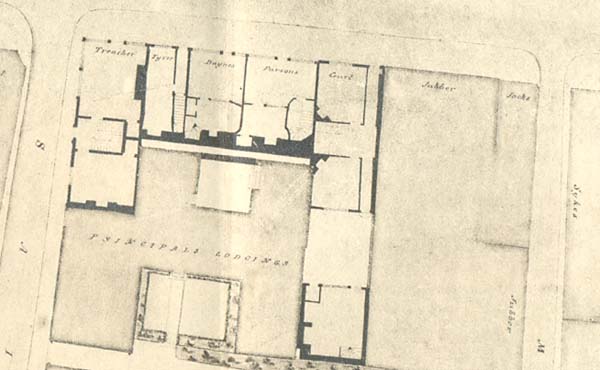
The extract from an Oriel College plan of 1814 below shows the seven shops between Oriel Street (left) and Magpie Lane (right) and their occupiers at that date, namely (right to left on the plan): Jacks (95), Jubber (96), Court (97), Parsons (98), Baynes (99), ?Tyrer (100), and Treacher (101). Both Baynes and Jubber were still occupying these shops in 1839.
The ecclesiastical warehouse based at No. 99 in this row may well have been in the mind of Thomas Hardy when he wrote Jude the Obscure in 1895. Jude’s cousin Sue Bridehead who lived in Oxford was:
an artist or designer of some sort in what was called an ecclesiastical warehouse, which was a perfect seed-bed of idolatry… The shop seemed to be kept entirely by women. It contained Anglican books, stationery, texts, and fancy goods; little plaster angels on brackets, Gothic-framed pictures of saints, ebony crosses that were almost crucifixes, prayer-books that were almost missals.
Several of the businesses that once operated in this row of shops and are shown in the table below later flourished elsewhere in Oxford:
- Adamson & Co. Tailors moved across Oriel Street to huge new premises at 102/103 High Street in 1891;
- Hall Bros Tailors moved to 94 High Street and later to 119 High Street;
- Joseph Vincent moved to 109 High Street;
- The junior photographer James Soame joined up with Gillman to form Gillman & Soame, the photographic firm that still survives today.
Occupiers of the site
of 95–101 High Street |
|||||||
Date |
95 High St |
96 High St |
97 High St |
98 High St |
99 High St |
100 High St |
101 High St |
1772 |
Craddock |
Morten |
Court |
Buck |
BAYNE family, cutlers, Mary Bayne Charles Bayne John Bayne Ann Bayne Mary A. Bayne (1852) |
Johnson |
Charles King |
1814 |
Jacks |
Henry Jubber |
Parsons |
Tyrer[?] |
Treacher |
||
1839 |
John Bellman |
Charles Feldon |
Ann Davis |
Thomas
Roberts |
James Spiers |
||
1846 |
Joseph Steele M. R. King |
E. T. Spiers Later (Moved next door in 1859 and gave up the bookselling) |
Charles Wyndham Robinson |
Henry Brown |
|||
1852 |
Robert Milne, Watch & clock maker, silversmith, jeweller & engraver to March, then James Sheard |
Charles Joseph Sweetinburgh |
|||||
1861 |
Abraham Zacharias |
E. T. Spiers
|
George Davis |
District Savings Bank |
William Garrard |
||
1876 |
George P. Day |
Flack & Smith With |
John King |
Mrs Wells The Misses |
Adamson
& Co. |
||
1880 |
John Chapman |
HEDDERLY
William Hedderly
William Hedderly,
William Hedderly |
|||||
1884 |
Page & Slade |
||||||
1887 |
Slade & Co |
||||||
1889– |
W. G. Hooper |
||||||
1893 |
Arthur Richardson
Joseph Vincent |
Mrs Henrietta Armstrong |
Edwin Saunders |
Oriental Art Company |
|||
1894 |
Mrs Carter Upstairs: University lodgings |
||||||
1895– |
George Richard Beesley |
Mrs Ellen Davis |
James Soame |
||||
1900– |
Miss Ada K. Baughan |
||||||
1904 |
Miss Smith, M.A. |
||||||
1905– |
Frank Thomas Long |
||||||
1909 |
No listing |
||||||
1910 |
No listing: Building work |
||||||
Since |
Rhodes Building, Oriel College |
||||||
