

Nos. 68–74: Extension to Taylorian

This large extension to the Taylor Institution was built in two phases in the 1930s on the site of six houses and a yard. It was designed by Harold Hughes and made of Bath, Portland, and Clipsham stone. It is Grade II listed (List Entry No. 1369442).
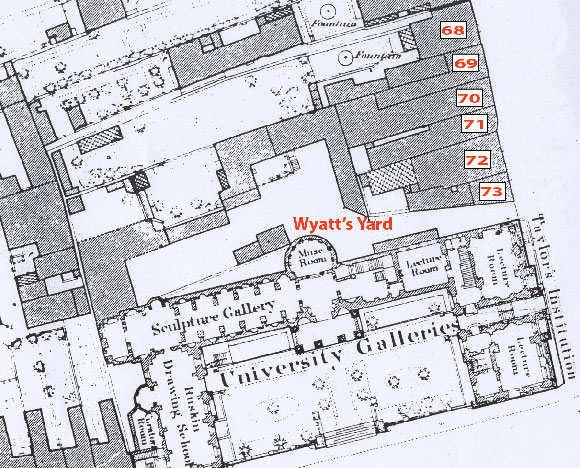
The plan below shows the six St Giles' Street houses in St Mary Magdalen parish that were demolished for this extension. No. 68 was evidently a grand house, with a fountain in the garden. (Wyatt's Yard to the south of No. 73 had already been sold to the University in 1883.)
The photograph below (Historic England HT03433) was taken by Henry Taunt in 1880 and gives a glimpse of this group of houses just to the north of the old Taylorian building of 1845.
The former 68 St Giles' Street
The solicitor George Rackstrow lived here from at least 1839 to 1852. The 1841 census shows him here with his wife Jane and their four children, plus two female servants. They were still here in 1851 with three of their children and one servant.
By 1854 the accountants Hawkins & Sylvester were based here. The 1861 census shows the accountant Thomas Hawkins (58) living here with his wife Ann and their three children, plus a servant. They were all still here in 1871, and in 1881 they were here with two children. Thomas Hawkins died here at the age of 82 on 15 October 1885, and his widow Anne remained at No. 68 until her own death on 7 March 1890.
The house was listed as unoccupied at the time of the 1891 census.
The Oxford Cycle Company was here from 1895, The advertisement on below, taken from the University Calendar of 1897, shows this business at 68 St Giles:

The business became the Oxford Cycle & Motor Car Co in 1900, and the 1901 census the cycle & motor car agent & repairer William Frederick Parker (40) lived here with his wife Martha and their five children, plus a monthly nurse for the new baby and a servant. The family was still here in 1911. The photograph below (Historic England CC51/00671) dates from this period:
By 1921 his business was called Oxford Motors Ltd. The 1921 census shows William Frederick Parker (61), described as the manager of that business, still living at No. 68 with his wife Martha and three of their children: John (25) and Frederick (20) both worked in the motor trade, and John's twin Lillian had home duties. Tey had one servant.
The northern side of the Taylorian extension could not be built until 1938 when the leases of Nos. 68 and 69 ran out.
The former 69 St Giles' Street
The 1841 census shows the upholsterer William Taylor living here with his wife Maria and their servant. On 6 July 1844 he announced in Jackson's Oxford Journal that he was about to give up running his household furniture warehouse here after 25 years, and offered his stock for sale. He also stated that his house with workshops at No. 69 was now to let (as well as his warehouse, yard, and brewhouse in Walton Place). He appears to have remained here until his death in 1846.
On 6 May 1848 Joseph J. Hemmings announced that he was opening a grocery shop here with the assistance of his second son. This was very short-lived, and on 13 October 1849 Isaac West advertised that he would be opening a chemist's shop here. The 1851 census shows the master chemist & druggist Isaac West (28) living here, and in a separate household was the gentlewoman Miss Martha Miller (55) with her sister and a servant.
The 1861 census shows the unmarried draper Caleb Bolton (32) living here with his two assistants and a servant. He married Martha Early in 1863, and in 1871 he was here with his wife Martha and two apprentices, plus a servant. In 1881 he stated that he was a master draper employing three women and two boys, and was living here with his wife and three draper's shopmen (two of him his nephews) and their servant.
In 1891 the stationer Michael Angelo Alfred Mathews (69) lived here with his daughter Henrietta (44), who was described as a stationer's assistant.
In 1901 the printer & stationer at No. 69 was Louis R. Vincent (46), who lived here with his wife Elizabeth and their baby daughter, plus a 13-year-old servant girl.
The building is not listed in the 1911 census.
The 1921 census shows the printer and employer Frederick Ferris Vincent (58) living here at No. 69 with his wife Mary (53) and their son the Revd Edgar Court Baxter Vicent (28) and their daughter Winifred Elaine Vincent (19), who was in full-time education.
Occupants of 68 & 69 St Giles' Street listed in directories |
||
Date |
68 St Giles |
69 St Giles |
1839–1846 |
George
Rackstrow |
William Smith
Taylor |
1848 |
Joseph J. Hemmings |
|
1849–1852 |
Isaac West |
|
1859 |
Hawkins
& Sylvester |
William Baker |
1861–1882 |
Caleb Bolton |
|
1884–1890 |
David Price
Clifford |
|
1891 |
— | Michael
Angelo Alfred Mathews |
1893–1894 |
Oxford
Cycle Co. |
|
1895–1925 |
Joseph
Vincent |
|
1926–1934 |
Archibald
G.H. Lambert |
|
1935–1937 |
Halifax Building
Society |
|
1937 |
Demolished to make way for the Taylorian extension, Phase II |
|
Nos. 70, 71, 72, & 73 (demolished in the first phase of 1931/2)

Four houses (Nos. 70–73) were demolished in December 1931 to make way for the southern part of the new extension: they can be glimpsed in the picture on the left, separated from the main Taylorian building by Wyatt’s Yard
The entrance to the old Wyatt’s Yard (which was given the number 74 when all the houses to the south were demolished to make space for the old part of the Taylorian) is now a side entrance to the Taylorian between the original building and the first extension.
The first section of the new extension was opened by the Prince of Wales (the future Edward VIII) on 9 November 1932, and there is a bust of him inside the building
H. E. Salter in The Oxford Deeds of Balliol College lists the occupants of No. 74 during the period it owned it, and incidentally names its neighbours at No. 73 to the north.
The detail below from an engraving of 1853 shows the entrance to Wyatt’s Yard and No. 73, now part of the site of the extension.

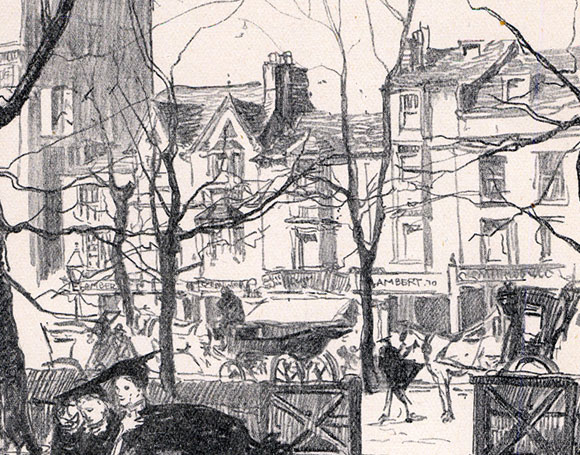
The engraving below (made by Frederick Charles Richards in about 1912) shows the shops that were demolished in 1931 to make way for the first Taylorian extension. The shop names that can be read are Lambert at No. 73 on the left (next to the old part of the Taylorian) and Lambert again with the number 70 three doors to the north. The shop on the right (No. 69) was spared until its lease ran out in 1937.
The former 70 St Giles' Street
The 1841 census shows the gilder Thomas Dodd as well as the livery stable keeper William Smith living here with his wife Margaret and their five children, the eldest of whom, George, was his apprentice.
On 27 April 1850 the ironmonger George Wyatt announced that he had moved here from No. 67, and the 1851 census duly shows him here at the age of 46, described as the employer of four men and one boy, with his wife Martha and their three children, plus two servants. They were all still here, in 1861, with a fourth child. In 1869 Wyatt moved into No. 67 (which he had just rebuilt along with No. 66).
On 25 February 1871 Miss Mary Procter announced that she was moving her “millinery & mantle magasin” here from 13 St Giles' Street. The 1871 census duly shows her living here with her sister Harriet Procter and their assistant, their saleswoman, and their general servant. In 1881 they described themselves as mantle, dress, & millinery makers and they lived here with their four assistants and their cook and housemaid. They were still here in 1891 with three dressmaker's assistants, a milliner' s assistant, and a showroom assistant, plus their cook and housemaid. Miss Procter gave up the business in 1892, and on 24 September that year a forthcoming auction of the shop fixtures and fittings was advertised.
By July 1899 the widowed boot & shoemaker Mrs Agnes Martha Lambert had moved her shop here. The 1901 census shows her living here at the age of 59 with her daughter and grandson, plus a boarder and a servant. Her son Francis William Lambert died here on 7 July 1899.
On 7 April 1900 while Mrs Lambert was in residence a forthcoming auction of her shop and No. 71 next door under the terms of the will of Mrs Radford. Mrs Lambert was still here with her daughter Eveline and a servant in 1911. The 1921 census again hows Mrs Lambert (80) living here with Eveline (52); both were described as boot & shoe sellers and employers on these premises.
Mrs Lambert died at the age of 83 near the end of 1924, and her daughter Eveline took over the business until 1930, when their shop was demolished to make way for the extension to the Taylorian.
The former 71 St Giles' Street
The 1841 census shows the baker Robert Vaughan here with Fanny Sheard and what appear to be her two daughters.
In 1851 the confectioner Robert Drewett, a widower of 51 who employed two men, lived here with his two children, a confectioner's apprentice, and two house servants, plus a 67-year-old lodger. On 19 June 1852 Drewitt announced that owing to ill health he was declining business in favour of Henry Edward Morgan, junior.
Morgan went bankrupt in 1860, and on 17 November that year the baker & confectioner George Grace announced that he was moving from No. 32 to more commodious premises here. The 1861 census duly shows him at the age of 28 living here with his wife Elizabeth and their three children, plus an assistant, an apprentice, and two servants.
By 1864 the confectioner Josiah Arnett had the shop here, and the 1871 census shows him at the age of 25 living at No. 71 with his wife Ellan and their three children, plus a lodger and a servant. On 12 April 1873 a forthcoming auction of the premises was advertised when Arnatt was in occupation:
All that DWELLING HOUSE and Business Premises, known as No. 71 St. Giles's-street, immediately opposite St. John's College, comprising a commanding front shop and back parlour on the ground floor, front sitting room and two bed rooms on each of first and second floors, with kitchen and other offices in the basement, approached through a private entrance from the street, and also leading to the business premises at the back, comprising bakehouse with a nine-bushel oven, store room, and two bed rooms over, with separate staircase; large scullery, coal-house, and yard, with pump and well of excellent water, the whole extending a depth of 80 feet, with a frontage to the street of 16 feet 9 inches.
Arnatt announced on 27 September 1873 that he was moving to 98 St Clement's Street.
The cooks & confectioners A. & W. Boffin were here by 1875, but at the time of the 1881 census only a shopwoman and a housemaid were at home.
The 1891 census shows the widow Charlotte M. Clear living here with her servant. Two other separate households here comprised a confectioner's assistant and a student.
On 7 April 1900 while Boffin's was in occupation a forthcoming auction of this shop and No. 70 next door under the terms of the will of Mrs Radford.
No. 71 was still Boffin's confectionery shop at the time of the 1901 census, and Alice A. Long (28), the manageress of the shop, lived here with her shop assistant. A separate part of the house described as 71A was occupied by Henry Smith (86), Secretary of the Oddfellows, and his wife Rose, plus their servant.
In 1911 No. 71A was occupied by the Hungarian ladies' tailor Joseph Geiger (52) and his boarder and housekeeper.
The 1921 census lists Theodore William Chaundy (32), a Mathematics don at Christ Church, living on the premises of the Boffin's shop with his wife Hilda (31).
Boffin's had to leave in 1930 so that the building could be demolished.
The former 72 St Giles' Street
Nos. 72 and 73 St Giles were tenements of Christ Church, and in 1829 they were leased to Mrs Dodd. The occupiers were then Mrs Skidmore, Peckover & Bateman, Munt, and William Hemmings.
The 1841 census shows the land surveyor John Allen living here with their own four children, two other children with the surname Guest, and an independent lady with what appear to be her two children, another male lodger, and a young baker.
At the time of the 1851 census John Richard Carr (40), the managing agent of an attorney, lived here with his wife Elizabeth and their four children, plus a servant and a two lodgers. His address was wrongly given as 72 Magdalen Street. Elizabeth Carr died here on 8 August 1854. He was still at 72 St Giles' Street in 1861 with his second wife Hannah and one of his sons, plus their servant. By 1871 all the children had left home and they were here with three servants (a cook, housemaid, and groom).
By 1880 the foreign fruiterer & Italian warehouse man Edwin F. Greenwood had taken over this shop, and he can be seen here in the 1881 census with his wife Florence and their three young children, plus two servants and a lodger. They were still here in the 1891, 1901, and 1911 censuses, but his shop is no longer listed in directories after 1916.
From 1923 the watchmaker Roland B. Bennett had his shop here, but he had to leave in 1930 so that the building could be demolished.
The former 73 St Giles' Street
The 1841 census shows the cordwainer Charles Goffe here with his wife Fanny and their three children, plus a college servant and apprentice shoemaker and their servant.
On 23 February 1850 Enock Pettyfer announced that on that day he had opened these premises adjoining the Taylor Gallery and had a choice assessment of foreign fruits, and was also a tea & coffee agent and a dealer in cigars. The 1851 census shows him living here at the age of 23 with his wife (wrongly giving the address as 73 Magdalen Street. The Misses Mary & Emily Dumbleton, dressmakers; and the engraver, printer, & stationer Michael Matthews and his wife and daughter comprised another two households on the same premises.
By 1860 the foreign fruiterer Elisha Ball Workman had taken the shop over and the 1861 census shows him at the age of 37 living here with his wife Elizabeth, and the situation was the same in 1871.
In 1876 the foreign fruiterer & Italian warehouse man Edwin F. Greenwood briefly took over this shop before moving to No. 72 next door.
The building was described as unoccupied at the time of the 1881 and 1891 censuses, and was not listed in 1901 or 1911. The Lamberts had a second shoe shop here from 1899, but had to leave in 1930 so that the building could be demolished.
The former 74 St Giles's Street (Wyatt’s Yard)
Wyatt's Yard was set back from St Giles' Street, with an entrance between No. 73 and the older part of the Taylorian. As can be seen from the street plan at the top of this page, there was a house in that yard, which was numbered 74.
Margaret Wyatt, widow of the mason & builder Thomas Wyatt, had announced in Jackson's Oxford Journal on 31 March 1827 that she intended to continue his business, aided by her son and able assistants.
The 1841 census shows her described as a builder and living in St Giles' Street with her daughter Charlotte, two servants, and two lodgers. Hunt's Directory for 1846 lists her without a number between No. 73 and the Taylor Institution.
The 1851 census lists Mrs Wyatt between No. 73 and the Taylor Building and gives correctly gives her number as. 74, but wrongly names the street as Magdalen Street. She was then a builder employing 20 men, and her three unmarried daughters Elizabeth (43), Charlotte (32), and Eliza (29) lived with her.
At the time of the 1861 census Mrs Wyatt (78) was correctly listed at 74 St Giles' Street (between No. 73 and the Taylor Building). She was described as the employer of 56 men, and only one of her daughters, Charlotte, was now living with her, plus a servant.
Mrs Wyatt died here on 23 May 1865, and her effects came to nearly £12,000. Her son George Wyatt took over the business, and from 1866 it was listed in directories as George Wyatt & Son (masons & builders).
George Wyatt died on 15 February 1872 and his son Thomas Alder Wyatt took over the business. On 24 February 1872 he put the following announcement in Jackson's Oxford Journal:
THOMAS ALDER WYATT respectfully announces that he succeeds to his late Father’s Business of a BUILDER, and to the Buildings, Builder’s Yard, and Stock-in-Trade at No. 74, Saint Giles’ Street, Oxford; and he trusts, by personal assiduity, and the aid of his Staff of skilful and experienced Workmen, to retain his late Father’s connexion, and to extend it. This department of the Business will be conducted, as heretobefore, under the name of "George Wyatt and Son."
The 1871 census shows the builder Thomas Alder Wyatt (35) living at No. 74 here with his wife Susanna and their servant. He was still here in 1881, when he was described as the employer of 60 men.
Less than two years later Thomas Alder Wyatt sold 74 St Giles' Street and its large yard to the University of Oxford for £7,000, and the following notice appeared in Jackson's Oxford Journal on 24 February 1883:
UNIVERSITY INTELLIGENCE.
AUTHORISATION OF PURCHASE.—In the same Convocation [held on 20 February 1883] it was resolved that the Curators of the University Chest be authorised to purchase the builder's yard and premises, No. 74 St. Giles's, Oxford, adjoining the University Galleries and Taylor Institution on the north, from Mr. Thomas Alder Wyatt, for the sum of 7000l. The Dean of Christ Church [Henry Liddell] advocated the purchase, in order to secure control of lights and to diminish the chances of conflagration. Mr. Wyatt had offered the yard in 1874 for 5000l., but then he was to retain it for his business for eight years. This eight years' occupancy he estimated at 2000l. The price was, of course, an accommodation price, but for that not excessive Mr. Robinson explained that the money could only be found by borrowing from an appropriated fund, say the Bodleian, and paying off principal and interest in 30 years by an annual sum diminishing gradually from 400l.In the same edition a forthcoming auction of all the stock was advertised, and Thomas Alder Wyatt (who had no children) announced that henceforth the builder's business would be carried on at 67 St Giles's Street by his (half-) brother William West Wyatt. On 7 July 1883 another auction was announced, this time of the materials of the carpenters' shops, saw pit, and other sheds and offices in the yard.
Occupants of 70, 71. 72. & 73 St Giles' Street listed in directories to 1930 |
||||
Date |
70 St Giles |
71 St Giles |
72 St Giles |
73 St Giles |
1839 |
William Smith |
Robert Vaughan |
— | Charles Goffe |
1841–1846 |
Robert
Drewitt H. E. Morgan |
John
Allen |
John Dewe |
|
1851 |
— | |||
1852–1860 |
George
Wyatt |
— | — | |
1860 |
George Grace |
John
Richard Carr |
Elisha
Workman |
|
1864–1869 |
Josiah
Arnatt |
|||
1871–1872 |
Miss
Mary Ann Proctor |
|||
1875 |
A.
& W. Boffin |
|||
1876 |
E. F. Greenwood |
|||
1880 |
Edwin F.
Greenwood |
T.
Smith |
||
1882–1891 |
Miss Lambert |
|||
1894–1895 |
Mrs
Agnes Lambert |
Artists’ Studio: |
||
1896–1898 |
W. Howe Nurse |
|||
1899–1916 |
Mrs Agnes
Lambert |
|||
1918 |
— | Archibald
G.H. Lambert |
||
1919–1922 |
St Giles Blue Triangle Club (YWCA) |
|||
1923–4 |
Roland
B. Bennett |
|||
1925–1930 |
Miss Eveline
Lambert |
|||
1931 |
Demolished to make way for the Taylorian extension, Phase I |
|||