Oxford Inscriptions: City Coat of Arms

The coat of arms of the City of Oxford appears throughout the city. The above example, which is on a sign that used to be to the right of the main gates of Headington Hill Park, has been selected because usually only the shield is shown.
The coat of arms is canting, as the central shield (Argent an Ox Gules armed and unguled Or passing over a Ford of Water in base barry wavy Azure and Argent) depicts a visual pun on the city's name (an ox crossing a ford), which is first found on a fourteenth-century Oxford seal. Beneath is the city motto FORTIS EST VERITAS [Truth is strong].
The Crest above the shield is unique and as it was was granted to the city by Queen Elizabeth I it shows:
A
lion wearing an imperial crown and holding a Tudor rose, and dotted with blue fleur-de-lys
(on a Wreath of the Colours a demi Lion rampant guardant Azure crowned with an Imperial Crown proper holding between the paws a Rose Gules charged with another Argent)
The meaning of the supporters of the shield is uncertain, but they may have been taken from the coats-of-arms of two members of the court of Elizabeth I who spent a week at Christ Church, Oxford in 1566, namely:
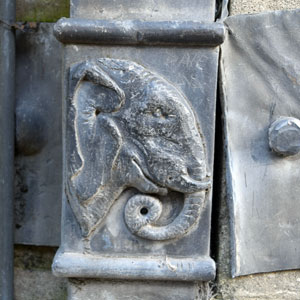
- Elephant
(Elephant Ermines eared Argent tusked Or collared and lined Or)
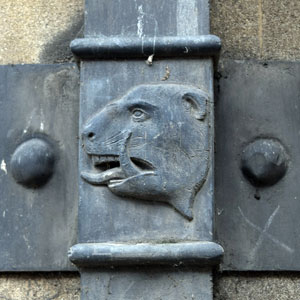
From the arms of Sir Francis Knollys (d.1596), High Steward of the City, Lord Lieutenant, and MP for the County - Beaver
(Beaver Vert its tail barry wavy Azure and Argent ducally gorged and lined Or)
From the arms of Henry Norreys (d.1601), Captain of the City Militia, Sheriff of Oxfordshire, and MP for the County
The arms, crest and supporters as shown above were recorded by the Heraldic Visitation of 12 August 1634.
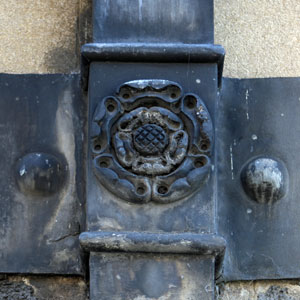
Naturally the City coat of arms appears over the main entrance of Oxford's Town Hall (complete with motto and the date A.D. 1895), but the ornate support brackets that hold in place the three downpipes on each side of the main entrance have carvings of element of the arms: elephants, Tudor roses, and beavers. One example of each is shown below |
||
 |
|
 |