

6–7 Cornmarket Street: Santa Nata/Change Money/Oxford Spires

No. 6 Cornmarket (right) and No. 7 (left) were rebuilt in 1907 and designed by John R. Wilkins. The offices upstairs are called Marlborough Chambers.
The original architect's drawing by John Wilkins is show below (Historic England HT13805):
These shops were in the parish of St Martin's (Carfax) until that church was demolished in 1896, whereafter they were in the parish of St Martin's & All Saints until All Saints Church closed in 1971. They are now in the parish of St Michael-at-the-Northgate.
The photograph below shows the present building at Nos. 6 & 7 Cornmarket in the 1940s. On the left is Boots the Chemist in its former shop at No. 7, and on the right at No. 6 are the Stevco coal merchants.

Former buildings on this site (to 1907)
The old shops that previously stood on this site were photographed by Henry Taunt just before demolition in 1907. The photograph, which can be seen below, shows the entrance to the Golden Cross at No. 5 on the right, then Goodall & Sherratt in the former No. 6, and the Civet Cat with its name high across the front at No. 7 to the left. This photograph also appears in Michael L. Turner and David Vaisey, Oxford Shops and Shopping, page 43, photograph 93.
No. 6 to the south
This was Prior's tailor's shop from at least the 1830s to 1881.
An auction of the freehold of this building was advertised in Jackson's Oxford Journal on 10 May 1884, with this description:
The Property comprises an excellent Two-windowed SHOP, with entrance in the centre, having a frontage to the street of 33 feet. On the ground floor also is a capital office and packing room. The Dwelling House contains, in the basement kitchen, scullery, cellars and offices, passage with private door, and entrance from the Golden Cross Gateway; on the first floor two good sitting rooms, one bed room, dressing room, and w.c.; on the second floor three good bed rooms, dressing room, and servants' room.
Also a capital Yard, with Stable, Coach House and Harness Room, Closet, &c. two rooms on the first floor (sublet to Mrs. Franklin as a yearly tenant), and a large workshop over the same; also a small portion of one kitchen of the Cross Hotel (also occupied by Mrs Franklin as a yearly tenant of the vendors, at the nominal rent of one shilling).
This Property includes all Rights of Way at all times through the Golden Cross Yard and Gateway, and also the use of the pump in the said yard.
The whole, with the exception above mentioned is let on a repairing Lease to Mr. Robert Prior, for a term of 21 years, from the 8th of February, 1878, at a rental of £170 per annum, determinable at the end of the first 7 or 14 years at the option of the tenant, by giving three months' notice. Land Tax, £2 16s.
Robert Prior went bankrupt in 1886 and Arthur Shepherd moved his tailor’s business here from across the road at 62 Cornmarket Street (where he had been since 1877). Jackson's Oxford Journal of 16 October 1886 reported on the plate-glass front inserted here by Shepherd. The 1891 census shows Arthur Shepherd (57), a tailor & robe maker, living here with his wife Sarah and son Ernest and their servant.
He died here at the age of 60 on 10 February 1895, but the business continued under his name.
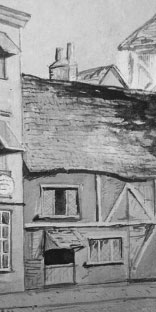
No. 7 to the north
Nos. 7 was originally a low half-timbered building (shown right), but had been rebuilt by the 1840s.
Edwin Thomas Spiers announced in Jackson's Oxford Journal on 15 January 1842 that the partnership of Spiers & Adams at 13 Cornmarket had been dissolved and that in future he would continue his business at 8 Cornmarket Street, by which he must have meant No. 7. He added “A great variety of Fire Works, and every thing in the Polytechnic [sic, presumably for Pyrotechnic] Art, always on hand”. His toy & fancy goods shop remained here until 1843.
On 14 October 1843 Frederick Rose (who by 1841 had opened a shop he called the Civet Cat next door at 8 Cornmarket Street) announced that he had purchased Spiers' shop and stock of toys and fancy goods and had moved here.
Rose died in 1861 and T. P. Rose took the shop over. It was later run by the Goodalls, who retained the name of the Civet Cat.
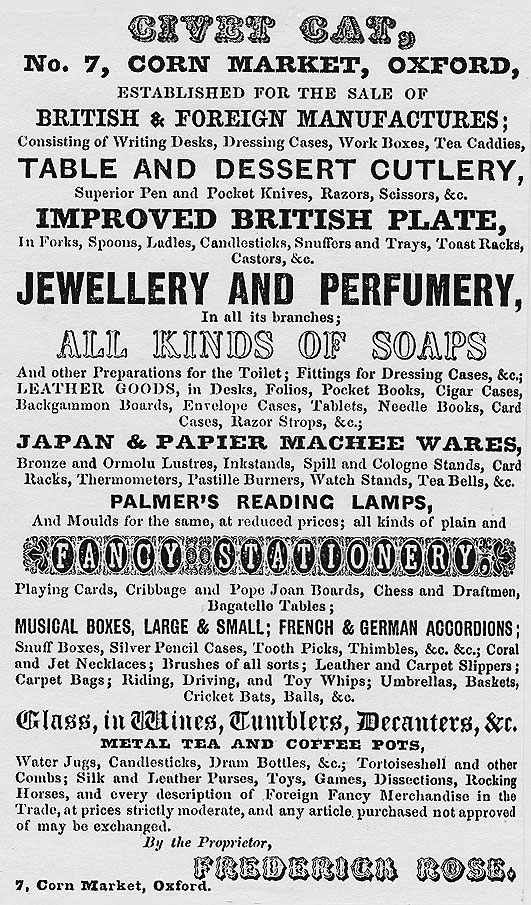
The advertisement below appeared in Hunt's Directory for 1846
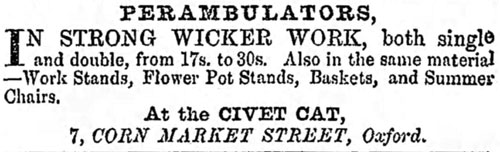
The advertisement below for wicker perambulators at the Civet Cat appeared in Jackson's Oxford Journal on 1 May 1858. They were not popular with the magistrates, and In February 1861 a nursemaid was charged at the City Court with “wheeling a perambulator on the pavement”.
The 1891 census shows Louisa S. Goodall, a widow of 50 described as the proprietress of a fancy repository, living here with her three children Mary, Ellan, and George, plus an assistant in the business and two servants.
In 1903 the Civet Cat pioneered the gramophone in Oxford.
Present building of Nos. 6 & 7 (from 1908)
In 1907 the tailoring business of Arthur Shepherd at No. 6, also acquired No. 7, and demolished and rebuilt the pair of shops. Shepherd moved temporarily to 109 High Street while these two shops were rebuilt.
In 1908 the Shepherd business reopened at No. 7 on the left of the new building, and the Civet Cat (Goodall & Sherratt) reopened at No. 6 on the right . This photograph of the brand-new building (Historic England HT13827) shows that although the Civet Cat had the smaller of the two shops, it spread over the top two floors of both shops:
The Civet Cat closed about a year after moving into their new shop.
In 1929 the Shepherd business was amalgamated with that of Mr Wilton Woodward who was then operating at 110 High Street, forming Shepherd & Woodward.
In 1955 Boots the Chemist moved into Shepherd’s former shop, and remained there until 1972, when they moved into the former Roebuck Inn at 8–10 Cornmarket.
A revised planning application affecting the offices above Nos. 6 & 7 (and the Golden Cross entrance at No. 5) was approved in April 2022: 22/00046/FUL. This includes an interesting Heritage Statement (under the Documents tab).
Occupants of 6 and 7 Cornmarket Street listed in directories etc. |
|||
Date |
No. 7 (left) | No. 6 (right) | |
1839 |
William Preedy, Wholesale & Retail Grocer, |
Joseph Prior Prior & Son Robert Prior |
|
1841–1881 |
Civet Cat Fancy Repository Frederick Rose (1841–1861), T. P. Rose Rose & Goodall (1872) Rose & Stringer (to 1881) Mrs Louisa Sophia Goodall (1890–1907) |
||
1886–1907 |
Arthur Shepherd, Tailor Upstairs: J. R. Mallam & Son, Auctioneers; |
||
Rebuilt in 1907. |
|||
1908 |
Arthur Shepherd |
Civet Cat |
|
1909–1930 |
James Smith & Sons, Dyers Together with Stevens & Co. (later Stevco) |
||
1932–1947 |
Boots Cash Chemist |
||
1952–1973 |
Boots The Chemist |
||
1973–1976 |
No listing |
No listing |
|
| 6/7 (left) | 6 (middle) | 5 (number of Golden Cross adopted) | |
2001–c.2015 |
Starbucks Coffee |
Argenteus |
West Cornwall Pasty Co |
2015–2021 |
Change Money |
Kiehl's |
|
2021–2022 |
Vacant |
||
2022–2023 |
Chopstix |
Santa Nata |
|
2023– |
Oxford Spires |
||
6 & 7 Cornmarket Street in the censuses
1841
No. 6: Joseph Prior (30), a tailor, lived here over his shop with Elizabeth (25), Joseph (6), Robert (5), Ann (3), Elizabeth (2), and Thomas (seven months). They had three female servants.
No. 7: identification uncertain. Possibly the cook James Grove (40) listed after Joseph Prior above, who lived in Cornmarket with Mary (40) and Charles (15) and had three servants.
1851
No. 6: James Cooper (68) a tailor’s foreman, lived here with his wife Mary (60) and his son James (31), who was also a tailor, and James's wife Elizabeth (25) and daughter Alice (eleven months). They had one general servant.
No. 7 (described as the “Civet Cat”): Frederick Rose (41), an unmarried jeweller and cutler, and his brother Thomas lived here with their sister Eliza (38), who acted as their housekeeper. They had one general servant, and three students were lodging with them.
1861
No. 6: Robert Prior (25), an unmarried tailor who employed 18 men, lived here with his sister Anne (23), who kept house for him. He also had one general servant, and his foreman, a widower of 68, also lived over the shop.
No. 7: Frederick Rose (50), a widowed toilet soap maker “&c” (described as “cabinet case makers, cutlers, jewellers & perfumers” in the PO Directory of 1841), lived here over his shop with his son Alfred (10), his daughter Mary (8), and his sister Eliza (45), who was his housekeeper. They had one house servant, and also living in the house was one of the assistants who worked in the shop, William Crake (24).
1871
No. 6: Robert Prior, tailor, still lived over the shop, but on census night only his children Ethel (5) and Ernest (3) were at home, looked after by their cook and nursemaid.
No. 7: Thomas P. Rose, a dealer in fancy goods, lived here with his wife Eliza (32) and his niece Emma Roberts (11). He had one servant, and an assistant in his shop lodged with him.
1881
No. 6: Robert Prior (44), a tailor who employed 14 men, lived over his shop with his wife Emma (38) and their three daughters: Ethel (15), Maud (8), and Annie (6). They had a cook and a housemaid.
No. 7: Thomas Stringer (30), a fancy warehouseman who was now a partner in Rose & Stringer, lived here over his shop with his wife Elizabeth (25) and son Albert (2), and one servant. Also living with them was Annie Hall (38), an assistant at the fancy warehouse.
1891
No. 6: Arthur Shepherd (57), a tailor & robe maker, lived here over his shop with his wife Sarah (46) and his son Ernest (25), who was his assistant. They had one general servant.
No. 7: Louisa Goodall (50), the widowed proprietress of the fancy depository downstairs, lived here with her children Mary (18), who was her assistant, Ellen (16), and George (14). Another assistant was boarding with them, and they had two general servants.
1901
No. 6: Described as a clothier's shop and auctioneer's office, uninhabited but in occupation.
No. 7: John Sherratt (28), a toy & fancy warehouseman and a partner in Goodall & Sherratt, lived here over his shop with his wife Mary (28) and their children John (2) and Constance (1), plus his mother-in-law Louise Goodall (61) and his brother-in-law George Goodall (23), also described as a toy & fancy warehouseman.
Rebuilt in c.1907
1911
No listing for either shop, as there were now only offices (Marlborough Chambers) upstairs.