

11–12 Cornmarket Street: Wasabi
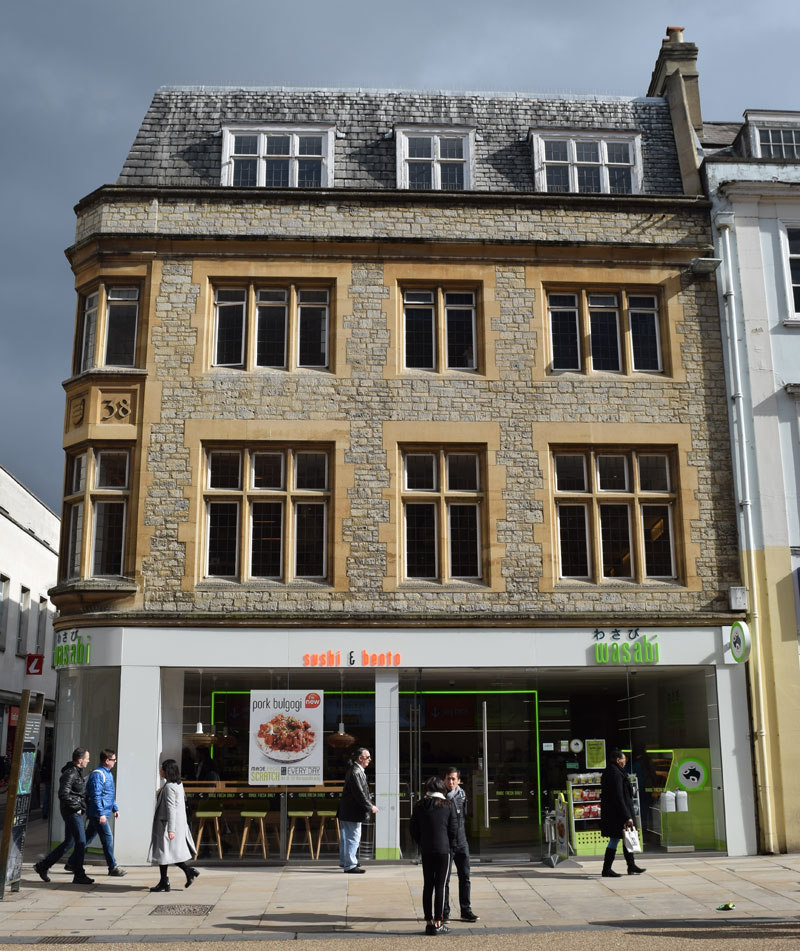
This single shop was built in 1938/9 on the site of two narrower old shops at 11 and 12 Cornmarket. The date 1938 can be seen inscribed on the corner between the windows of the first and second floor.
The image below shows the former shops that stood on this site
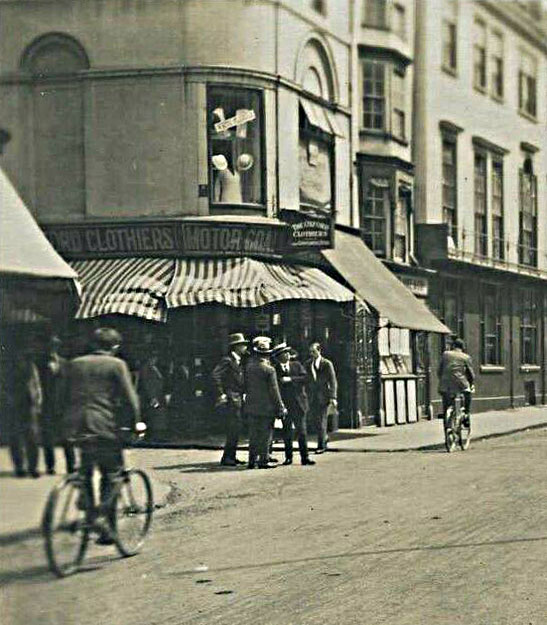
The former shops and the present building have always been in the parish of St Michael-at-the-Northgate Church.
The former No. 11 (on the right)
On 26 September 1849 George Dicks, who described himself as late Cook to the Noblemen, Masters, and Students of Christ Church, announced that he would open dining rooms here on Saturday 3 October 1840, and that he would also supply balls, routs, dinner, and water parties.
These premises were occupied by the saddler C. Collins in 1842.
On 3 April 1847 the chemist Frederick Telfer announced that he had moved here
By 1890 the Metropolitan & Birmingham Bank Ltd was here, but they only remained for a short time and in 1891 moved to its new purpose-built premises on the other side of the road at Nos. 59–61.
Lloyds Bank opened its first Oxford branch here on 1 January 1900. This was intended to be temporary, as the bank was already planning to build its new premises at 2–3 High Street.

The previous buildings at 11 & 12 Cornmarket in c.1905.
On the right of the photograph is the northernmost
part
of the Roebuck Inn at No. 10; in the middle is the whole
of No. 11 (Hamlet & Dulake's estate agent's office); and
on the left is most of No.12 (Margetts’s hatter’s shop).
The former No. 12 (on the left)
No. 12 on the corner of Market Street was left to the council by Alderman Payne after his death in 1619, with the rent of 6s. 8d. a year to pay for the repair of the constables' staves. For more information on rentals here, see H. E. Salter, Oxford City Properties, p. 253.
The shop was rebuilt in the mid-1840s. Together with 1 & 2 Market Street adjoining, it was then owned by Mrs Amelia Tyson Brazier. She died in 1847, and on 6 May 1848 Jackson's Oxford Journal announced the forthcoming auction of this property:
“Lot 1.—The FREEHOLD HOUSE and PREMISES, occupied by Mrs. Scott, hatter, being No. 12 Corn Market-street, and No. 1, in Market-street, in the City of Oxford; comprising, on the basement, an excellent light kitchen, with beer cellar, larder, and coal cellar, force pump, and good supply of water; on the ground floor, the excellent well-known and old-established hatter's shop, having a frontage to Corn Market and Market-street of 45 feet, or thereabouts, together with a private entrance from Market-street, handsome staircase, water closet, &c.; on the first floor, a handsome good-sized lofty drawing room and comfortable sitting room; on the second and third floors, four excellent lofty and airy bed chambers, with every requisite convenience.—The only outgoing with which this property is charged is a payment of eight shillings upon each quarter day to the almsmen of Bartlemas.
The whole of these commanding Premises have been lately entirely re-built in the modern style, under the superintendance of an eminent architect of this city, and the external appearance is only equalled by its interior comforts, which to be properly appreciated must be seen.”
(Lot 2 was 2 Market Street.)
This freehold house and shop at No. 12 had a rental of £120 per year when it was again advertised for auction in Jackson's Oxford Journal on 18 April 1863. The windows facing Cornmarket and Market Streets were described as having about 250 square feet of glass. The lease of the tenant, the tailor George Margetts, was terminable in 7, 14, or 21 years. Margetts died at the age of 53 on 8 August 1866, and Frederick Margetts (probably his nephew) continued with the business.
Below: Advertisement in Jackson's Oxford Journal on 3 April 1880: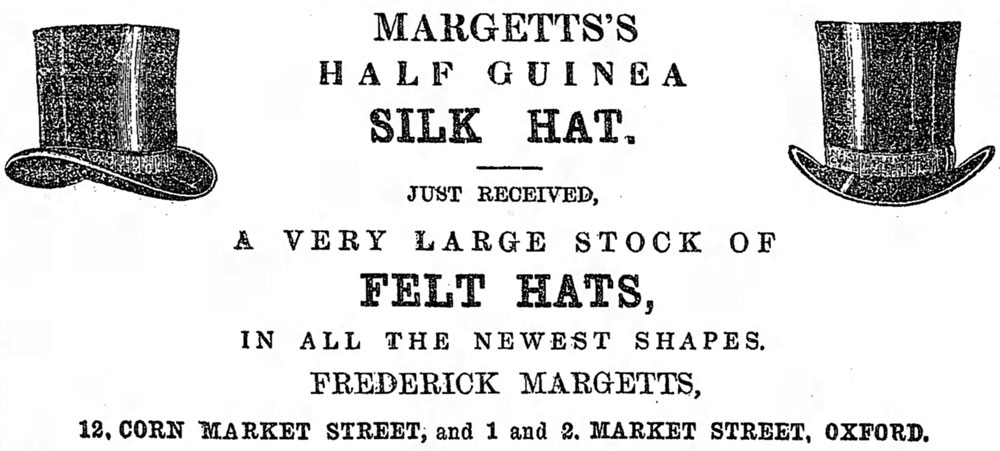
Occupants of the former 11 Cornmarket and 12 Cornmarket Street listed in directories etc. |
||
Date |
No. 12 (left) | No. 11 (right) |
1839 |
Alexander John Scott then his widow Scott's London Hat Warehouse (1855) |
William Brown, Confectioner/biscuit maker |
1840 |
George Dicks, Dining rooms |
|
1842 |
C. Collins, Saddler (to November 1843) |
|
1846 |
Edward Bartlett, Accountant |
|
1847–1860 |
Frederick Telfer, Chemist |
|
1860–1861 |
George Margetts
Frederick Margetts |
William Perry |
1862–1867 |
Thomas Hughes |
|
1871–1880 |
Gillman & Son |
|
By 1890–1891 |
Metropolitan & Birmingham Bank Ltd |
|
1892–1899 |
London Rubber Co (William E. Jennings, Manager) |
|
1900–1901 |
Lloyds Bank Ltd (temporary accommodation) |
|
1903–1911 |
Hamlet & Dulake Herbert Dulake & Co by 1925 |
|
1914–1936 |
Oxford Clothiers |
|
1938 |
No listing |
|
The two shops were demolished and rebuilt as a single block in 1938,
with the upstairs |
||
Occupants of the present 11 Cornmarket and 12 Cornmarket Street listed in directories etc. |
||
1941–1973 |
Noel Fashions |
|
1976–1982+ |
Peter Lord, shoe retailers |
|
1990 |
Bally Group shoe retailers |
|
2000–c.2015 |
Vodafone |
|
2016–present |
Wasabi On the third floor since 2018: Cornmarket Street Dental Practice |
|
11 & 12 Cornmarket Street in the censuses
1841
No. 11: No listing.
No. 12: Alexander Scott (40), a hatter, lived here over his shop with Phebe (40), Jane (15), and Benjamin (12). Two independent men aged about 25 also lived with them.
1851
No. 11: Fredric Telfer (43), a chemist & druggist, lived here over his shop with his wife Jemima (38) and son Fredric (14). Also living over the shop were his apprentice Isaac Price (19) and one female servant.
No. 12: The widow Phebe Scott (49) and her son Benjamin (22) lived here over their shop: both were described as hatters and hosiers. They had one servant.
1861
No. 11: William Perry (26), a chemist & druggist, lived here over his shop with his apprentice Medmer Goodwin (36) and one servant.
No. 12: This was described as “shop only”. The proprietor, George Margetts, was then living in Headington.
1871
No. 11: Richard Gillman (52), cordwainer, lived here over his shop with his wife Mary Ann (51) and their children Mary (25), Richard junior (21), also a cordwainer, Charles (18), a photographer, Alice (13), and Matilda (7), and their granddaughter Lydia Molyneux (9). They had one servant, and an apprentice also lived with them.
No. 12: No listing: probably part of Margetts' shop downstairs.
1881
No. 11: Richard Gilman (62), bootmaker, still lived here with his wife Mary (61) and their five daughters: Mary (28), Rose (26), Sarah (24), Alice (21), and Matilda (17). They had one servant.
No. 12: This is again described as uninhabited. Frederick Margetts (51), the proprietor (described as a hatter & outfitter employing eight assistants and two boys) spent the night at his home at 61 James Street in east Oxford with his wife Sarah (54) and his sons Frederick Arthur (17) and Arthur George (14). They had one female servant.
1891
No. 11 (Metropolitan & Birmingham Bank Ltd): Alex McNeil (44), bank manager, lived here with his wife Caroline (52) and his three stepdaughters Ellen Guy (27), Sarah Guy (24), and Florence Guy (21). They had one servant.
No. 12: Listed as uninhabited: probably part of Margetts shop downstairs.
1901
No. 11: Richard Butler (63), the caretaker at Lloyds Bank, lived here over the bank with his wife Emily (63), his daughter Alice (28), who was a factory needlewoman and his sister Miss Sarah Holdar (74).
No. 12: Listed as being in occupation: probably part of Margett's shop downstairs.
1911
No. 11: John William Nix (48), a pensioner & caretaker, lived in these four-roomed premises with his wife Alice (34).
No. 12: No listing.