

1–5: Lloyds Bank

There is a sharp contrast in style between the two main sections of the current Oxford branch of Lloyds Bank. The early-twentieth-century section that turns the corner from Cornmarket into the High Street is extremely ornate, and Pevsner says that it “shows the consequences of seeing too much Jackson about every day. There is nowhere that motifs don’t sprout, alternately blocked columns, Ipswich windows, big, steep shaped gables.” The smaller and older building to the east (formerly 4 & 5 High Street) dates from c.1800 and is much plainer.
Both sections of the current bank are Grade II listed:
Nos. 1–5 High Street were in the parish of St Martin's (Carfax) until that church was demolished in 1896, and then in the parish of St Martin & All Saints. When All Saints’ Church closed in 1971, the property was taken into the parish of St Michael-at-the-Northgate Church.
The whole of the Lloyds Bank premises here on the site of the former Nos. 1–5 High Street and 1 & 1A Cornmarket was purchased by Brasenose College in late 2018, and they commissioned the following history of the building::
The bank remains as tenant, but the college stated here that in the medium term it would consider adapting the upper floors for accommodation for its students.
The four shops on the corner of Carfax that were demolished
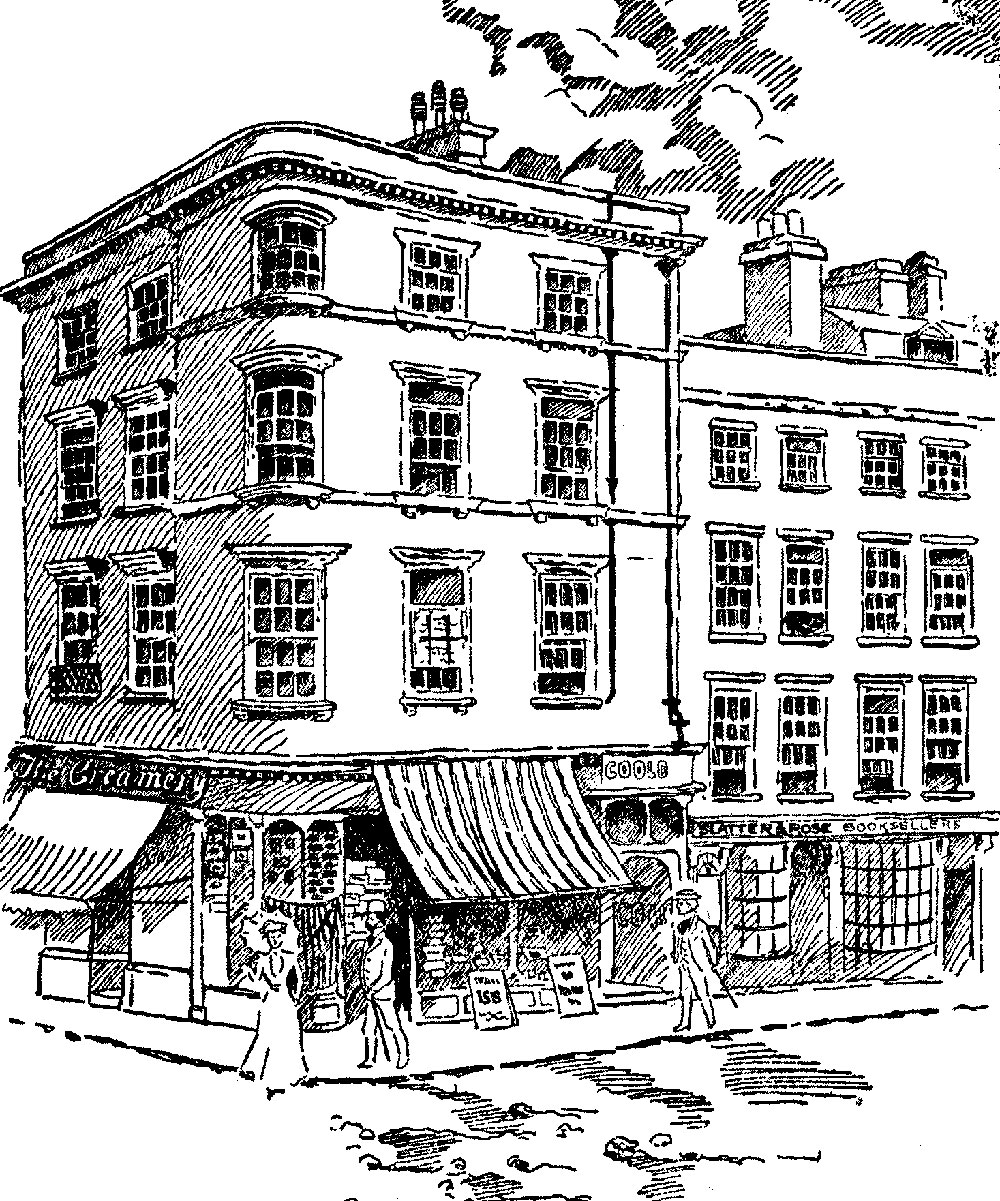
The drawing on the right was published in Jackson's Oxford Journal on 21 July 1900 under the heading “CARFAX IMPROVEMENT”. It shows two buildings (1 Cornmarket /1 High Street to the left and 2 & 3 High Street to the right) that were about to be demolished.
The text underneath read: “Above we give a sketch of the buildings at the north-east corner of Carfax which are shortly to be pulled down for the widening and improvement of the thoroughfare at that corner of Carfax.”
Below: the corner building in an 1835 engraving
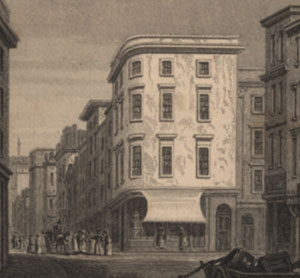
On 28 April 1900 Jackson's Oxford Journal had reported on a special meeting of the city council held three days' earlier where it adopted the General Purposes Committee's report to purchase this corner building, stating.
No. 1, High-street, is in the occupation of Mr. Alfred Savage at the annual rent of £120. After considerable negotiation with Mr. Montague W. Wootten an opportunity arose of acquiring this property. It has been purchased by Dr. Galpin, as agent for Alderman Gray, for the sum of £4,500. A copy of the contract is produced. Alderman Gray offers the property to the Corporation at the same price.
Photograph of the old building on the corner, just before demolition, showing Savage's facing the High Street and The Creamery facing Cornmarket
The ornate early-twentieth-century building on the north-east corner of Carfax
Since 1976 Lloyds Bank has occupied seven adjacent shops, namely 1, 2, 3, 4, & 5 High Street as well 1 and 1A Cornmarket Street. They were only responsible, however, for building a small part of it. The redevelopment of this corner started off as a much smaller plan by Lloyd's Bank to replace 2 & 3 High Street with a new building for their bank.
On 1 January 1900 Lloyds had opened at temporary premises in Oxford at 11 Cornmarket Street, but evidently wanted a more impressive building to compete with the premises of Oxford's three other established banks, namely Barclays (which had just taken over the Old Bank at 92/93 High Street), the London & County Banking Company Ltd (which had moved into its new premises at 120–122 High Street in 1869), and the London City & Midland Bank Ltd (which had built new premises at Carfax on the site of four shops at 62–65 Cornmarket in 1896/7).
The bank bought the shops at 2 & 3 High Street that were then occupied by the booksellers Slatter & Rose: they vacated the premises in mid-1900, moving to 16 High Street. The new building (below) was designed specifically for the bank by Stephen Salter. The Directors of Lloyds Bank had also planned to rebuild the two shops on the corner of Carfax at the same time, but this idea fell through.

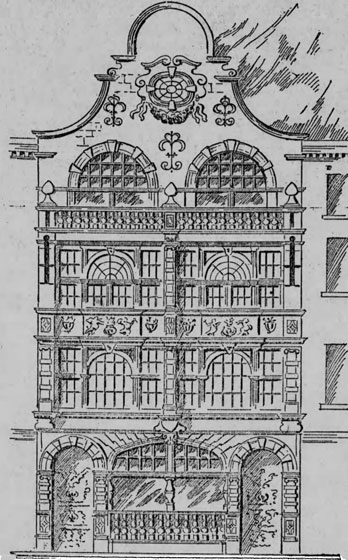
Above left: The original Lloyds Bank at Nos. 2 & 3 High Street photographed in September 2019
Above right: Drawing published in Jackson's Oxford Journal on 1 December 1900 under the heading “NEW BANK PREMISES AT CARFAX”. This drawing was a copy of the design for the bank that Salter had made earlier in the year, and shows the bank running along the original building line to join up with the earlier building at 1 High Street on the left.
When the bank submitted Salter's plans for 2 & 3 High Street, however, Oxford City Council referred the plans back to the bank in August 1900 and negotiated for the building to slope back at an angle from the road to start a gentle curve that the council could later continue around into Cornmarket to create more space at Carfax. Jackson's Oxford Journal of 25 August 1900 reported on a city council meeting held three days earlier on 22 August to appoint an arbitrator to decide how much compensation the council should pay the bank for the 8¾ yards of the site that they now wanted to be part of the public street. On 3 November 1900 it reported that a sum of £500 for 78 square feet had been agreed.
Over five months earlier on 23 June 1900 the city council had purchased 1 High Street for £4,500, and negotiations for 1 Cornmarket Street (which was part of the same corner building) had begun. The text underneath the above drawing of Salter's original plan published on 1 December 1900 mentions that the bank's new building would now be set back from the frontage of the old Slatter & Rose shop (in anticipation of what the city council planned):
The above sketch was drawn by our artist from the plan for the proposed new premises at Carfax, to be erected for Lloyds Bank, Limited. The new structure is to occupy the site of Slatter and Rose's old premises, and will be set back from two to three feet beyond the present frontage. The whole of the front will be faced with Milton stone, and the approximate cost of the building exceeds £6,500. The architect is Mr. Stephen Salter, F.R.I.B.A., and the contractors are Messrs. Benfield and Loxley.
Lloyds Bank moved into the present building (which was then still numbered 2–3 High Street) as soon as it was finished in 1901, and Stephen Salter (the architect who designed it) moved across the road from 136 High Street into one of the many offices upstairs.
In 1902 Lloyds Bank bought 1 High Street and the adjoining shops at 1/1A Cornmarket from the City Council and began work on Phase 2 of their development, which rounded off the corner and allowed more room for the heavy traffic that met at the crossroads. The architect Stephen Salter continued the building in the same style. The Oxford Chronicle of 23 October 1903 (p. 7) showed the architect’s drawing of the complete new building and reported as follows:
The two old shops at the corner of Carfax have been removed, and two new ones, with suites of offices, are roof high. Both the shops have been already let by Messrs. Hamlet and Dulake; they will complete the block original design, of which Messrs Lloyds Bank was only an isolated portion. The renaissance style adopted does not appear to advantage in a narrow front, but is exceedingly effective in a block. The buildings are designed to bring in the utmost return in outlay, and as third floor offices do not let readily, a fine studio across the entire width of the two shops, having a north roof light, has been designed. The contractors are Messrs. Benfield and Loxley, the architect Mr. Stephen Salter, F.R.I.B.A., of Carfax, and the carving is being executed by Mr W. H. Feldon of Oxford.
Until the mid-1920s the bank let out the shops on the corner and continued to occupy just 2 & 3 High Street. The photograph below, probably dating from around 1920, shows the jeweller H. Samuel at 1 Cornmarket Street and a cigar shop at 1 High Street, and between them is a large entrance on the corner of Carfax. The shops at No. 4 & 5 on the right whose signs are obscured by their sunblinds must be Sainsbury's the grocer and Gill's the ironmonger.

In the mid-1920s Lloyds Bank expanded into No. 1 High Street to the west and around the corner into 1 Cornmarket Street (thus now occupying the whole of Salter's ornate building), and also into the older building at 1A Cornmarket Street. The main entrance then moved to the corner of Carfax, and it was probably then that the beehive with the letters LBL (Lloyds Bank Ltd) was carved over the doorway there.
In 1971 Lloyds Bank bought Nos. 4 & 5, but leased them back to Sainsbury's until the latter were able to move into their present shop in the new Westgate Centre in c.1974. The bank then demolished most of the building, but retained the existing façade. For a short time the bank moved into this new building while refurbishing their original building to the west. They now occupy the whole of their present site.
The eighteenth-century buildings on this site
The above drawing (copied by John Buckler from a drawing in the possession of Joseph Lock) shows the side of a building facing Cornmarket, and then seven shops where there were later five. The one on the right has “Bush Brazier” over the doorway.
Occupants of the building at 1–3 High Street (demolished and replaced in 1900/1)
Former No. 1
The 1841 census shows William Wiseman the draper here living over the shop with his wife Mary and their four children, plus two apprentices two shopmen, and a servant girl. He was still here at the time of the 1851 census with his wife and six children, plus a draper’s assistant. By the time of the 1861 census he was living over both 1 & 2 High Street with his wife and three of his children.
In 1868 the firm became Wiseman & Blake, and the 1871 census shows the draper Joseph Blake living over this shop with his wife and two sons, an assistant draper and an apprentice, plus two servants. Blake moved to 64 Cornmarket Street in 1872, and died of rapid consumption at the age of 39 on 17 November that year.
By 1880 the University & City Wine & Spirit Stores occupied 1 High Street, and the 1881 census records that no one was then living over that shop.
The stationer Alfred Savage, who produced many postcards of Oxford, had his shop here from 1889, and at the time of the 1891 census he was living upstairs with his wife Marian and their two young children, plus a general servant and a 13-ear-old undermaid.
No. 1 High Street was sold by Sarah Wootten on 23 June 1900 to Alderman Gray who sold it on to the Mayor and Corporation of Oxford for £4,500, and the 1901 census lists No. 1 as a stationer's shop and 1a as a coal office, with no one living upstairs. Savage moved to a new shop at 2 & 3 Queen Street, and in 1902 the Corporation sold 1 High Street and the adjoining 1/1A Cornmarket Street to Lloyds Bank, who demolished them.
Former Nos.
2–3
The 1841 census shows the bookseller Henry Slatter living over Nos. 2 & 3 with a woman who was probably his wife and two teenagers Mary and John Rose, plus two servants. By the time of the 1851 census Henry Slatter (aged 61) and John Rose (aged 26) were business partners, living over Nos. 2–3, together with an apprentice and two servants. Charles Dodgson (Lewis Carroll) recorded in his diary on 2 February 1856 that he ordered poetry books at Slatter's bookshop here.
By the time of the 1861 census William Wiseman at No. 1 appears to have also occupied the upstairs of No. 2, but Henry Slatter continued to live over No. 3, where he died at the age of 76 on 7 March 1865.
The 1871 census shows the bookseller John Rose living over Nos. 2–3. He was still here at the time of the 1881 census when he was a bachelor of 56, living with his 78-year old mother, his two spinster sisters, and a cook and housemaid. His mother Eliza, the widow of William Thomas Rose, died here at the age of 85 on 12 May 1888. The 1891 census shows John Rose still living over the two shops with one sister, Emilia, plus a cook and a housemaid.
Slatter & Rose were were forced to move out of their bookshop at 2 & 3 High Street in the summer of 1900 to make way for the ornate new building on the corner, transferring their business to 16 High Street.
The 1901 census notes that two new properties were being built here. By the time of the 1911 census the caretaker of Lloyd's Bank, George William Barrett, lived over Nos. 2 & 3 with his wife Annie. The 1939 Register shows Frederick G. Ponting, the caretaker & messenger at the bank, living there with his sife and son.
Occupants of the present building at 4–5 High Street (dating from c.1800)
No. 4
J. & F. Withers, chemists & druggists, announced in Jackson's Oxford Journal on 8 April 1848 that they had moved here, and on 12 October 1850 that they were moving on again to 131 High Street.
The 1841 census shows Joseph Drew, a young hatter, living here at No. 4 with Ann Drew, who was probably his wife, and two independent young women. Drew went bankrupt later in 1841, and on 22 & 23 December all his stock in trade, household furniture, and effects were auctioned.
The 1851 census shows another hatter John Mawer living over No. 4 with his wife and a servant. By the time of the 1861 census the hatter’s shop was still there, but the upstairs was let out to John Rose of Slatter & Rose at Nos. 2–3 next door. There was no one living over No. 4 at the time of the 1871, 1881, 1891, 1901 and 1911 censuses.
J. Sainsbury Ltd had a shop at No. 4 High Street from c.1910 which expanded to include No. 5 High Street in about 1926.
No. 5
The 1841 census shows the ironmonger Charles Pilcher here with an older woman Elizabeth Pilcher and three servants.
By the time of the 1851 census the ironmonger here was James Gill, a bachelor of 35, living over No. 5 with a housekeeper, a general servant, and a lodger. He was still there at the time of the 1861 census, when he was described as an ironmonger employing 18 men and three boys. There was no one living over No. 5 in the 1871 and 1881 censuses. The premises were partly destroyed by fire on 2 April 1890, and Jackson's Oxford Journal of 11 October 1890 reported on the rebuilding work:
IMPROVEMENTS AT TRADESMEN’S ESTABLISHMENTS.—Messrs. Gill and Co.’s premises in the High-street, which were partially destroyed by fire on April 2nd, have been re-constructed. The house front, which was greatly damaged, has been partly taken down and re-built. The whole of the roof is new, and there has been a great structural alteration in the interior, on account of No. 4, which was held by Messrs. Mawer and Son previous to the fire, now being added to Messrs. Gill and Co’s premises. The ground, second, and third floors are formed into spacious show rooms and stores, the first floor being reserved for offices, lavatories, &c. This establishment will now comprise some of the finest show rooms in this part of the country. The whole of the re-building was executed in the remarkably short time of ten week. Messrs. Christopher and White, of Bloomsbury-square, London, were the architects, and Messrs. Symm and Co. the contractors.
On 25 June 1892 Jackson's Oxford Journal reported that Gill & Co had immediately taken advantage of the new electricity supply in Oxford and had 26 lamps in their shop window.
There was no one living over No. 5 at the time of the 1891 and 1901 censuses.
The ironmonger James Gill remained in these large premises at 4 & 5 High Street until 1911, when the business retreated back into to No. 5 and Sainsbury's moved into No. 4.
In 1922 Barlow & Alden Ltd and Ison, Kidman & Watts amalgamated under the name of Gill & Co. Ltd.
Then in 1925 Sainsbury’s at No. 4 expanded into No. 5, rejoining the two shops again. The 1939 Register lists the following people as living over Sainsbury's at 4 & t High Street: a housekeeper, three domestic servants, a senior assistant at the provision shop, four or five shop assistants, and two butcher's cutters and a butcher's assistant. Sainsbury's remained at 4 & 5 High Street until the 1970s when it moved to its present larger store at the Westgate Centre.
When Sainsbury's expanded into No. 5 Gill's moved across the road to 127–8 High Street, then moving in 1953 to a smaller shop in the adjacent passage.
Occupiers of 1–5 High Street | |||||
Date |
1 High St |
1A High Street |
2 & 3 High St |
4 High St |
5 High St |
1772 |
Mr L. Berrick |
Mr Moor Mr Smith Mr Bullock
|
Mr Midwinter Mr Treadwell Mrs Smith (possibly not the present building) |
||
1839 |
William Wiseman (Wiseman & Blake from 1868) |
Henry Slatter
E. King, Surgeon dentist
Slatter & Rose |
Joseph Drew |
Charles Pilcher |
|
1846 |
Joseph Steane |
Gill & Ward
|
|||
1848–1850 |
J. & F. Withers |
||||
1850–1871 |
John William Mawer
Later |
||||
1872–1876 |
Vacant |
||||
1880 |
University & City |
Carfax Chambers: |
|||
1884–1887 |
Frederick Flight |
Goold & Buckell Goold & Son |
|||
1889 |
Alfred Savage |
||||
1890–1900 |
Gill & Co. |
||||
1901 |
No listing |
||||
1902–1906 |
No listing |
Lloyds Bank Ltd with numerous From 1904
|
|||
1907–1909 |
Carfax |
||||
1911–1913 |
John Sainsbury |
Gill & Co. |
|||
|
1914–1923 |
Colin Lunn, |
||||
1925 |
No listing |
||||
|
1927–1974 |
Lloyds Bank Ltd |
J. Sainsbury Ltd |
|||
| 1976–present |
Lloyds Bank PLC | ||||
* Listed below are the offices listed under 2 & 3 High Street in 1905 and in 1922. The increase in the number of offices suggests that they in fact occupied all the property above Lloyds Bank, including the part around the corner in Cornmarket. It seems likely that the only access to these offices was the new entrance between 2 & 3 High Street.
1905
|
1922
Then the School of Foreign Languages is |
