6–7: Anthropologie

This was originally two shops: No. 6 is the very narrow building with a late eighteenth-century Venetian window at first-floor level to the left of the present shop, and No. 7 the much wider building with four windows with iron balconies at first floor level to the right.
The building dates from the late eighteenth century, but was largely rebuilt in 1959 with a modern shop front for the International Tea Company Stores (planning application 59/07057/A_H).
The two buildings that form this shop are separately listed:
No. 6 (left): Grade II* (List Entry No. 1047311)
No. 7 (right): Grade II (List Entry No. 1116359)
These were the first two houses in the High in the parish of All Saints until that church closed in 1971. The shop is now in the parish of St Michael-at-the-Northgate Church.
The goldsmith Edward Lock (Mayor of Oxford in 1776/7, 1791/2, and 1806/7) set up business at No. 7 in mid-1759, and it was continued by his son Joseph Lock (Mayor of Oxford in 1813/14 and 1829/30). At some point, possibly after Joseph's marriage in May 1781, they took over the house to the left (No. 6) as their living quarters. The drawing below (copied by John Buckler from a drawing in the possession of Joseph Lock) shows No. 6 & 7 High Street (with a sign over the door of the bank on the right reading LOCK):

No. 6 (narrower house on the left)
In 1772 a survey of every house in the city was taken in consequence of the Mileways Act of 1771. According to H. E. Salter, No. 6 with the passage down its side was then in the occupation of the hosier Mr Underhill, and its frontage measured 5 yards 0 feet 6 inches.
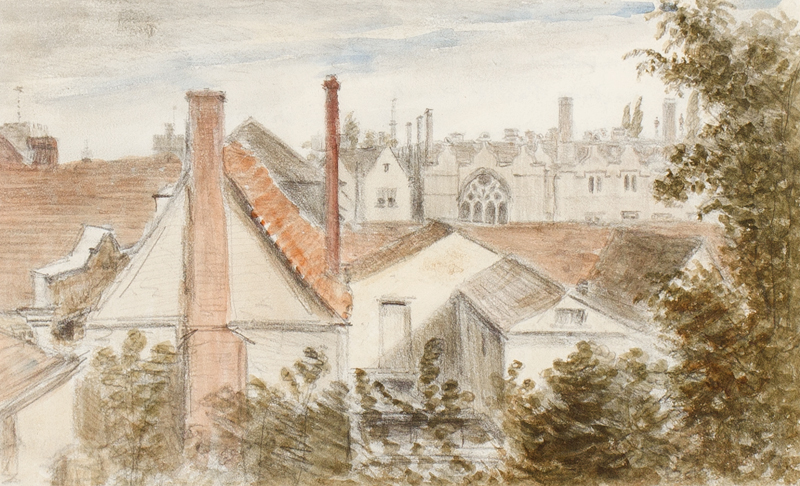
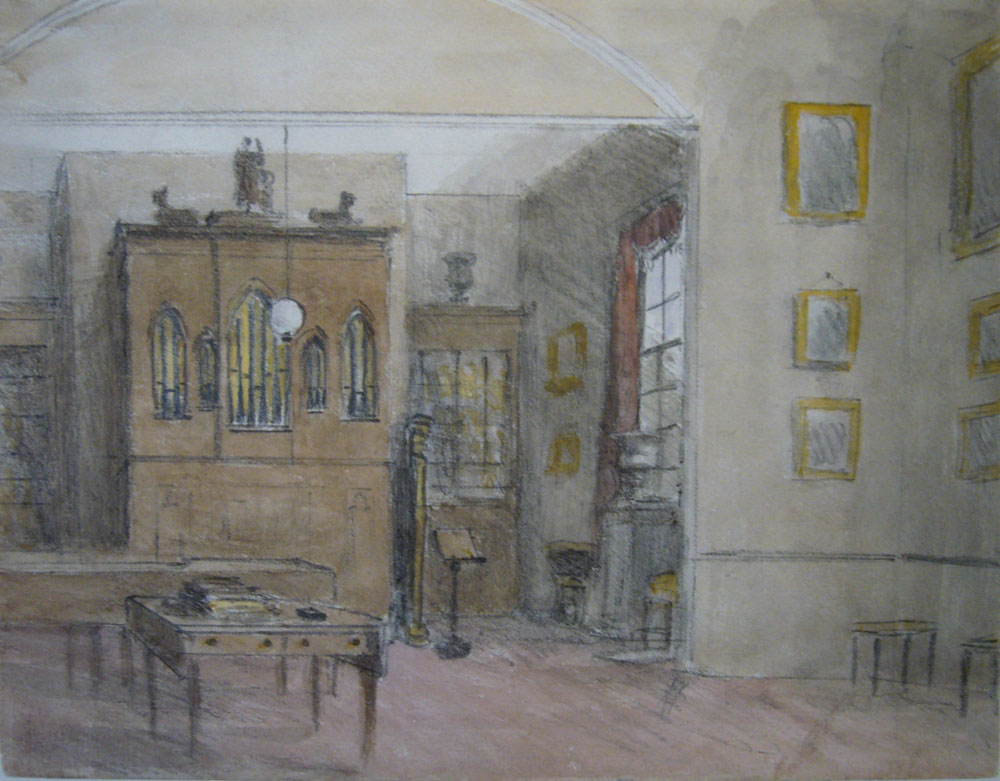
The goldsmith Edward Lock had moved his goldsmith and banking business into No. 7 next door in June 1759, and by 1794 he had taken on this house at No. 6 as well. The above drawing indicates that his house was here at No. 6 and the bank in the larger premises to the right. He died in 1814, and his son Joseph Lock, took over the business. He had built Denton House in Iffley and then Bury Knowle House in Headington in the hope that his remaining children would survive in the country air, and he himself spent time here in the High Street and also in his country house. William Crotch stayed as a guest at Sir Joseph Lock's house here at 6 High Street in the 1830s, and painted this view from his bedroom window at the back, looking north towards Jesus College, with the towers of St Michael's and St Mary Magdalen Church in the distance on the left. He also painted the watercolour shown below of Lock's organ room in this house, with the organ that was built by George or George Pike England for Sir Joseph's daughter Maria:
The 1841 census shows Sir Joseph Lock still occupying the premises at No. 6/7 High Street with his daughter Maria, three other people, and three servants. He died on 16 January 1844 at the age of 83. On 4 May 1844 an auction of part of his household furniture, paintings, china, and glass, as well as his landau carriage, a one-horse cab on two low wheels for an invalid, and a four-wheeled phaeton was advertised in Jackson's Oxford Journal.
That auction notice also stated: “The very excellent Dwelling House and Premises, with Coach-house, Stabling, &c. to be LET”, and they were let separately from the mid-1840s to 1958.
On 29 March 1845 William Peter Adams (whose former shop at 13 Cornmarket was about to be demolished to widen Market Street) announced that on 2 April 1845 he would open his toy & stationery warehouse here at No. 6 . The 1851 census shows him at the age of 40 living over his shop with his wife Emma and their two children plus a general servant. He can be seen here at the time of the 1861 and 1871 censuses, and remained until 1880.
From 1880 to 1882 the cabinet maker & upholsterer Thomas Plaister was here, and the 1881 census shows him at the age of 41 living over his shop with his wife Ann and their three children, plus their servant.
From 1888 to 1910 the surgical boot maker William Cleaver had this shop. No one lived at the boot shop and offices at the time of the 1891 and 1901 censuses.
From 1911 to 1923 the Dorian Shoe Company was here. At the time of the 1911 census the Misses Dora and Ada Randall, who described themselves as restaurant keepers, lived in six of the rooms over No. 6.
No. 7 (larger house on the right)
In May 1759 Edward Lock who had worked for Wilkins the goldsmith at 135 High Street announced that he had taken over his business and was moving it across to the other side of the road to this building at 7 High Street.
The 1772 survey shows No. 7 was then divided into two parts, the one to the west occupied by Mr Lock (with a frontage of 6yds 2ft 3in) and the one to the east by Mrs Radford (with a frontage of 3yds 1ft 11in.
That “Mr Lock” was the goldsmith Edward Lock, and Parson Woodforde paid many visits to his shop here.
In about 1792 Edward Lock started the University and City Bank here, going into partnership with his son Joseph.
On the night of Thursday 12 June 1794 there were illuminations in Oxford to celebrate the defeat of the French fleet by Lord Howe at the battle eleven days earlier that was known as “The Glorious First of June”. Jackson's Oxford Journal reported thus two days later on the celebrations outside his house at No. 6 and the bank at No. 7:
… and the Front of the House of Messrs. Locks, Goldsmiths, with the Bank adjoining, was remarkably conspicuous, by Wreaths of variegated Lamps, and a Transparency; where a select Band of Musick had been procured, consisting of French Horns, Clarinets, Violins, and divers other Instruments, who played up, with infinite Spirit, the good old Tunes of God Save the King, Rule Britannia, and Britons Strike Home;—Musick both well-timed and popular.
Edward Lock died in 1813, and his son Joseph Lock took the business over.
The 1841 census lists Joseph Lock and his wife living at No. 6 High Street and probably over No. 7 as well.
Pigot’s Directory of 1842 still listed the University and City Bank (which drew on Willis, Percival & Co. London) at 6 & 7 High Street. Lock died on 16 January 1844, and his bank survived until the end of August 1844, with Jackson's Oxford Journal reporting on the 10th of that month:
We are informed that the old and respectable firm of Sir Joseph Lock and Co., University and City Bank, Oxford, have given notice to their customers that they shall discontinue business on the 31st instant, and have recommended them to transfer their accounts to Messrs. Robinson and Co. of the Old Bank.
Underhill grocers at No. 7 (1845–1921)
The Underhill family had traded in Oxford since the early sixteenth century. The grocer Michael Underhill, whose shop had been on the other side of the road at 138 High Street (also in All Saints' parish), moved into No. 6 with his family in about 1845.
The 1851 census shows Michael Underhill (64), described as a grocer and employer of 23 men, living over his shop at No. 7 with his wife Eleanor (née Scrivener) and their children Matilda (23) and William Michael Underhill (20), who was described as a grocer's assistant, and his granddaughter Eleanor Adnams, plus three servants (a shopman, cook, and general servant). In a separate household above No. 7 lived his married son Henry Scrivener Underhill (27), described as his business partner, who was alone with his servant on census night.
Two more of Michael Underhill's sons were also running grocer's shops:, Charles Underhill at 11 Beaumont Street, and Ernest Augustus Underhill at 16 St Clement's Street. The advertisement below that appeared in Billing's Directory for 1854 mentions the main shop here at 7 High Street and the two branches:

(Charles Underhill moved his grocer's shop from 11 Beaumont Street to 37 Cornmarket Street in 1854.)
The 1861 census shows that Henry Scrivener Underhill (37), described as a grocer & tallow chandler employing 14 men as grocers and six as tallow chandlers, now had charge of his father Michael Underhill's shop here and was living upstairs with his wife Anne and their son George (1). Michael Underhill died in 1868 at 21 St John Street.
At the time of the 1871 census Henry Scrivener Underhill and his wife lived here with three children and three servants. They were still here at the time of the 1881 census, and both he and his 26-year-old son Henry Michael John Underhill were described as grocer & provision merchants.
(Henry Scrivener's other son George Edward Underhill was now an undergraduate at Magdalen College and was to be a Fellow of the college to 1919, and his grocer son Henry Michael John Underhill was also an antiquarian, artist, and expert in natural history and archaeology: see article on him in Oxoniensia in 2008.)
For a short period in the mid-1880s M. Underhill & Sons is listed in directories as occupying both Nos. 6 & 7.
The 1891 census shows that Henry Scrivener Underhill (67) was still working as a grocer and living over the shop with his wife Anne, his unmarried son Henry Michael John Underhill (36), who was also described as a grocer, and his daughter Annie (24), who was a school teacher, plus servants.
In 1893 Henry Scrivener Underhill took out the first lease on 20 Bardwell Road in north Oxford and retired there to live privately. He died at his new home at the age of 71 on 22 February 1896. At the time of the 1901 census his son Henry Michael John Underhill can be seen living at Bardwell Road with his widowed mother and sister.

No. 7 remained Underhill's until 1921, and then became the International Tea Co. Stores Ltd.
The Ross Café/Hotel run by the Misses Price and Kenyon was upstairs at 7a High Street from 1939 to 1957 (advertisement, right)
The 1939 Register lists four café & hotel proprietors/proprietresses as living upstairs:
- Miss Amy E. Price (born 1880)
- Miss Elizabeth L. Price (born 1886)
- Robert T. Kenyon (born 1898),
also described as an ex-mechanical draughtsman - Mrs Alice S. Kenyon (born 1889)
Vincent’s Club
Vincent's Club met at Carfax House above Nos. 6 & 7 from 1894 to 1931, when it moved to its present address in King Edward Street.
At the time of the 1901 census Henry Browne (42), the manager of the club, was living over the shop at No. 7 with his wife Annie and a housemaid and kitchenmaid. There does not appear to be listing for No. 7 in the 1911 census, but the 1921 census again shows Henry Browne and his wife and their servant living in three rooms at the club.
Nos 6 & 7 combined as one shop
In 1958 the two premises combined to form a single retail shop, the International Stores, and this was followed by Ryman's stationers by 1980. From the 1980s to 1911 there was a health & fitness club upstairs.
In 2012 two planning applications that turned the whole building into a four-storey retail shop were approved:
- 11/02100/FUL: Change of use of first, second and third floors from Gymnasium use (class D2) to Retail use (class A1) and installation of rear fire escape door
- 11/02101/LBC: Internal alterations involving changes in floor levels to ground floor and basement, insertion of new staircase from basement to 1st floor, removal of existing partitions, insertion of new partitions and lift serving all floors. Insertion of external fire escape door on rear elevation at second floor level.
Occupiers of 6–7 High Street since 1839 | |||
Date |
6 High Street |
7 High Street |
Upstairs (Carfax House) |
1759–1844 |
Edward Lock, goldsmith & banker (1759–1813) |
Probably offices of the bank as well as extra accommodation for the smaller house next door |
|
1845–1880 |
William Peter Adams |
M. Underhill & Sons |
Living accommodation |
1880–1882 |
T. Plaister |
||
1883–1887 |
M. Underhill & Sons, Grocers & tea dealers |
|
|
1888–1921 |
William Cleaver Dorian Shoe Co. Ltd (1911–1923) |
M. Underhill & Sons |
1894–1931: Vincent's Club |
1923–1931 |
W. A Roper Lennards Ltd, |
International Tea Co. |
|
1932–1956 |
1932–1937: Various dentists |
||
1939–1943 |
The Ross Café (to 1940) The Ross Hotel (from 1941) |
||
1945–1956 |
No listing |
||
1958–1974 |
“Carfax House” International Tea Co.’s Stores Ltd |
1962–1966: Strange (Oxford) Ltd, 1962–1972:
Phonotas Co. Ltd., 1962–1971: Arthur Guinness, Son & Col (Park Royal) Ltd, brewers 1967–1974: Maison Gray ladies hairdressers |
|
1975–1976+ |
Roland of Switzerland, ladies' hairdressers Carless & Adams, quantity surveyors |
||
By 1980–2012 |
Ryman (Stationers) |
From c.1980s to 2011: |
|
2012–2019 |
Jack Wills |
||
2019– |
Anthropologie |
||