

Former houses at 18–20 Cornmarket Street
These three houses stood on the north section of the site of Northgate House until 1960. They were always in the parish of St Michael-at-the-Northgate.
There was an inn on each side of the group: the Bell Inn at No. 18 on the right closed in 1912, and the Star & Garter Inn at No. 20 on the left survived as the Tunnel Hotel until the group of buildings was demolished in c.1934.
In 1772 a survey of every house in the city was taken in consequence of the Mileways Act of 1771. According to H. E. Salter, the three houses on this site were then occupied as follows:
- 18 Cornmarket was occupied by Mr Cox, with a frontage of 3 yards, 2 ft. and 9 in.
- 19 Cornmarket was occupied by Mrs Marsh, with a frontage of 4 yards, 1 ft. and 7 in.
- 20 Cornmarket was occupied by Mr Box, with a frontage of 5 yards, 1ft. and 11 in.
Photograph showing these three narrow houses before 1901: The Star & Garter (No. 20) is to the south (right) of the White Hart Hotel, then comes Orpwood's saddle shop with his name across the front (No. 19), and then the Bell Inn with its name on the gable (No. 18).
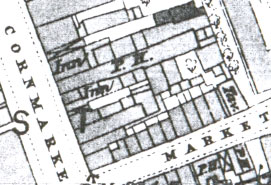
The 1876 map (left) shows the long tunnel leading to the Star & Garter at No. 20 marked P.H. (public house) and the Bell Inn at No. 18 to the south marked Inn.
(The third inn shown to the north of the Star & Garter is the White Hart.)
No. 18: Bell Inn
On 9 June 1832 Messrs Beesley & Beechey announced that their fly vans left the Bell Inn in Cornmarket for London and Worcester every Monday, Wednesday, and Friday at 8am.
Francis Thompson, the landlord from 1852 to 1855, also operated as a wine & spirit merchant at this pub, and his successor John Mayo continued with the retail side, announcing in Jackson's Oxford Journal that he would be selling Morrell's fine ales & stout and Guy, Leadbeater, and Gammon's wines and spirits. On 7 September 1867 he announced that he was giving up the Bell Inn after thirteen years and would carry on the retail bottle trade at his new premises (Clarendon Chambers, at 13 Cornmarket Street)
The next landlord, William Barrett, announced on 6 June 1874 that after serving as landlord here for seven years he would be taking over the George Hotel at the north-west end of Cornmarket.
On 2 October 1880 Jackson's Oxford Journal advertised a forthcoming auction of this inn and the cottages behind, describing it thus:
To Brewers, Capitalists, and Others.
FREEHOLD FULLY-LICENSED HOUSE, known as the "BELL INN," Corn Market-street, Oxford,
together with FIVE COTTAGES and other Buildings at back, in a most commanding and desirable position....The BELL INN occupies an important site, and contains a good bar, two large smoke rooms, sitting room, seven bed rooms, box room and w.c., and the Cottages at back are convenient, and well let to good permanent tenants.
Messrs Simonds of Reading stopped bidding when the price reached £2,300, and the property was knocked down to Messrs Hanley, brewers of Oxford, at £2,575.
The next landlord, William Powell, died at the inn on 13 April 1881.
The Royal Antediluvian Order of Buffaloes' Oedipus Lodge moved to the Bell Inn on 4 February 1892.
No. 19
The auction of this house/shop was advertised thus in Jackson's Oxford Journal on 12 April 1856 when it was occupied by the cheesemonger George Brown:
FREEHOLD HOUSE (with SHOP)
The very desirable HOUSE, No. 19, Corn Market-street, in the occupation of the proprietor, Mr. G. Brown, which comprises a good front shop, with sitting room behind, one front sitting room, three bed rooms, under-ground kitchen, and cellar. The situation is unquestionably one of the best in Oxford for business.
The shoemaker Robert Baxter occupied the shop from 1861, but on 24 October 1863 Jackson's Oxford Journal reported that he had been sentenced to twelve months' imprisonment with hard labour for diverting a pipe at his son's shop in Banbury to enable him to have free gas.
On 29 February 1868 the saddler & harness maker William Samuel Orpwood announced in Jackson's Oxford Journal that he had just secured new premises here at 19 Cornmarket Street. (Prior to this he had operated from New Road, and then for a short time the saddler William Slark's premises at 2 Magdalen Street.) In 1875 Orpwood had become the first leaseholder at 21 Leckford Road, but he died there at the age of 44 on 17 December 1876. On 14 May 1861 at Wytham he had married Emma Lipscomb of Godstow and Emma, who had seven children to support, continued to run the business until 1911. She died aged 93 in February 1929.
No. 20: Star & Garter
On 18 January 1806 William Gassey of the Bell at No. 18 announced in Jackson's Oxford Journal that he had taken on the Star & Garter Inn next-door-but-one at No. 20. In that year a Birmingham to Southampton goods waggon called here every Monday.
The currier Thomas Sylvester announced on 24 June 1826 that he was moving his leather warehouse from the Star and Garter to George Street.
On 29 April 1837Jackson's Oxford Journal advertised a forthcoming auction of the Star & Garter, stating that it measured 172 feet from front to back and describing it as follows:
All that desirable FREEHOLD INN and PREMISES, called the Star and Garter, Corn Market, Oxford; comprising a bar, tap room, and parlour, large front dining room, and eight commodious bed chambers on the first, second, and third floors, two staircases, kitchen, roomy cellaring, extensive range of stabling, with hay and corn lofts over the same, large warehouse, ostry [sic: for ostelry?], yard, good water, and every other requisite convenience.
The Star & Garter was advertised as coming up for auction again on 9 January 1847:
All that very desirable FREEHOLD PUBLIC HOUSE, known as “THE STAR AND GARTER,” situate nearly opposite the Star Hotel, in Corn Market Street, Oxford, in the occupation of Mr. Nichols; comprising capital wine and beer cellars in the basement; tap-room, bar, and back sitting room, on the ground floor; a large front dining room and two bed rooms on the first floor, and four large bed rooms over; a spacious and lofty passage entrance from the street, leading to a large yard at the back, and a range of STABLING for upwards of FORTY HORSES, with hay and corn lofts over the whole; also a warehouse, with two bed rooms over, kitchen, and wash-house; a capital dry arched cellar, 26 feet by 9 feet, and other conveniences; the premises altogether extending a depth of 172 feet from the street, and affording ample space for the erection of a Brewery, if desired.
“THE STAR AND GARTER” is too well known to require any comment from the auctioneer further than that its very eligible situation must always command an extensive and profitable trade.
On 16 June 1849 following the bankruptcy of John Parker who owned the freehold of this pub it was advertised as being up for auction again.
On 5 July 1856 Messrs Shillingford & Blake, who had hitherto been at 41/42 Cornmarket, announced:
MESSRS. SHILLINGFORD & BLAKE,
Importers of Wines and Spirits,BEG respectfully to inform their friends and the public they have removed to their NEW PREMISES, late STAR AND GARTER, Corn Market-street, Oxford, and, from the extensive cellerage [sic], stowage, and warehouse room provided, and the facilities afforded for their business, they hope to extend their connexion and increase their trade.
Wine will be supplied in Pipes, Quarter Casks, and Bottles; and, for the convenience of small consumers, single Bottles of Wine and Spirits may be procured….
It became the Star & Garter Hotel (“The Tunnel”) in about 1904, and was simply known as The Tunnel Hotel when it was demolished with its neighbours in c.1934.
Marks & Spencer
The site of 18, 19, and 20 Cornmarket was redeveloped twice in the twentieth century on both occasions for Marks & Spencer.
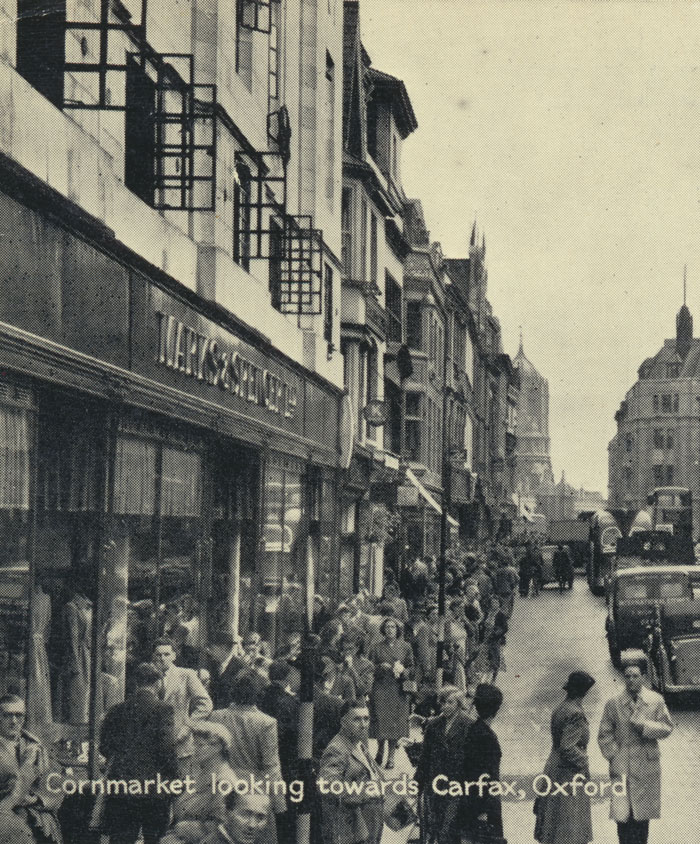
The first Marks & Spencer
In 1934 the three houses here at 18–20 Cornmarket were demolished and replaced by an earlier, smaller Marks & Spencer store, shown in the above photograph, which opened on 10 May 1935,
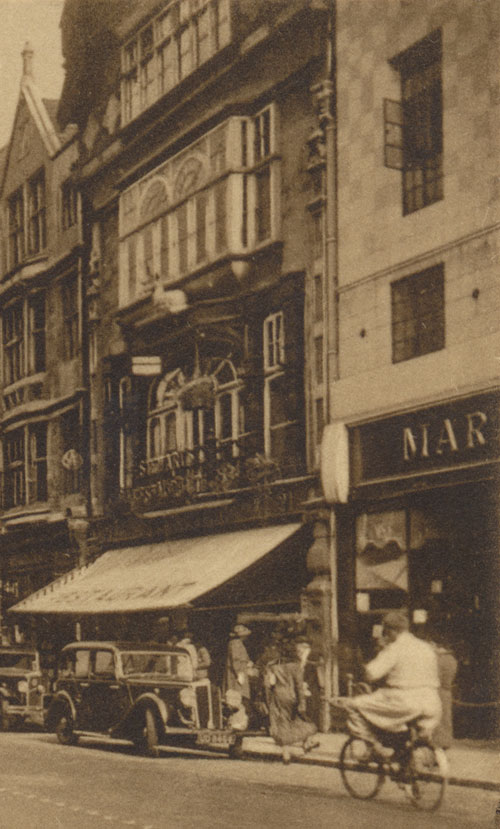
The photograph on the right, which dates from 1937, shows the north end of Marks & Spencer and the restaurant at 21 Cornmarket (into which it later expanded) adjoining it.
The shop was very successful, and by November 1939 it had extended its premises northwards to include the White Hart Inn.
- See Julie Kennedy, The Changing Faces of Oxford City Centre, Book 1, p. 41. for a photograph of the houses being demolished, and p.45 for one showing the new 1935 shop.
The second Marks & Spencer
Jesus College demolished the Marks & Spencer shop in 1960, just 25 years after it was built at the same time as five old shops to the south to make way for a huge new store for Marks & Spencer, Northgate House at 13–20 Cornmarket Street.
The move of Marks & Spencer
In 1976 Marks & Spencer moved out of Cornmarket when it exchanged stores with the Queen Street Co-op.
In 2019 Northgate House was demolished by Jesus College.
Occupants of 18–20 Cornmarket Street listed in directories etc. |
|||
Date |
No. 20 (left) |
No. 19 |
No. 18 (right) |
1839 |
Landlords (not subject to Star & Garter Wine & spirit merchants Star & Garter Hotel Tunnel Hotel
(Wenborn & Son, cutlers, |
Richard Chaundy |
Landlords (subject to 1823: John Northgrove [sic] Also J. R. Mallam by 1909 |
1841– |
George Brown |
||
1861– |
Robert Baxter |
||
1867 |
Mrs Prichard |
||
1868– |
William Samuel Orpwood Mrs Emma Orpwood |
||
1914 |
Smith & Co |
George Bryan & Co with offices upstairs, e.g. |
|
1921– |
|||
1930 |
James Walker Ltd |
||
1932 |
|||
1934 |
These three houses were demolished and replaced by a modern block | ||
1935– |
Marks & Spencer |
||
1961 |
Rebuilt a second time as part of Northgate House for a huge new Marks & Spencer store, |
||
2019– |
Rebuilt a third time as accommodation for Jesus College |
||
18–20 Cornmarket Street in the censuses
1841
No. 18 (Bell Inn): The victualler James Prior (40) lived here with Eliza Prior (40), and Emma and Harriet Prior (9 and 6). They had one female servant, and on census night one independent lady was staying at the inn.
No. 19: George Brown (55), cheesemonger, lived over his shop with his wife Mary (55) and Ann Waddin (30) and Mary Waddin (2). They had one female servant.
No. 20 (Star & Garter): William Nickols (50) lived here with his wife Ann (45), and his five children Harriet (20), William (15), Charles (12), Henry (8), and Ann (6). There were three servants (one male and two female), and two guests. (By 1861 Nickols was at the Anchor Inn at 25A Cornmarket.)
1851
No. 18 (Bell Inn): The innkeeper Miss Mary Prior (25) lived here with her two sisters Emma (20) and Harriett (17) as assistants. They had a lodger (Francis Thompson (22), a Derby-born china merchant), and also living with them was a domestic servant and a porter. Their lodger Thompson had taken over the pub by 1852.
No. 19: George Brown (68), cheesemonger, was still here with his wife Mary (70) and one female servant.
No. 20 (Star & Garter): William Nickols (65) was still innkeeper and lived here with his wife Ann (55) and four of their children: Harriet (28), William (26), described as his father’s assistant); Henry (19), apprenticed from home; and Ann (16). Also living with them was Nickols’s niece Jane Roberts, who was a dressmaker, and an ostler and a house servant.
1861
No. 18 (Bell Inn): John Mayo (31), described as a wine and spirit merchant rather than a landlord, lived here with his wife Celia (30) and his three children: Alice (8), William (6), and Laura (2). They had two female servants and a male porter.
No. 19: The bootmaker Robert Baxter (a widower of 54) lived over the shop with a female shop assistant and house servant.
No. 20 (“Star & Garter”): The pub was now owned by Shillingford & Blake, and there was no live-in landlord: it was occupied by a brickmaker.
1871
No. 18 (Bell Inn): William Barratt (39), licensed victualler, lived here with his wife Sarah (37) and his children Caroline (16), William (14), John (12), Edward (10), Charlotte (8), Samuel (4), and Frederick (2). They had a 15-year-old servant girl and a lodger.
Two other households were listed as living in the Bell Yard. Charles Fitzgerald (35), a coachman lived there with his wife Fanny (28) and his children Alice (4) and Ann (six months), while Charles Bennett (45), a bookbinder, lived alone.No. 19: No listing.
No. 20 (“Star & Garter”): John Slatter (52), a managing clerk, lived here with three servants (two assistants and a housemaid.
1881
No. 18 (Bell Inn): William S. Powell (34), described as an inn-keeper, lived here with his wife Carolina (34) and children Percy (12), Richard (10), Edith (8), William (6), and Daisy (1). Also living at the inn were his father William (55), described as an engineer, and his mother Maria (60). They had two general servants (one male, one female), and a barmaid. Another household is listed as living in Bell Yard.
No. 19: The widowed saddler & harness-maker Emma Orpwood (44) lived here with her children Emma (19), Georgina (17), William (14), described as a saddler’s assistant, Harry (11), Frank (9), Sidney (8), and Alice (4). They had a 15-year-old female general servant
No. 20 (“Star & Garter”): was still owned by Shillingford & Blake and was occupied by the cellarman James Rowles (49), his wife Eliza (51), and his son Albert (17), who was a pupil teacher. Also living on the premises were two barmaids.
1891
No. 18 (Bell Inn): Josiah William Charlton (33), inn keeper, lived here with his wife Nellie (33) and their children Frederick (8), Gertrude (6), Mabel (4), Lillian (2), and Olive (seven months). They had one lodger and one servant.
Two houses in the Bell Yard are listed as uninhabited.
No. 19: Uninhabited: probably part of the saddlery downstairs.
No. 20 (“Star & Garter”): The pub was occupied by his housekeeper and two barmaids.
1901
No. 18 (Bell Inn): William Preston (51), publican, lived here with his wife Elizabeth (47) and his sister Fanny Preston (47). Two barmaids also lived with them.
No. 19: Uninhabited, but in occupation: probably part of the saddlery downstairs.
(Mrs Orpwood, the saddler, was living with three of her children at 21 Leckford Road)No. 20: Part uninhabited but in occupation, and the other part occupied by Mrs Lydia Gass (32), the housekeeper in charge, and her daughter Dorothy (5), plus two barmaids.
1911
No. 18: No listing: the Bell Inn had just closed down.
No. 19: No listing: probably part of the saddlery downstairs.
(Mrs Orpwood the saddler was still living at 21 Leckford Road with three of her childrenNo. 20 (The Tunnel): Samuel James Pickering (50), licensed victualler, lived in seven rooms over this pub with his wife Matilda (44) and daughter Olive (23), who both assisted him in the business, plus a servant.