

24–25 Cornmarket Street: Amorino Gelato
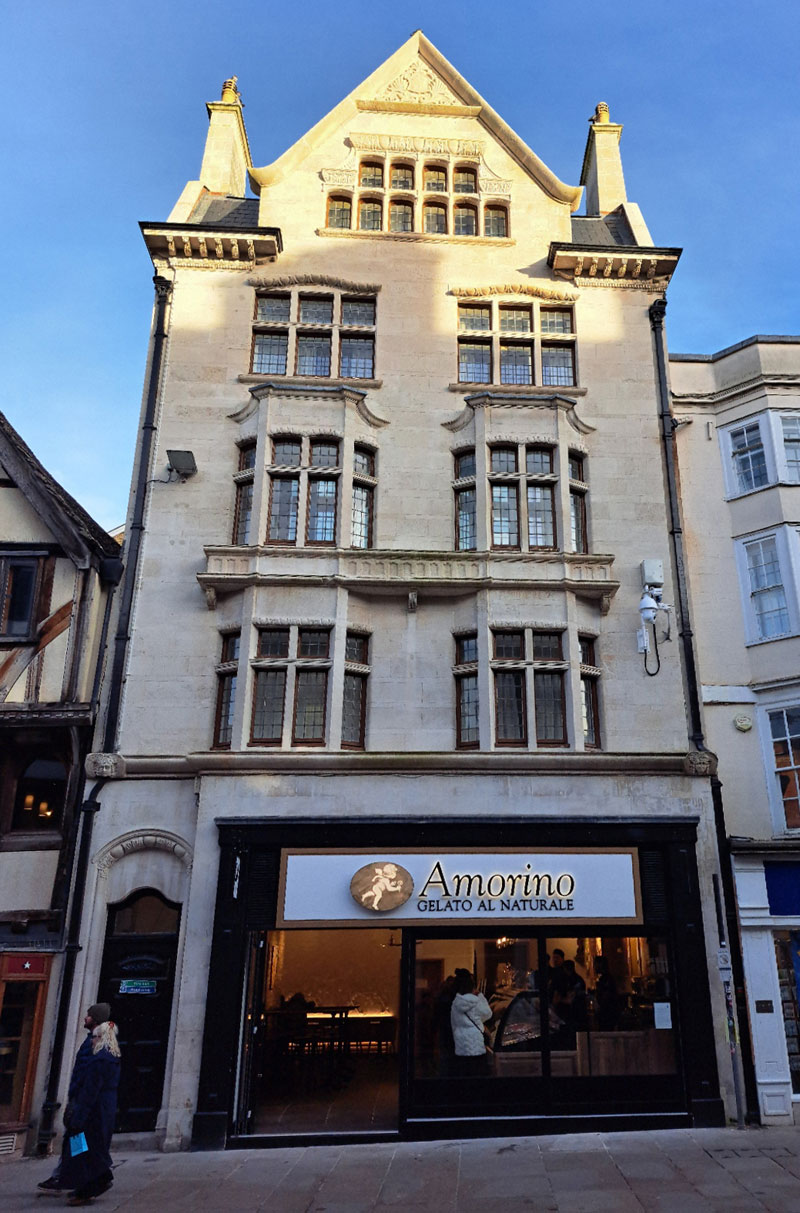
This building was erected in 1911 for the Capital & Counties Bank. It is now owned by Jesus College.
Former building on this site

The above picture shows the pair of matching shops that stood at 24 and 25 Cornmarket from the early 1830s to 1911, No. 24 on the right is marked Luff, Chemist: William Luff had this shop for over fifty years from 1836 to 1890.
The two shops were in the parish of St Michael-at-the-Northgate Church, as is the present single building.
This pair of shops was advertised thus in Jackson’s Oxford Journal on 8 July 1837:
[No. 24, right] All that modern built HOUSE and PREMISES, in a first rate situation for business, erected within these few years at a great expense, and situated in the Corn Market, Oxford; containing a very good front shop, with a staircase leading to a warehouse on the first floor, excellent parlour and kitchen behind the same, with back entrance, a bow windowed front dining room and bed room on the first floor, large front bed room with dressing room adjoining, 2 bed rooms and water closet on the second floor, and bed room over, two good cellars, and other conveniences, in the occupation of Mr. Luff, chemist and druggist.
[No. 25, left] Also, the HOUSE and premises adjoining, built at the same time; containing a front shop, bow windowed dining room, 15ft. by 12ft. and 2 bed rooms on the first floor, large sitting room and 2 small bed rooms on the second floor, and a large bed room and 2 smaller ditto over the same, a kitchen in the basement with back entrance, and other conveniences, in the occupation of Mr. Irwin, hair dresser.
At the time of the 1841 census the chemist William Luff lived at No. 24 with his wife Emma and an apprentice and two lodgers.
The 1841 census shows the hair cutter Charles Irwin lived at No. 25 with Elizabeth Irwin, a lodger, an apprentice, and a servant. On 24 April 1841 Frederick Irwin announced that he had fitted up his first-floor set of lodgings here as haircutting rooms.
The King's Head Inn
From 1772 the King's Head inn at 12 High Street also had an entrance at about this point from Cornmarket. On 28 March 1772 in Jackson's Oxford Journal the corn chandler & seedsman Richard Williams announced that he had taken and entered upon the King's Head Inn, to which he had added his dwelling house in Cornmarket which adjoined it, in order “to enlarge and make the same more commodious”, but that he would also continue the corn-chandlery and seedsman's business as previously. The inn was to be fitted up and genteely furnished, and had post chaises and saddle horses available.
Williams was still a corn dealer and Master of the King's Head Inn when he died on 4 May 1781, and on 26 May his widow Susanna Williams announced that she would continue the business of the inn.
Anchor (or Blue Anchor) Inn
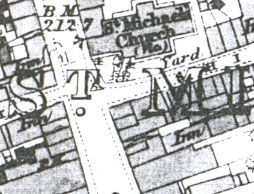
This was in the yard behind the former shops at Nos. 25 & 26 Cornmarket Street, and is marked as “Inn” in the 1876 map, right. It was numbered 25A or 25½, and its name was sometimes lengthened to the Blue Anchor.
On 18 March 1775 Jackson's Oxford Journal advertised a forthcoming auction of the freehold of the Anchor Inn in Cornmarket, along with five adjoining tenements occupied by Mrs Bennet, Mr Baxter, Mr Wootten, Mr Tyror, Mr Coombes, and Pavor, and let at upwards of £54 a year. By 1777 it had been purchased by Henry Talmage.
On 25 April 1795 the following advertisement appeared:
TO be LETT or SOLD,—A PUBLICK HOUSE, called or known by the Sign of the BLUE ANCHOR, in the Corn Market, Oxford, with a small House up the Yard: Likewise two good HOUSES in the Front of the Street, capable of making two good Shops. The above Premisses are Freehold.
The next month, on 16 May 1795, more detail was provided:
Lot I. A large FREEHOLD INN, known by the Name of the BLUE ANCHOR, situated in the Corn-Market, Oxford, with a good Yard, Stabling for eighteen Horses, and a large Granary; likewise a small DWELLING HOUSE in the same Yard, which, if lett separate, always brought in 5l. per Annum, exclusive of Taxes.
Lot II. A FREEHOLD DWELLING HOUSE, adjoining Lot I, facing the Corn-Market, late in the Occupation of Mr. Bennett, Breeches Maker.
Lot III. A FREEHOLD DWELLING HOUSE, on the other Side the Blue Anchor, and facing the Corn-Market aforesaid, late in the occupation of Mrs. Teasler, Widow.
On 28 February 1801 it was advertised for sale again, with the adjoining houses now let to Mr Butler and Mr Prior.
On 23 November 1839 Jackson's Oxford Journal gave a full description of this inn, which was again coming up for auction:
All that extensive and very valuable FREEHOLD INN, situate in the CORN MARKET, Oxford, known by the Sign of the ANCHOR, in the occupation of the proprietor; comprising a carriage entrance from the street and yard, on the south side of which is a range of rooms, consisting of a large parlour, bar, tap-room, store-room, and back kitchen, with large arched cellar under, and four large bed rooms over the same; also a three-stalled stable: these are detached, and approached by a flight of stairs from the yard; two large sitting rooms, harness room, and wash-house; two bed rooms on the first floor, and four bed rooms on the second floor. On the north side of the yard there is stabling for 14 horses, with lofts over, gig-house, and other conveniences.
In the 1841 census it is named the Queen’s Arms, but this seems to have been a temporary aberration, possibly reflecting the recent coronation of Queen Victoria). The innkeeper Benjamin Huslam then lived here with his wife Louisa and their four children, plus several lodgers and two servants.
On 12 April 1873 another auction was advertised, with this description:
Corn Market Street, Oxford
The valuable FREEHOLD MARKET INN, known as “THE ANCHOR, No. 25½ Corn-Market street, in the occupation of Mr. Arthur Lloyd, and in the centre of the most business part of the town....
The Inn contains, on the first floor, three bed rooms and one sitting room; on the ground floor, large smoke room, bar, tap room, and larder, and a large and good cellar in the basement.
There is Stabling for 17 horses, Sheds for vehicles, a nine-roomed House let in Lodgings, Yard, &c., &c.
There is also a Carriage Entrance from Ship-street, which the tenant rents.
On 14 September 1897 J. Penn announced in Jackson's Oxford Journal that he had taken over the Anchor Inn in Cornmarket, adding:
The House having been thoroughly repaired, the Bed-Chambers are fitted up and furnished in a Manner so as to render them comfortable and agreeable. The Stabling, which is extensive and convenient, together with large Store Rooms adjoining, he has also had put in good Repair, and made quite complete for the Accommodation of Horses standing at Livery.
Photograph showing the site of the Blue Anchor Inn in July 1904.


Capital & Counties Bank
In 1901 the Capital & Counties Bank moved into Luff’s old shop at No. 24 and demolished the Blue Anchor Inn behind.
In c.1910 the bank also took over No. 25 next door to the north. It demolished both these shops and replaced them with the current building, which is faced with Portland stone.
The bank reopened in 1911, and the photograph on the left shows the bank in its new premises.
In 1918 the Capital & Counties Bank was amalgamated with Lloyds, and in about 1919 this branch closed down.
Since 1919 the building has been used mainly as a café, latterly as Burger King (right), now closed,
Jesus College extensively restored this block in 1985 (85/00270/NFH)
In August 2023 Jesus College was granted planning permission to convert all five upper floors to accommodation for fourteen students (23/01389/FUL).
Fuller’s Café
For over fifty years the former bank building was occupied by Fuller's Café (shown below), which was here by 1921 and remained until 1972.

Occupants of 24, 25 and 25a Cornmarket Street listed in directories etc. |
|||
No. |
25a (behind left) |
25 (left) |
24 (right) |
1839–1846 |
Anchor Innkeepers |
Charles Irwin, Hair cutter to 1841 |
William Luff (by 1836) |
1851 |
James Sparrow Mary Ann Sparrow |
||
1867–1871 |
John G. Miller |
||
1872 |
Frederic Blagrove |
||
1890 |
Frank Thomas Long |
||
1899 |
Clarence P. A. Morrison |
||
1901–1902 |
Capital & Counties Bank |
||
1903–1905 |
|||
1909 |
Frank Smith refreshment rooms |
||
1911 |
Nos. 24. 25 &, 25A were rebuilt as a bank, numbered simply 24 |
||
1911–c.1918 |
Capital & Counties Bank Ltd with Stafford House, a private boarding house in 1914 |
||
1921–1972 |
Fuller’s Ltd., Confectioners (with bootmakers Lambert in 1947 and Lotus & Delta Ltd in 1952, |
||
1973–1976 |
Kardomah Restaurant |
||
1981 |
Burgerland |
||
1984 |
Huckleberry’s Ltd |
||
1990– 2020 |
Burger King |
||
2020–2025 |
Vacant [but Burger King moved back in temporarily in 2022] |
||
2025– |
Amorino Gelato |
||
24–25 Cornmarket Street in the censuses
1841
No. 24: William Luff (30), a chemist lived here with his siblings Emma Luff (25) and Richard Luff (15). Two “independent” people also lived over the shop: Samuel Baker (53) and John Baker (16).
No. 25: Charles Irwin (30), a hair cutter, lived here with Elizabeth (35). Also in the household is apprentice Henry Fox (15), and independent lodger, and one female servant.
No. 25A (pub, surprisingly named the Queen’s Arms rather than the Anchor): Benjamin Haslam (30), inn keeper, lived here with Louisa (30) and Lavinia (10), William (7), Mary (5), and Benjamin (3). There was one male and one female servant, and four other people who appear to be guests.
1851
No. 24: William Luff (40), the chemist and druggist, still lived here. Born in Abingdon, he was married to Prudence (40) and they had four children: Prudence (7), Mary (6), William (5), and Ann (1), plus one female servant. Also living with them were an “on-liking as an apprentice” called William Dalrymple, and an undergraduate of Brasenose College
No. 25: James Sparrow (38), milliner & mercer, lived here with his wife Marianne (32) and his children Marianne (15), Emily (12), Henry (11), Fanny (9), Charles (7), Frank (6), and Caroline (4); they also had four female staff members (an apprentice, two assistant milliners, and an assistant dressmaker), and one house servant.
No. 25A (pub): Not listed.
1861
No. 24: William Luff (50), chemist and druggist, lived here over his shop with his wife Prudence (50) and their five children; Prudence (17), Mary (16), William (15), Ann (11), and Elizabeth (1), plus one house servant and a 19-year-old chemist’s apprentice. They also had a lodger who was a Commoner of Exeter College.
No. 25 was occupied by the saddler Henry Adams (38) and his wife Ann (36). They had one house servant.
No. 25A (Anchor Inn): William Nickols (74), a widower and innkeeper, lived here with his daughter Mrs Harriett Boucher (37), described as a barmaid, and his granddaughter Emily Boucher (2). Nickols was the former landlord of the Star & Garter at 20 Cornmarket. Also living at the inn were a general porter, an ostler, a house servant, and a nursemaid.
1871
No. 24: William Luff (60), chemist, still lived here over his shop with his wife Prudence (60) and his children Prudence (27), Willilam (25), who was a chemist's assistant, and Elizabeth (20). They had one servant.
No. 25: John G. Miller (31), jeweller, lived here over his shop with his wife Elizabeth (26) and their children Louisa (7), Herbert (4), and Francis (3), plus his sister-in-law Miss Sarah Ann Williams (24) and his niece Louisa Faulkner.
No. 25A (Anchor pub): Arthur Lloyd (46) licensed victualler, lived here with his wife Jane (40) and one servant.
1881
No. 24: William Luff (70) was still the chemist here . He was now a widower, living with his three unmarried daughters: Prudence (37) was simply described as a chemist’s daughter; Mary (36) as a student; and Elizabeth (30) as a housekeeper. They had one servant girl, and a chemist’s assistant was boarding with them.
No. 25: Frank Long (34), a cutler, lived here over his shop with his wife Caroline (29).
No. 25A (Anchor pub): George Strange (47), innkeeper, lived here with his wife Charlotte (47), his son George (7), and stepdaughter Sarah Spencer (18). They had five boarders (an engine fitter, a porter, an inn ostler, and two seamstresses), and two lodgers (a charwoman and a 12-year-old schoolboy).
Living in a separate part was Carey Wilkins, a waiter described as “head lodger”, together with his wife Annie (40), who was a charwoman, and their children Elizabeth (14) and Charles (7).
A second “head lodger” in another subdivision of the pub was Catherine Bench, a charwoman, and her her son Alfred (26), who was a shoe maker.
1891
No. 24: William Luff (80), chemist & druggist, still lived here with his married daughter Anne Woodford (41), who acted as his housekeeper, and her three children Annie (14), William (10), and Mary (5). A chemist's assistant lived with them, and they had one servant.
No. 25: Frank Thomas Long (44), a cutler, lived here over his shop with his wife Caroline (39) and his sister Mrs Sarah Louise Howard (50). They had one domestic servant
No. 25A (Blue Anchor pub): John Baylis (41), builder & publican, lived here with his wife Eliza (41) and daughter Annie (15), who both assisted in the pub. They had one lodger.
1901
No. 24: Alexander Wilson (26), the cashier at the Capital & Counties Bank that had just moved in on the ground floor, lived here with his married sister Maggie Marwood (34) and her children Ralph (9) and Phyllis (3), plus a general servant.
No. 25: Frank Long (54), cutler, lived here over his shop with his wife Caroline (49).
No. 25A (Anchor pub): John Baylis (51), a licensed victualler, lived here with his wife Pamela (49).
SITE OF NOS. 24, 25, & 25A REDEVELOPED in c.1910
1911
Nos. 24 & 25: Arthur Kippin (30) and his wife Matilda (28), both described as lodging-house keepers, lived here over the new Capital & Counties Bank premises with their son Arthur (2) and two servants. Only one boarder was staying in these 17-roomed premises.