

52 Cornmarket Street (site of former Star/Clarendon Hotel)

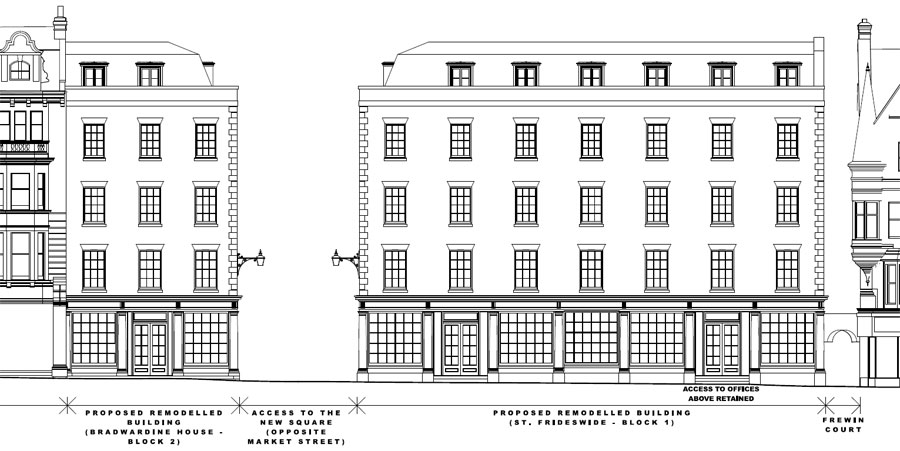
Clarendon House (above, in 2018) is currently closed and is being altered and part demolished as part of the creation of Oxford's Clarendon Quarter. The proposed elevation to Cornmarket is shown below:
Clarendon House replaced the former Clarendon Hotel (shown below in c.1905), which was demolished in 1954.

The ancient coaching inn on this site was known as The Star for at least 400 years until 1863. Its front was replaced with a symmetrical façade in 1783.
See E. M. Jope, “The Clarendon Hotel, Oxford. Part I. The Site” and W. A. Pantin, “The Clarendon Hotel, Oxford. Part II. The Buildings” in Oxoniensia XXIII (1958).
The 1772 Survey of Oxford suggests that Mr Mewhill may have been the innholder of the Star at that date.

The blue plaque (right) on the north side of the Clarendon Centre remembers the Star Inn as the place where the Oxford Yeomanry was formed in 1794.
In 1823 the following coaches left the Star each day:
- For London: The Blenheim at 8am; the Star at 9am; the Aurora at 11am; the Royal Sovereign and the Retaliator at 12.30pm; the Courier at 2pm; and the Royal Eclipse at 9pm.
- The Banbury, Warwick, Leamington, and Birmingham coach left the Star at 12.30pm
- The Ludlow coach left the Star at 12 noon
- For Woodstock: The Blenheim left the Star at 4pm
- For Worcester: The Aurora left at 12.30pm, and
the Eclipse at 11pm.
The print below shows the Blenheim coach, which travelled between London and Woodstock via Headington and Oxford, loading passengers outside Coles's General Coach Office at the Star Inn in Cornmarket, probably in about 1831. The door of the coach lists Thomas Kirby, John Kirby, and John Coles. The office proclaims that coaches left the Star for all parts of the kingdom, and above the gateway on the right is the sign for Richard Staning, the current innkeeper, announcing that he was a "licenced retailer of beer, cyder, foreign & British spirits & foreign wines":
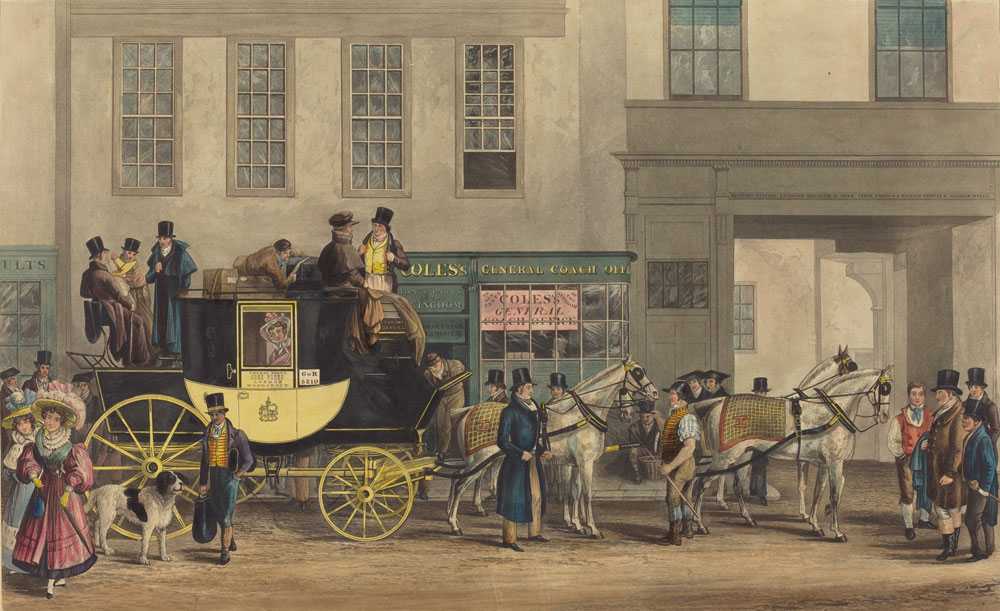 This print held by the National Gallery of Art in Washington is available in a larger size on Wikimedia Commons

At the time of the 1841 census about twenty guests were staying at the Star Hotel, including the Marchioness of Londonderry and her daughter Lady Alexandra Vane, plus about ten female servants and fourteen male servants.
In the 1840s and 1850s the railway began to be the predominant mode of travel (with Woodstock station opening in 1853), and coach travel became less popular.
In 1863 the Star was acquired by the Oxford Hotel Company, and Jackson’s Oxford Journal for 14 March that year reported that it would be renamed either the Alexandra (after the newly wed Princess of Wales) or the Clarendon. The latter won the day, and reopened just in time for Commemoration: on 13 June 1863 it was advertised in Jackson's Oxford Journal as having new furniture throughout and an “elegant coffee room for the ladies”. On 26 June 1863 Charles Dodgson (Lewis Carroll) wrote in his diary, “[Augustus George Vernon] Harcourt and I afterwards dined together at the new 'Clarendon' Hotel."
The Clarendon Club was founded here in 1863, but moved to 54 Cornmarket in 1882. (It returned here in the 1940s and early 1950s.)
On 15 October 1864 Jackson's Oxford Journal reported that the Clarendon Hotel had been new fronted, and that a building was being erected on the site for the Apollo University Lodge of Freemasons.
The map below shows the Clarendon Hotel in 1876, with its large yard to the south and west.

The Clarendon Hotel Livery Stables were in that yard. In 1878 Mr Attwood, who had recently taken them over, advertised that as well as hearses and morning coaches, the Posting Department was “replete with every kind of Conveyance, including roomy Flys for Balls, and Landaus, Dog Carts, Phaetons, Wagonettes, and with steady Horses and careful Drivers, at moderate charges. Also elegant Wedding Broughams, with Postilions if required.”
The photograph below was taken outside the Clarendon Hotel in 1906, and shows a group of young men (probably undergraduates of Pembroke College) about to embark on a journey in the rain.

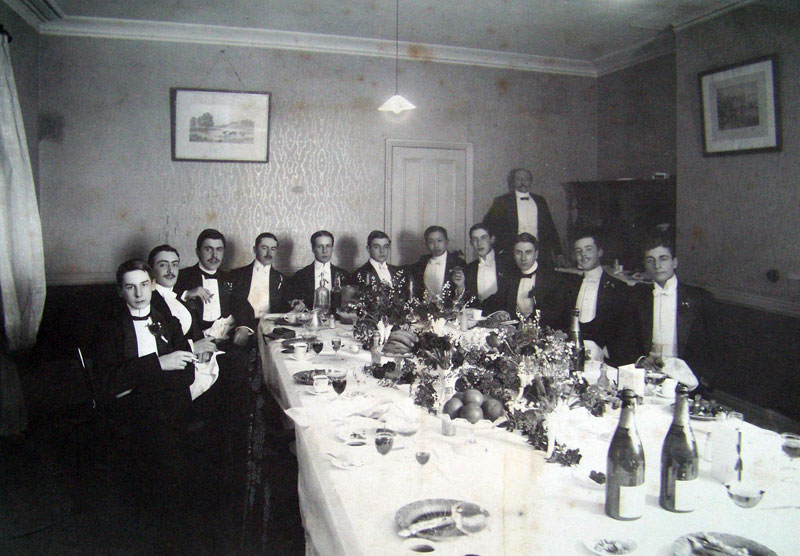
The photograph below shows a CTC (presumably Cyclists’ Touring Club) dinner at the Clarendon on 7 November 1905. (Both these photographs are in the possession of Derek Collier.)
The Clarendon can be seen dominating the east side of Cornmarket in the postcard below:

There is a free-standing electric lamp outside the hotel, whose proprietor appears to have been shocked initially at the amount of light it gave out. On 7 January 1893 the city council’s General Purposes Committee “considered the request of the proprietor of the Clarendon Hotel that the electric lamp opposite Market-street be extinguished after 9.30 or 10 every night, but are of opinion that the difficulties in the way of acceding to this request are insuperable”.
This hotel later became part of the Trust House group, which produced the postcard shown below: the same lamp is still visible:

The Clarendon Hotel closed down in 1939.
The Clarendon Hotel at 52 Cornmarket Street in the censuses
1851
No innkeeper appears to be present at the Star Hotel on census night. The guests at the hotel include the Marchioness of Londonderry and Alexandra La Lane and the physician Thomas Star with Georgina and their two servants. An office clerk and fourteen servants (six female and eight male) slept on the premises.
1851
Samuel Young Griffith (51, born in Bath) is hotel keeper at the “Star Hotel”. He lived here with his wife Sarah (44, born Marlborough) and two daughters: Grace (21) and born in Oxford, and Rebecca (5) and born in Cheltenham. They had ten live-in servants (two chambermaids, a housemaid, kitchenmaid, china-maid, nurse, waiter, porter, and coachman. Staying at the hotel were two commercial travellers, and a retired horse-keeper aged 82. Living next door at the Star Tap were Thomas Beesley, the hotel’s porter, with his wife and four children, his mother-in-law, and a house servant.
1861
Samuel Young Griffith (61) was still the keeper of the Star Hotel and was also described as a wine merchant. His wife Sarah (56), and his unmarried Oxford-born daughter, Adelaide (21) were living with him. He had until recently also run the Angel Inn in the High Street, which was in the process of being closed down. There were eleven servants living at the inn: a cook, barmaid, ostler, and waiter; three housemaids; two chambermaids; and two porters. There were only two guests on census night: James Manning (79), who was the Recorder of Oxford, and his niece Sarah.
1871
William Swadling (38), described as licensed victualler at the Clarendon Tap, lived here with his wife Elizabeth (38) and two domestic servants. The main hotel building is described as unoccupied.
James Belcher (36), cellarman, lived in Clarendon Passage with his wife Emma (32) and their children Ernest (13) and Christiana (1).
1881
John F. Attwood (50), the keeper of the Clarendon Hotel, lived here with his wife Hannah Attwood (36)and his wife’s sister, Mary E. Kite, who worked in the inn. The other sixteen live-in servants were a book-keeper, a barmaid, a chambermaid, a kitchenmaid, housemaid, still-room maid, under-chambermaid, scullery maid, three waiters, a boots and under-boots, a plate-man, page, and billiard-marker. Next door at the “Clarendon Tap” lived two Clarendon Inn ostlers.
1891
Edward St Clair Rogers (27), the proprietor of the Clarendon, lived here with his wife Helen (33) and their children Helen (10) and Howden (6). Also living on the premises were a bookkeeper, nurse, domestic servant, barmaid, page boy, waiter, two general servants, housemaid, two boots, and a platemen. Three guests were staying at the hotel.
There is a separate listing for the “Clarendon Shades” in the Clarendon Yard: its manageress, Emilie Kimber (27) lived there with a servant girl.
1901
James Dyson (51), the hotel keeper at the Clarendon, lived here with his wife Elizabeth (50) and their children Helen & Alice (both 24), Jessie (22), and Alan (17). There were also 21 servants living on the premises (the hotel bookkeeper, three barmaids, a chambermaid, four housemaids, a still-room maid, a vegetable maid, a scullery maid, three porters, a chef, two waiters, a plateman, and two pages. There were seven guests and one boarder at the hotel.
1911
George Sanders (59), the proprietor of the Clarendon, lived in this 60-roomed hotel with his son Hugh Saunders (26), who was the hotel manager. Twenty-two servants lived with them: a chef, a vegetable chef, two kitchen porters, a pastry cook, a plateman, a house porter, a billiard marker, a head bookkeeper, a relief bookkeeper, three housemaids, a barmaid, a stillroom maid, a ladies maid, a linen-keeper, two night porters, two grooms and two workers. Eleven guests were staying at the hotel on census night.
Since 1939
In 1939 the Clarendon Hotel was bought by Woolworth & Co. (who then occupied the former Roebuck Hotel on the opposite side of Cornmarket). Their plans to demolish the Clarendon Hotel and replace it by a new store were delayed because of the war. In 1944 Lawrence Dale wrote in Towards a Plan for Oxford City, “When the Clarendon goes this superb street [Cornmarket] may be said to have been destroyed by inertia and intolerance more effectively than by high explosive.”
During the Second World war the building served as an American Servicemen’s Club, and then until 1952 it was used as offices.
Both the City and University refused planning permission to Woolworth's, but they went to appeal and in 1952 Harold Macmillan (then the Minister of Housing and Local Government) came down in favour of Woolworth’s. The Mayor of Oxford in 1953/4, Alan Brock Brown, described the decision as a disaster.
The Clarendon Hotel was demolished in 1955 (photograph of demolition) and the Morris Garages behind were closed to make way for the the new Woolworth's store, designed in 1956–7 by Lord Holford, with the front made of Clipston stone, Bladon stone, and grey slate. It was, five times larger than its predecessor and featured a cafeteria.
The new Woolworth's, was opened on Friday, October 18, 1957 by the Mayor for 1957/8, Robert Frank Knight, who told guests:
When I look at this very wonderful building from the Mayor’s Parlour, I realise what you have achieved. The inside is staggering and, inside and out, you have nothing to be ashamed of. I can say that, as a city, we are very proud of your frontage.
Pevsner commended Clarendon House as one of the best recent buildings in the city's main shopping streets, saying that it showed “how this kind of job can be done tactfully and elegantly”.
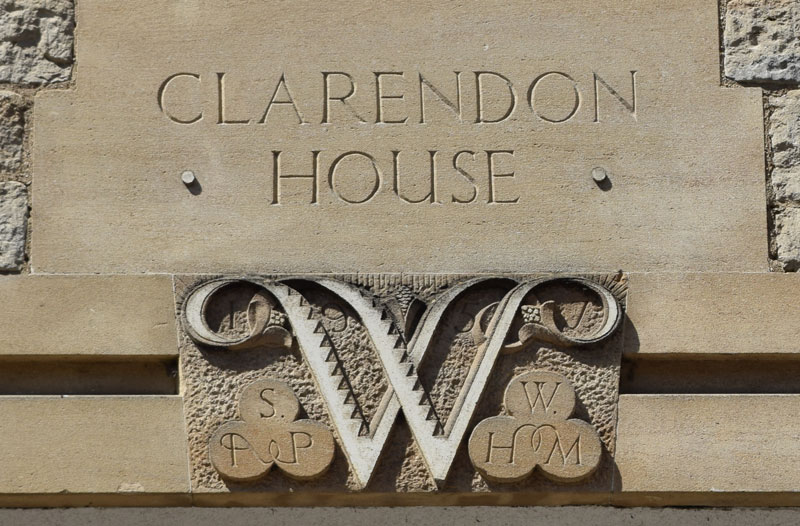
Below: The Woolworth’s logo of an ornate W with the date 1957 hiding in the top curls of the letters still remains on the front of the old store (photographed 2018). WHM on the right probably stands for William Harvey Moore, but the other set of initials, SAP, is uncertain.
The Oxford branch of Woolworth’s closed in January 1983.
First redevelopment of the area (1980s): Woolworth's becomes Clarendon Centre
in 1983/4 the Clarendon Centre (now owned by Lothbury Investment Management) was created (planning application 82/00756/A_H). This included one large retail unit, 22 small to medium units, and a pedestrian mall linking Cornmarket to Shoe Lane and Queen Street. Clarendon LP GP Ltd was incorporated on 11 January 2000, and the centre then underwent refurbishment (planning applications by the Lothbury Property Trust Co. Ltd 98/01716/NFH and 99/00459/NFH).
Second (abortive) attempt to redevelop the Clarendon Centre (2023)
In 2023/4 a major redevelopment of the Clarendon Centre behind Cornmarket Street and Queen Street was planned. Oxford Science Enterprises announced in March 2022 that it had entered into “a joint venture with the Lothbury Property Trust (“Lothbury”) to develop high-specification laboratory and office space, for early-stage life science businesses” here:
- OBN: Oxford Science Enterprises Enters Agreement with Lothbury to Develop State-of-the-Art
R&D Facilities in Oxford City Centre - UK Property Forums: £200m redevelopment for Oxford’s Clarendon Centre
Clarendon LP GP Ltd was formed, and the original plan was that some existing buildings would be reused and new ones erected to form retail, offices, research and development, and student accommodation for Brasenose College, with a new public square and a new pedestrian/cycle access through to Frewin Court (approved planning application 21/00110/FUL). The development was designed by Farrer Huxley: see their vision here.
This Clarendon Centre project stalled in February 2024 when Clarendon LP GP Ltd went bankrupt, and in September 2024 Lothbury Investment Management put the freehold of the Clarendon Centre up for sale.
Clarendon Square being created in 2026
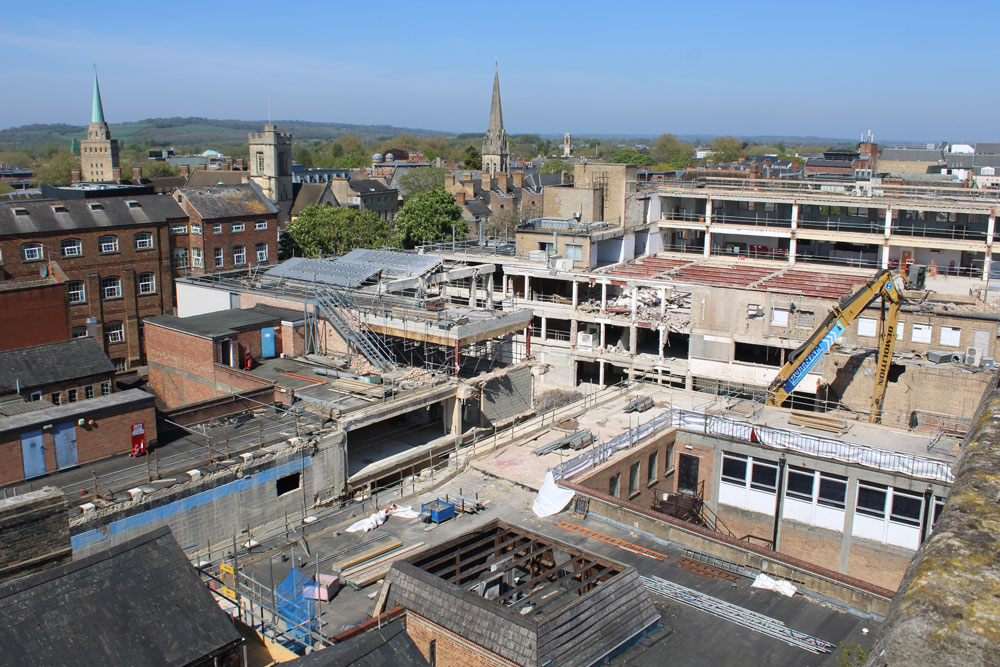
The redevelopment of the Clarendon Centre and adjoining buildings is at last under way. The above photograph (taken from the top of Carfax Tower) shows the Clarendon Centre in the process of demolition on 23 April 2026.
GP [Goldmoney Properties] Clarendon Square Ltd was incorporated on 29 November 2024, and on 10 December 2024 Goldmoney Inc. (the company of the the Canadian investor Roy Sebag) ) announced that it had completed the material acquisition of a portfolio of freehold properties known as the Clarendon Quarter. The project was now much larger, covering two acres, as Goldmoney also bought up adjacent shops (including the former premises of McDonald's and Barclays Bank, and the HSBC Bank and the Carfax Café area).
Clarendon Square Construction Ltd was incorporated on 22 December 2025, and in February 2026 GP Clarendon Square Ltd submitted a major planning application for the Clarendon Quarter, including a large new public square (measuring 41 x 42 metres) with a fountain:
Approved planning application 26/00463/FUL
This supersedes the earlier approved application and covers a wider area. Phase 2 (the new entrance from Carfax) will be the subject of a later application.
Occupants of 52 Cornmarket Street listed in directories etc. |
||||
To 1862 |
Star Inn Some innkeepers (subject to nineteenth-century wine licences): John Perry (1756) then Mrs Perry (until her death on 27 January 1769) |
|||
1863–1939 |
Clarendon Hotel Innkeepers/hoteliers (subject to 19C wine licences): Charles Titian Hawkins (1864/5) Henry Kelson & Son, tailors, were also listed at No. 52 in the early twentieth century |
|||
1939–1945 |
American Services Club, with Morris Garages (on the site of the former stables behind) Clarendon Club |
|||
1947–1952 |
Various Government offices,
e.g. in 1947 alone: The Morris Garages Ltd (Clarendon Garage) Clarendon Club |
|||
In 1954–1957 the former hotel was demolished and rebuilt as a large store |
||||
1957–1983 |
Woolworth’s, |
|||
In 1983 the old Woolworth's store was rebuilt as the CLARENDON CENTRE |
||||
Main shop (on right) |
Entrance |
Small shop (on left) |
Entrance |
|
1984–1999+ |
Littlewood’s |
Reject China Shop in 1984 |
||
2003–present |
Gap store |
H. Samuel to April 2018 and |
||
2019–2021 |
Tortilla Burritos |
|||
2021–2025 |
HMV |
|||
2025 |
Vacant and boarded up: Clarendon Centre undergoing major redevelopment |
|||