

Oxford Inscriptions: University Museum
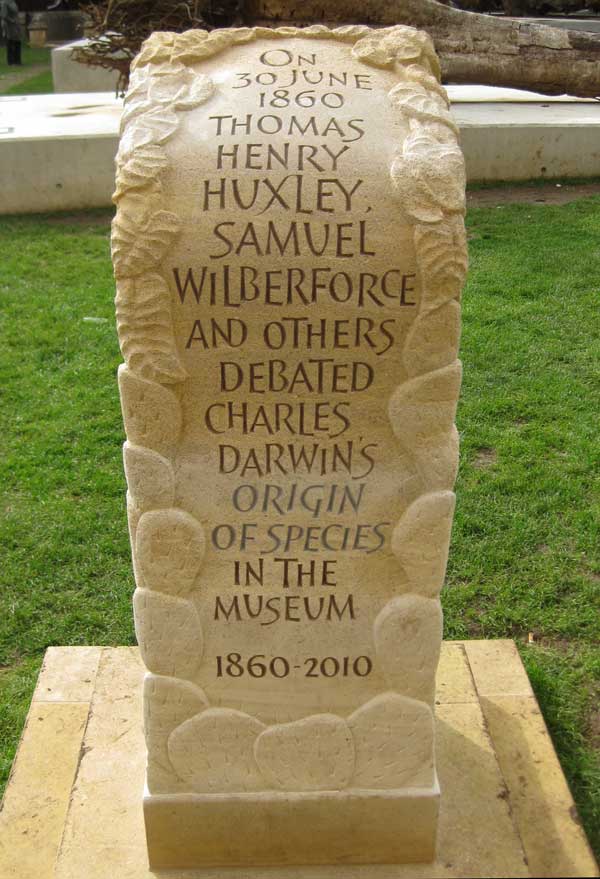
ON
30 JUNE
1860
THOMAS
HENRY
HUXLEY,
SAMUEL
WILBERFORCE
AND OTHERS
DEBATED
CHARLES
DARWIN’S
ORIGIN
OF SPECIES
IN THE
MUSEUM
1860–2010
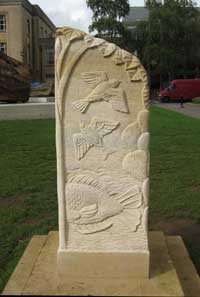
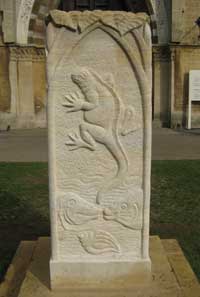
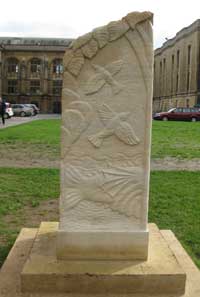
This stone was designed by 15-year-old Poppy Simonson from St Helen and St Katharine School in Abingdon and installed in 2010 to mark the 150th anniversary of Thomas Huxley’s debate with Bishop Samuel Wilberforce at the University Museum (now renamed the Oxford University Museum of Natural History).
The Great Debate
Below: the other three sides of this stone
William Tuckwell attended the debate at the Museum and described it in detail in his Reminiscences of Oxford (1900):
At last the Museum was so far finished as to receive the British Association of 1860. Sections fell conveniently into the lecture-rooms: the area, not yet choked with cases, held the evening gatherings; and the large Library, devoid of books and shelves, was dedicated to the Darwinian discussion, the great event of the week. The room filled early, and we waited long. Owen was to take the chair, but did not come; he was replaced by an unclerical-looking man in black, whom we in Oxford knew not, but whom all Cambridge honoured as Professor Henslow. The attack on Darwin's book was to be led by the Bishop of Oxford, who had written in the last Quarterly a denunciatory article inspired by Owen, and Huxley was to head the defence. The Bishop came late, trampling his way through the dense crowd to his place upon the platform, his face no longer refined and spiritual as in the early Richmond portrait; coarsened somewhat even plebeianised, by advancing years, but resourceful, pugnacious, impregnable, not a little arrogant. On the chairman's other side sat Huxley; hair jet black and thick, slight whiskers, pale full fleshy face, the two strong lines of later years already marked, an ominous quiver in his mouth, and an arrow ready to come out of it. For a moment Daubeny beamed on us at the upper door, inviting all at three o'clock to his experimental garden on the Iffley Road. Professor Draper of New York, eminent, serious, nasal, read a paper on Evolution; then, during an expectant pause, out came the Derby dog in the person of old “Dicky” Greswell of Worcester, who, with great eyes, vast white neckcloth, luminous bald head and spectacles, rising and falling rhythmically on his toes, opined that all theories as to the ascent of man were vitiated by the fact, undoubted but irrelevant, that, in the words of Pope, Great Homer died three thousand years ago. Another pause, an appeal from the chairman to Huxley, his sarcastic response that he certainly held a brief for Science, but had not yet heard it assailed.
Then up got Wilberforce, argumentative, rhetorical, amusing; retraced the ground of his article, distinguished between a “working and a causal hypothesis,” complimented “Professor Huxley who is about to demolish me,” plagiarised from a mountebank sermon by Burgon, expressing the “disquietude” he should feel were a “venerable ape” to be shown to him as his ancestress in the Zoo: a piece of clever, diverting, unworthy claptrap. Huxley rose, white with anger. “I should be sorry to demolish so eminent a prelate, but for myself I would rather be descended from an ape than from a divine who employs authority to stifle truth.” A gasp and shudder through the room, the scientists uneasy, the orthodox furious, the Bishop wearing that fat, provoking smile which once, as Osborne Gordon reminds us, impelled Lord Derby in the House of Lords to an unparliamentary quotation from “Hamlet.” “I am asked,” Huxley went on, “if I accept Mr. Darwin's book as a complete causal hypothesis. Belated on a roadless common in a dark night, if a lantern were offered to me, should I refuse it because it shed imperfect light? I think not—I think not.” He met Wilberforce's points, not always effectively, not entirely at his case; the “venerable ape's” rude arms were choking him. The Bishop radiantly purged himself. He did not mean to hurt the Professor's feelings: it was our fault—we had laughed, and that made him pursue the joke. We laughed again, and Huxley was not appeased.
Another pause, broken by a voice from the crowd of a grey-haired, Roman-nosed, elderly gentleman. It was Admiral Fitzroy, and men listened; but when the found he had nothing more to say than that Darwin's book had given him acutest pain, the cry of “Question” silenced him. Another voice from the far end of the long room, a stout man waved and slapped a blue-book; told us that he was no naturalist but a statistician, and that if you could prove Darwin's theories you could prove anything. A roar of displeasure proclaimed the meeting's inaptitude at that moment for statistics, and the stout man made his exit with a defiant remonstrance. Now, we thought, for business; but no, there was another act of comedy. From the back of the platform emerged a clerical gentleman, asking for a blackboard. It was produced, and amid dead silence he chalked two crosses at its opposite corners, and stood pointing to them as if admiring his achievement. We gazed at him, and he at us, but nothing came of it, till suddenly the absurdity of the situation seemed to strike the whole assembly simultaneously, and there went up such ἄσβεστος γέλος as those serious walls would never hear again. Again and again the laughter pealed, as purposeless laughter is wont to do; under it the artist and his blackboard were gently persuaded to the rear, and we saw him no more. He was supposed to be an Irish parson, scientifically minded; but what his hieratic meant or what he wished to say remains inscrutable, the thought he had in him, as Carlyle says of the long-flowing Turk who followed Anacharsis Clootz, conjectural to this day.
Wikipedia:
1860 Oxford evolution debate
Thomas Henry Huxley
Samuel Wilberforce