
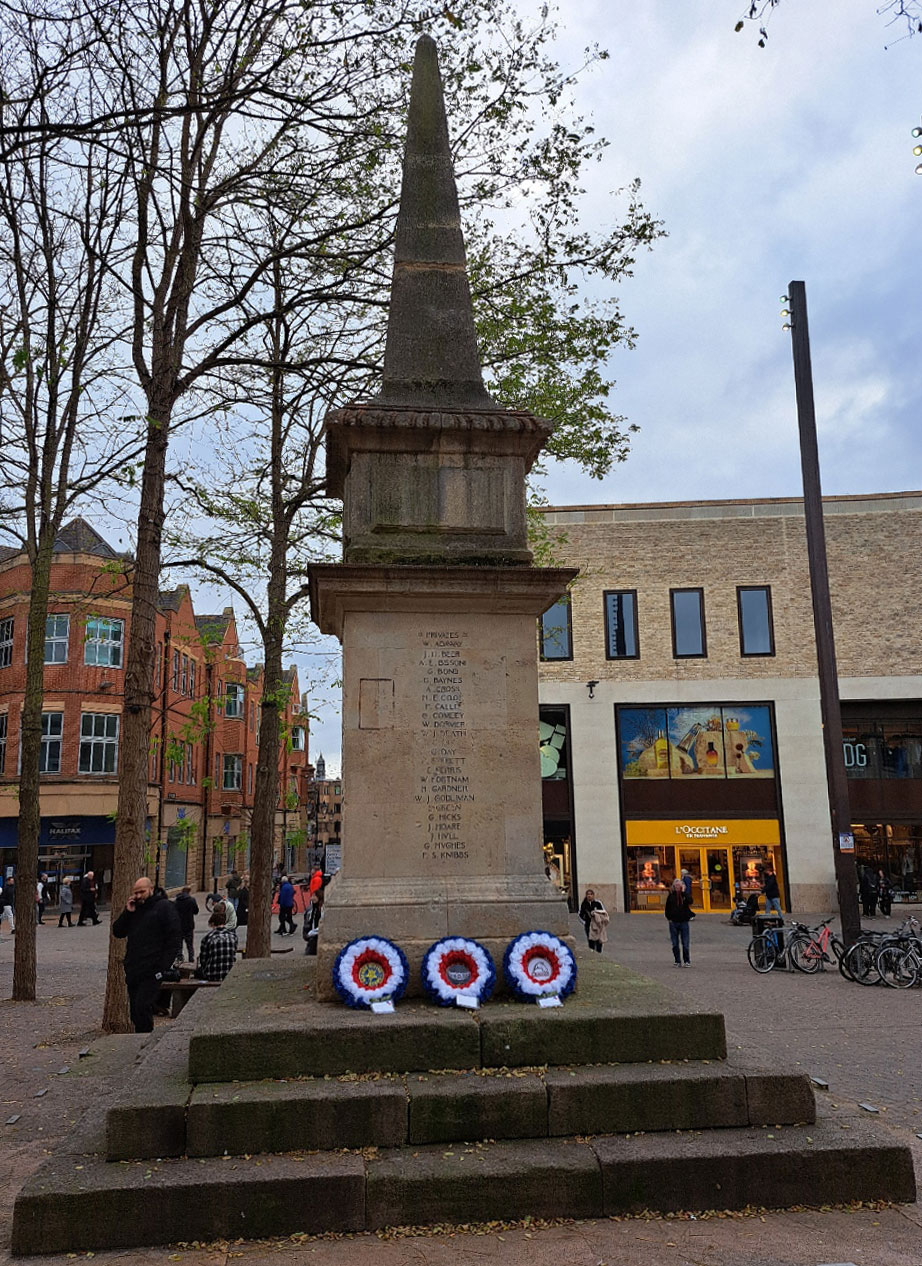
This so-called Tirah Memorial is the first free-standing war memorial ever erected in Oxford, and in 1972 it was designated a listed structure (List Entry No. 1338518). It was built in July 1900 and is often described as Oxford's first war memorial, but in fact the Balochistan memorial was placed on the wall of St Mary-the-Virgin Church nearly four years earlier in September 1886
It was designed by Francis Inigo Thomas (1865–1950) and built by Messrs Franklin of Deddington in 1900. The twenty-five-foot high obelisk is made of stone from Monk’s Park Quarry, Bath and stands on a base of Doulting stone. It has foundations 20 feet deep.
It commemorates the 62 soldiers of the 2nd Battalion of the Oxfordshire Light Infantry who died between 15 August 1897 and 4 November 1898 on the North West Frontier of India. Almost all of them took part in the Tirah Campaign which was launched in October 1897 and many had also taken part in the earlier Mohmand Campaign, but one was murdered by mutineers in Uganda. Very few died actually fighting: of the 62 men named, 53 died of disease.
This war memorial was erected in a public garden that had been formed in 1874 from a redundant churchyard. (The first Church of St Peter-le-Bailey used to stand on the corner of Queen Street and New Inn Hall Street, but was demolished in 1874 as part of a road-widening scheme.) This public garden was named Bonn Square after Oxford’s first twin-town in 1974, and in 2007/8 the old trees were removed and the garden paved over.
The men who died in the Tirah Campaign itself are buried at the Landi Kotal Cemetery at the Khyber Pass.
The Oxfordshire Light Infantry was a regiment formed during the Army reforms of 1881 by merging the 43rd (Monmouthshire Light Infantry) Regiment of Foot and the 52nd (Oxfordshire) Regiment of Foot (Light Infantry). These became the new unit's 1st and 2nd Battalions respectively.
Some of the names below are linked to brief biographies, but officers predominate as it is hard to identify many of the ordinary soldiers, especially as they come from all over the UK and dying of disease was insufficiently heroic to warrant a newspaper report. The numbers in square brackets (not on the memorial) are their regimental number.
South side (front)
At the top is a carved wreath surrounding
THIS MONUMENT WAS ERECTED |
|||
East side
KILLED BY MUTINEERS IN UGANDA
|
|||
North side
(“Died of disease” continued)PRIVATES |
|||
West side
(“Died of disease” continued) F. T. KING [4913] |


Jackson’s Oxford Journal for 7 July 1900 (p. 8) has a large drawing of the memorial (shown below), followed by a very full report headed The unveiling ceremony, of which the text on the right below is just a small part:

“ The monument to the memory of the officers and men of the 2nd Battalion Oxfordshire Light Infantry who died or were killed in action on the north-western frontier of India, and elsewhere, in the period from August, 1897, to November, 1898, and which has been erected by their comrades in the regiment on a site given by the Corporation, on which formerly stood the church of St-Peter-le-Bailey, and is now a public garden, at the junction of New-road with Queen-street, was unveiled on Friday afternoon, in the presence of a large assemblage of the general public, by Miss Morrell, daughter of the Mayor, who performed the ceremony in the unavoidable absence of her mother. The 2nd Battalion is now serving in India, and application for the granting of a site having been made by the Commanding Officer, Colonel Plowden, the Corporation fixed upon this position of ground as occupying one of the most convenient positions in the city, and very readily granted it for so appropriate a purpose. In digging for the foundations it was found necessary to go to a depth of 20 feet, the excavations having to be carried through the soil which had been used as a graveyard into the ground below, where a great many bones of animals were found. The human remains were carefully collected and taken away for re-burial at Osney Cemetery. At the bottom of the trench concrete was laid, and the foundation has been formed of this material for the ground level. The base of the monument consists of three steps of Doulting stone, and the erection then takes a square form to a height of about 14 feet, where there is a cornice, and about two feet above that a moulded string course, and from thence to the top the stonework is pyramidal in shape, the total height being 25 feet. The stone of which the monument consists from the base came from Monk’s Park Quarry, Bath.”
The newspaper then lists all the men whose names are recorded on the monument (although some of them are spelt incorrectly), and goes on to describe how a guard of honour and fifty men from the Barracks, some of whom were wearing the Tirah Medal, stood with fixed bayonets during the proceedings, which included long speeches by the Mayor (Frederick Parker Morrell), the Hon. & Revd William Talbot Rice (Rector of St Peter-le-Bailey Church), Colonel James Arthur Strachan from Cowley Barracks on behalf of the 2nd Battalion Oxfordshire Light Infantry, and Alderman Buckell. The Revd Talbot Rice said:
This monument, placed as it was in a very prominent position in the city, would help to remind all passers-by at what a great cost the Empire that they boasted and were proud of had been won and was being held.

Above: the Tirah Memorial before Bonn Square was redeveloped in 2008
Below: Historic England photograph (CC51/00444) showing that the Tirah Memorial
was originally protected by a fence:


India Medal of 1895
The obverse of the original India Medal of 1895 (left) shows a British and an Indian soldier supporting a flag, and is inscribed “INDIA 1895”.
The reverse of the original medal (right) shows a veiled and crowned bust of Queen Victoria with the text “VICTORIA REGINA ET IMPERATRIX” (“Victoria Queen and Empress”) around the edge.
The two bars added to the medal read:
“TIRAH 1897–8”
and
“PUNJAB FRONTIER 1897–98”

Private J. Walker of the Oxfordshire Light Infantry
wearing the medal shown above
For full details of the Tirah Campaign, see:
The Oxfor Tirah memorial on databases:
Imperial War Museums:
2nd Battalion Oxfordshire Light Infantry (Tirah Memorial)
War Memorials online:
Oxford (Tirah Campaign/
Oxfordshire Light Infantry)
The following book about the memorial was published in October 2024:
Duncan Taylor, Lest We Remember: what Oxford's war memorial tells us about the British Empire and why that matters
The memorial was coincidentally vandalized in that month:
Oxford Mail, 18 October 2024:
“Oxford Tirah war memorial spray-painted by vandals”
