Oxford Mileways Act 1771: Coach travel
The roads into Oxford from the east and north were heavily used by coaches, and this would have increased after the Mileways Act and the creation of the new London Road through Headington, avoiding Shotover.
In his Reminiscences of Oxford, William Tuckwell (born 1829, the son of the surgeon William Tuckwell senior) described the coaches that went past his house at the east end of the High Street in the 1830s, when almost a hundred coaches a day passed that way. He stated that travellers drew up at the Angel, or passed on to the Mitre or the Star, and described the coaches as follows:
Along that road [High Street] or into Oxford by the St Giles's entrance, lumbered at midnight Pickford's vast waggons with their six musically belled horses; sped stage-coaches all day long — Tantivy, Defiance, Rival, Regulator, Mazeppa, Dart, Magnet, Blenheim, and some thirty more; heaped high with ponderous luggage and with cloaked passengers, thickly hung at Christmas time with turkeys, with pheasants in October; their guards, picked buglers, sending before them as they passed Magdalen Bridge the now forgotten strains of “Brignall Banks,” “The Troubadour,” “I'd be a Butterfly,” “The Maid of Llangollen,” or “Begone Dull Care”; on the box their queer old purple-faced, many-caped drivers — Cheeseman, Steevens, Fowles, Charles Homes, Jack Adams, and Black Will. This last jehu, spending three nights of the week in Oxford, four in London, maintained in both a home, presided over by two several wives, with each of whom he had gone through the marriage ceremony, and and for many years — so distant was Oxford then from London — kept each partner ignorant of her sister's existence. The story came out at last; but the wives seem not to have objected, and it was the business of no one else; indeed, had he been indicted for bigamy, no Oxford jury could have been found to convict Black Will.
The coaches were horsed by Richard Costar, as great an original as any of his men; those who on his weekly visits to the Bensington stables sat behind Black Will and his master and overheard their talk, listened, with amusement or disgust, to a rampant paraphrase of Lucretius' Fourth Book. He lived in the picturesque house on the Cherwell, just opposite Magdalen Turnpike, having two entrance gates, one each side of the pike, so that he could always elude payment.
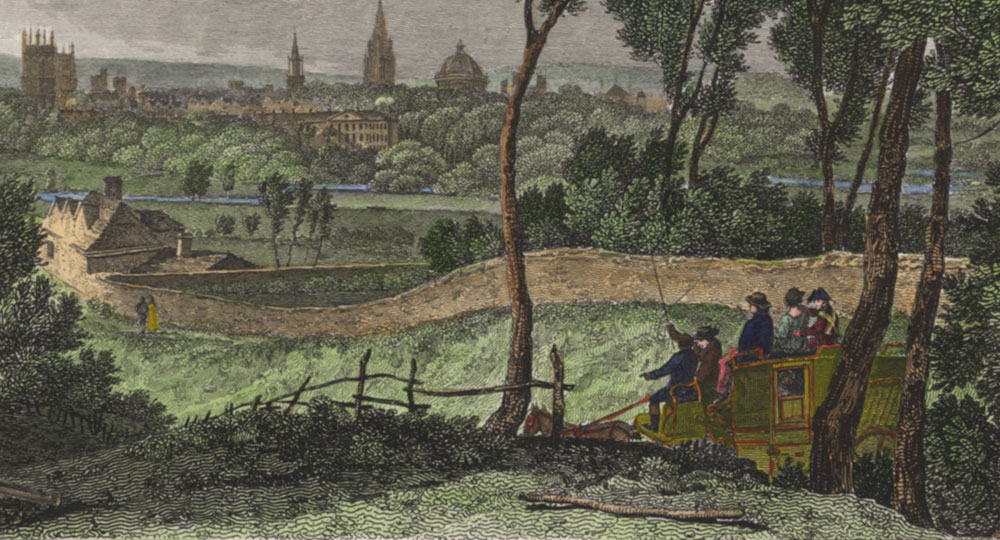
This extract from an engraving of a painting by J. M. W. Turner shows a coach going down Headington Hill in 1803–4:
The engraving of the Mitre Inn by J. Fisher shown below dates from c.1825 and shows the Defiance coach, which ran between Oxford and London via Henley, straddling the entrance to the Market and the coach office at No. 17:

The print below shows the Blenheim coach, which travelled between London and Woodstock via Headington and Oxford, loading passengers outside Coles's General Coach Office at the Star Inn in Cornmarket, probably in about 1831. The door of the coach lists Thomas Kirby, John Kirby, and John Coles. The office proclaims that coaches left the Star for all parts of the kingdom:
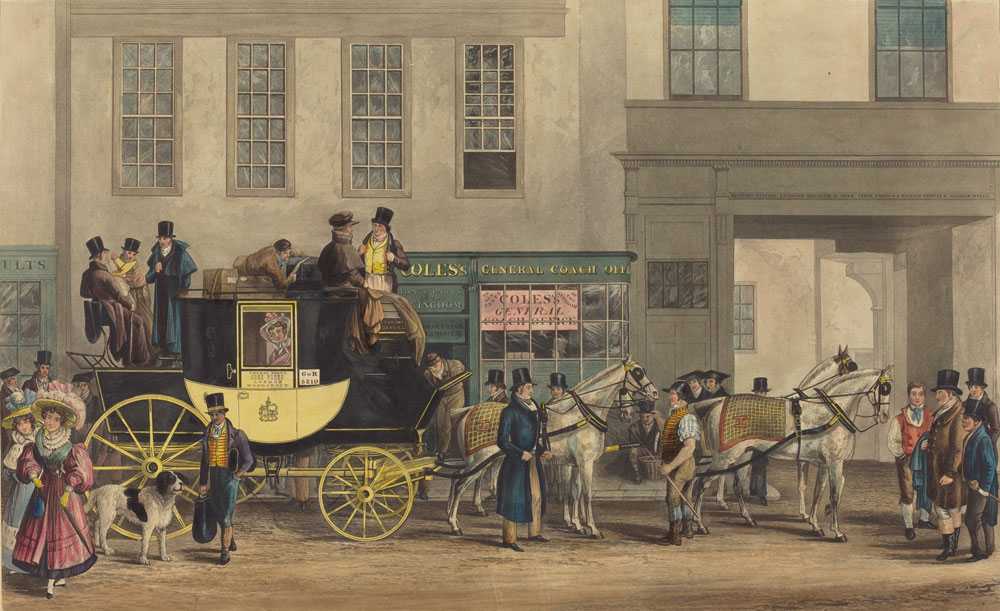 This print held by the National Gallery of Art in Washington is available in a larger size on Wikimedia Commons
Richard Costar (c.1766–1840)
Richard Costar was baptised at Benson [Bensington], Oxfordshire on 24 December 1766, the only son of William Costar or Costard and Sarah Shrubb and the cousin of William Costar of the Crown Inn at Benson. More on the Costars of Benson can be found here.
Soon after he was born he came to Oxford, where his father became Master of the Cross Coaching Inn (or Golden Cross) in Cornmarket, His mother died there on 30 April 1769 when he was only two years old.
On 30 January 1779 Richard's father William Costar (now described as formerly being of the Cross Inn in Cornmarket) announced in Jackson's Oxford Journal that he had taken over the Angel Inn in Oxford's High Street, and henceforth he ran coaches from there. The Universal Business Directory of 1794/5 lists the following service from the Angel: “A mail-coach to Bath and Bristol every morning at five o'clock to the White Hart, Bath, and Bush Tavern, Bristol; by Messrs Coster and Co. Oxford”.
When William Costar died at Iffley in 1802, Richard took over his coaching business based at the Angel Inn. It was probably then that he built his house in Cowley Place called The Willows on the site of a former timber yard. William Tuckwell explained how it had an entrance each side of the toll-gate (removed in 1869) to avoid tolls. (Enlarge this 1876 StreetPlan to see the building.) It was demolished to make way for Magdalen College School's 1894 building.
From 1805 to 1835 Richard Costar was an agent for the Royal Mail and ran coaches to all parts of the country, and his coaching company became the largest in Oxford. This painting by John Cordrey dated 1811 shows the Ludlow to Worcester Mail Coach on the road: the service was provided Messrs. Richard Costar and Christopher Ibberson (the latter being a coachmaster in Holborn):

On 21 December 1816 Richard Costar was described in Jackson's Oxford Journal as “Richard Costar, of the parish of St. Clement, in the suburbs of the city of Oxford, coachmaster” in relation to a contract he entered into for the purchase of land at Cogges.
Jackson's Oxford Journal on 29 June 1822 advertised the following coach service run by R. Costar, J. Coles, and Co.: “The LARK POST COACH, every morning at Eight o'clock, through Aylesbury, Woburn, Bedford, and St. Neot's, to the Eagle Inn, Cambridge”.
Costar's only sibling Sarah Costar was married to Richard Burford. a surgeon at the Radcliffe Infirmary, and on 21 April 1824 at St James's Church in Cowley their daughter Sarah Burford married Christopher Waddell, who ran his own coach company. In that same year Costar started working with Waddell, and an advertisement in Jackson's Oxford Journal on 19 June 1824 stated that the Oxford to Cambridge coach service was being run by R. Costar and C. Waddell. Pigot's Directory of Oxford for 1823 and 1830 records that The Lark left from the Angel Hotel in the High Street for Cambridge every Monday, Wednesday, and Friday at 7 a.m., adding in the latter year that it went through Thame, Aylesbury, Leighton Buzzard, Woburn, Bedford, and St Neot's.
On 4 September 1824 that newspaper advertised a new post coach called the Berkeley Hunt, “performed by R. Costar, C. Waddell, & Co.” running via Henley and Oxford to Cheltenham and back every day, and another one running daily to Worcester. Another post coach from Abingdon to London, performed by Esther Pope, R. Costar, and C. Waddell & Co. was also advertised.
- Painting of Charles Holmes, who drove the Blenheim Coach for Messrs Costar & Waddell from 1810 to 1830
By 1828 Costar was in full partnership with Waddell, and they operated from four Oxford inns: the Angel, the Mitre, the Star, and the Roebuck. This advertisement published in Jackson’s Oxford Journal on 12 July 1828 shows the numerous coach routes plied by Costar & Waddell from the Angel.
In 1835 St Clement's where Costar lived became part of the city of Oxford.
On 14 March 1840 Costar & Waddell advertised that they would recommence running the Oxford and Cambridge coach on 6 April.
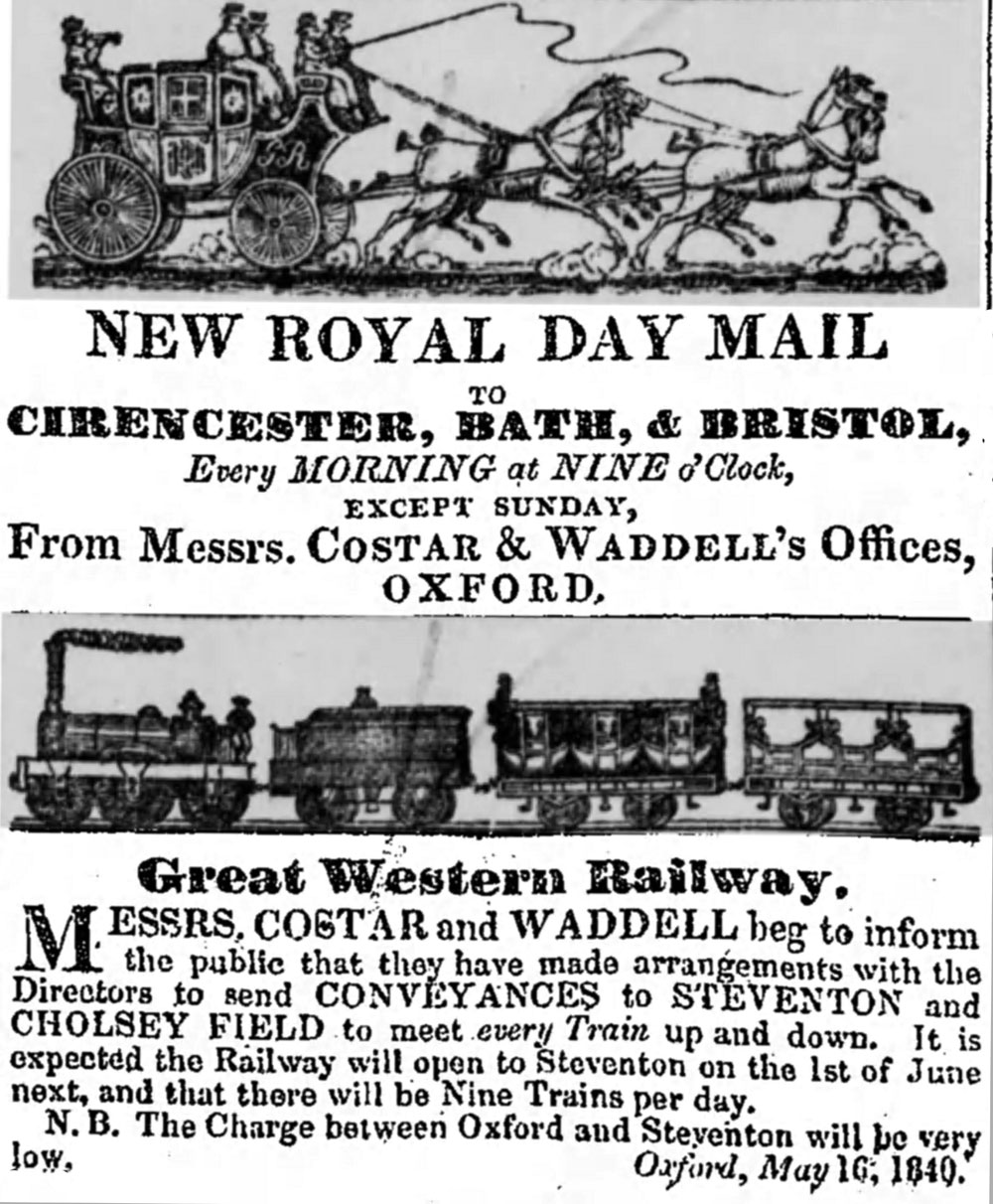
The following advertisement by Costar & Waddell introducing a new coach service to Cirencester, Bath, and Bristol appeared in Jackson's Oxford Journal on 23 May 1840. The second section of the advertisement advertised a coach service to Steventon, where the nearest railway station to Oxford was due to open on 1 June 1840:
Richard Costar died at the age of 74 on 25 September 1840, and his short obituary appeared in Jackson's Oxford Journal the following day:
Yesterday morning, at his residence in St. Clement's, after a long illness, Richard Costar, Esq. the well-known and highly-respected coach proprietor of this city. Mr. Costar lived to see the best days of coaching, and it may be truly said that no man ever carried on a concern in a more creditable manner. He was most punctual in his payments to his tradesmen, and an excellent master to good servants; and many will long have to regret his loss.
On 3 October 1840 Jackson's Oxford Journal reported on his funeral, stating, “The hearse was driven by a veteran who has grown grey in the service (W. Bowern, better known as Black Will); the next driver was T. Paine, a very old servant; the next Charles Holmes, the driver of the Blenheim; and after them came Stacey, the driver of the Defiance.” The coaches behind were filled with other coachmen and book-keepers in the service of Messrs Costar & Waddell. He was buried in his family vault at Benson on 2 October 1840.
His obituary in The Gentleman's Magazine, Vol. 169, read:
Lately. Mr. Richard Costar, coachmaster, of Oxford. His body was interred at Benson. The hearse and mourning coaches were driven by coachmen who had been a number of years in his employ, viz. W. Bowers, T. Paine, C. Holmes, and W. Stacey. The bookkeepers, and most of his other coachmen, also attended the funeral.
His Prerogative Court at Canterbury will (by which he left everything to his sister Mrs Sarah Burford and her daughter Martha) indicates how prosperous Costar was: as well as his large house, stables, coach houses, and land on the site of Magdalen College School, he owned land in Benson where he kept his stables and also two freehold houses occupied by a coachmaker and harness maker. In addition he owned arable land in the open fields of Cowley, a freehold estate at Ewelme, “freehold and leasehold messuages farms lands tenements tythes and hereditaments” at Littlemore, and a leasehold estate in Church Street, Soho, London (held jointly with his sister).
On 17 October 1840 the forthcoming auction of ten coach horses, the property of Messrs Costar & Waddell, was advertised in Jackson's Oxford Journal.
Griffin Fletcher, who had been the driver of the Oxford to Cambridge coach for many years, restarted the service as proprietor on Costar's death.
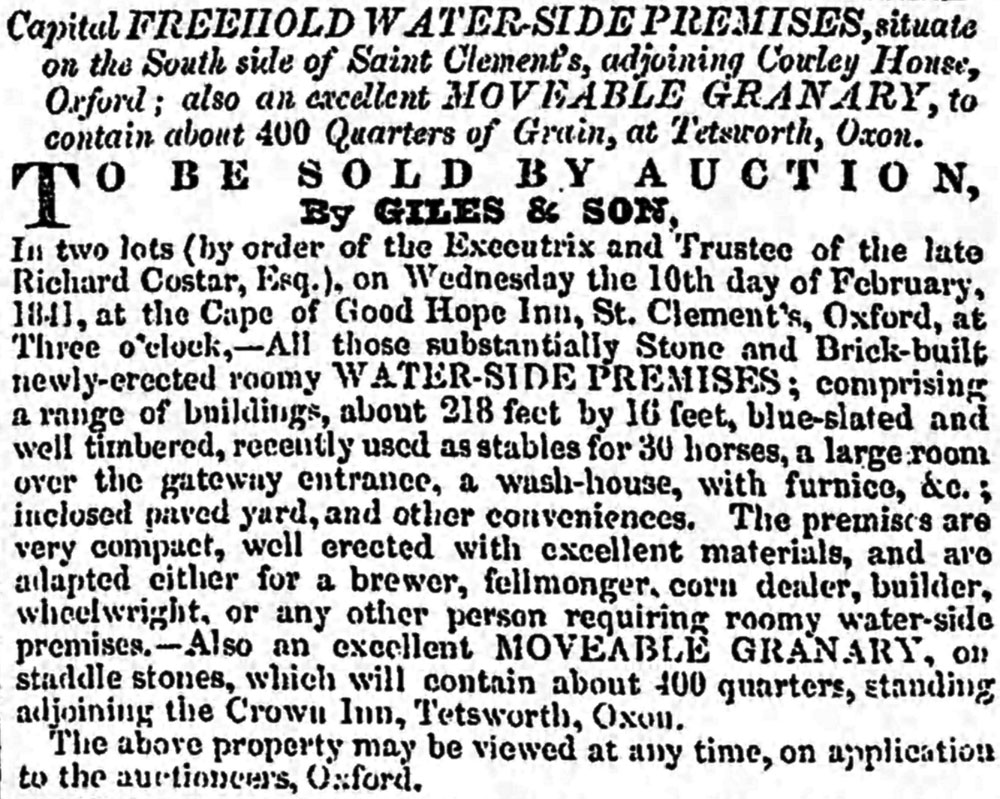
On 30 January 1841 the forthcoming auction of newly erected buildings recently used as stables for 36 horses and described as “a capital freehold water-side premises” adjoining Cowley House, was advertised along with Costar's granary in Tetsworth:
At the time of the 1841 census Richard Costar's sister Mrs Sarah Burford (about 70) was living in Costar's former house with her daughter Martha Burford (aged about 45) and Jane Shrubb (about 30), plus four servants. Next door was the coachman Edward Cracknell (32) and his family. Sarah Burford died there at the age of 76 and was buried at Benson on 5 January 1846.
On 21 August 1841 Richard Costar's nephew Edward Burford, who had served for several years as a stage coachman in Costar's service, died at Littlemore at the age of 49. Once again Black Will, described a the oldest coachman still in service in Oxford, drove the hearse to his burial at Benson.
In 1847 Richard Costar's niece Martha Burford married the builder and auctioneer John Fisher, and they continued to live in The Willows. Martha Fisher died there on 17 October 1865, and her husband John Fisher was still living in the house in 1871.
Tilleman Hodgkinson Bobart (1770–1838)
Another famous Oxford coachmaster was Tilleman Hodgkinson Bobart, the great-great-grandson of Jacob Bobart (1599-1680), the first gardener in the Oxford Botanic Garden. Tilleman was born in Woodstock and baptised there on 8 October 1770. He was the son of Gamaliel Hodgkinson Bobart and Sarah Hobday. (Tilleman's grandparents were Elizabeth Bobart and Henry Hodgkinson, who kept Hodgkinson Bobart as their surname.)
Tilleman was matriculated at the University of Oxford by University College on 5 May 1790 at the age of 18, but never graduated. G. V. Cox writes of him In his Reminiscences of Oxford (pp. 233–4):
Like some few individuals in the University at other and later times, he had acquired a taste for driving; but unlike those individuals, he thought he might as well make his favourite pursuit a source of profit. He therefore invested his patrimony in a four-horse coach, to run between Oxford and London, himself being the auriga. He kept up, at least, his acquaintance with Virgil, and was fond of challenging a freshman on his coach box to “cap verses.” Many a youth was led, from this encounter, to argue, “If Oxford coachmen are such scholars, what must the tutors and the heads be!” Poor Bobart was either very unfortunate on the road, or had lost much of his skill in driving, for twice, with a short period, his coach was upset, and he himself was, on each occasion, the sufferer by a broken leg. These accidents, however, gave a new and unexpected turn to his fortunes and occupations; first, they caused him to “give up the reins;” and secondly, they induced several of his academic patrons (especially at Ch. Ch., headed by Mr. Goodenough, afterwards Dean of Wells) to bring forward the “the classical coachman” as a candidate for the office of Esquire Bedel.
(Bobart was unanimously elected Esquire Bedel in Law in 1815, and Cox then goes on to describe his new career.)
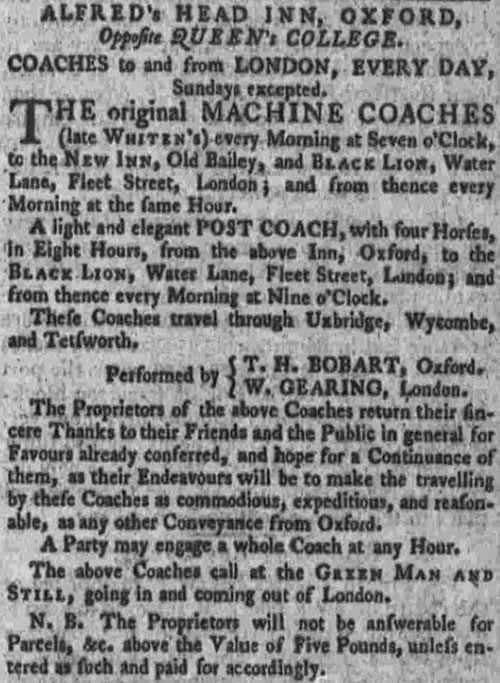
Bobart ran his coach every morning at 7.30 from the Alfred's Head, which was on the site of University College's Durham Building at 88 & 89 High Street. The following advertisement appeared in Jackson's Oxford Journal on 25 August 1798:
Tilleman Hodgkinson Bobart took his own life at his house in Holywell Street at the age of 67 on 30 December 1838.
- Caricature portrait of Tilleman Hodgkinson Bobart by Robert Dighton in 1808 entitled “The Classical alma mater Coachman Oxford”, showing Bobart wearing a coachman's coat and a beaver top hat, and carrying a long-lashed coach whip and heavy overcoat, with a bill in his hand with a list of passengers and goods for delivery.
Griffin Fletcher (c.1792–1853)
Fletcher ran the Ad Eundem coach service between Oxford and Cambridge: more details in his biography on the St Sepulchre's Cemetery, Oxford website.
Coaching Inns of the City of Oxford
The following Oxford coaching inns and taverns were all in the High and Cornmarket, which was a major route for coaches as it was part of the London–Oxford–Worcester turnpike. The three principal inns were the Angel, Star, and Mitre, and most coaches seem to have picked up passengers at all three.
- The Alfred's Head, High Street
Closed by 1811, and demolished to make way for University College's Durham Building of 1902 - The Angel, High Street
Closed in 1865 and largely demolished to make way for the Examination Schools - The earlier Bear Inn, High Street
Closed in 1801 and now two shops (123 and 124 High Street) - The Cross Inn, Cornmarket
Closed as a coaching inn in c.1874 and became a hotel until 1967. Now the Golden Cross - The Crown Inn, Cornmarket
Demolished and now the site of 59–61 Cornmarket - The Greyhound Inn, corner of Longwall Street and the High
Demolished in 1844 to make way for the western extensions of Magdalen College
- The Mitre, High Street
Latterly the Mitre Hotel, and then a restaurant (at present Gusto Italiano) - The Roebuck Inn, Cornmarket
Latterly a hotel, and now Boots the Chemist - The Star Inn, renamed the Clarendon in 1863, Cornmarket
Demolished in 1954 to make way for Woolworth's, with the site now occupied by the Clarendon Centre - The Vine Tavern, 133 High Street
Demolished in 1937 and rebuilt as a shop
Not far to the east of Oxford there was also the Old Black Horse Inn in St Clement's, and then in Headington the Britannia Inn on the New London Road and Titup Hall on site of the Crown & Thistle pub on the Old London Road.
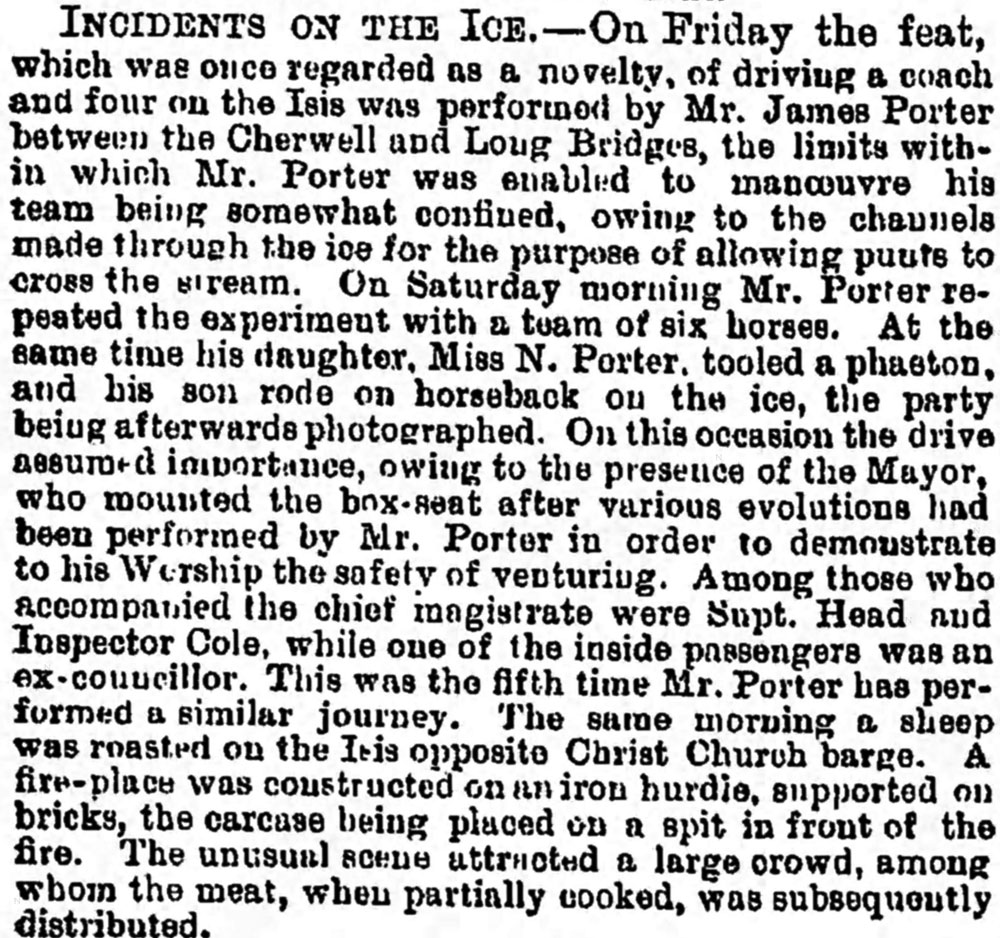
As this extract from Jackson’s Oxford Journal of 23 February 1895 shows, the coachman James Porter famously took a coach and horses a number of times on the frozen Isis between the Cherwell and Long Bridges, with his daughter Nelly driving the phaeton shown on the right in this photograph: