

East Oxford: Iffley Road

This photograph was taken on the Iffley Road, with the Howard Street junction behind the lamppost on the right. Below is the same scene in 2025:
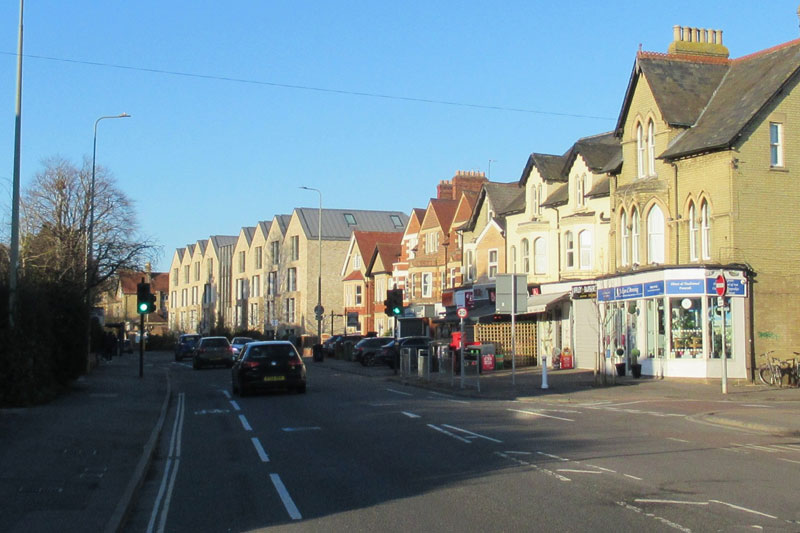
The villa with six chimney pots in the right forefront of the old postcard is 295 Iffley Road, which was built on the corner of Howard Street in about 1892. At the time of the 1901 census it was occupied by the builder Thomas Loosley (46), his wife Florence (39) and their son George (16), who was a pupil teacher. They had no live-in servants. The ground floor is now occupied by Ladbroke's.
By 1875, the north-east side of the road already had the following groups of short terraces and detached villas built on the meadows, as well as three pubs. The numbers given are those used today. (The Iffley Road had to be renumbered in 1892 because there was so much infilling in between these groups of terraces.)
19–25 (Portland Terrace)
27 (Rose Cottage)
29–31 (Grove Villas)
33–35 (Norfolk Villas)
37–41
The Cricketer’s Arms
45–53 (1–5 Magdalen Terrace), later the Isis Boarding House
57–61 (Isis Villas)
63–65
67–73 (St John’s Terrace)
77–83 (Merton Terrace)
85–93 (Christ Church Terrace)
95–101
103–109 (Henley Terrace)
111–119 (Carlton Terrace)
125–127 (Prospect Villa)
The Old Ale House (Fir Tree Tavern)
165–171 (Cheshunt Terrace)
239–241 (Carlton Lodge Academy)
The Magdalen Arms
The group of houses shown above were all built in the 1890s.
Except for a house called Fairacres, there were no buildings at all on the south-west side of Iffley Road until the twentieth century.

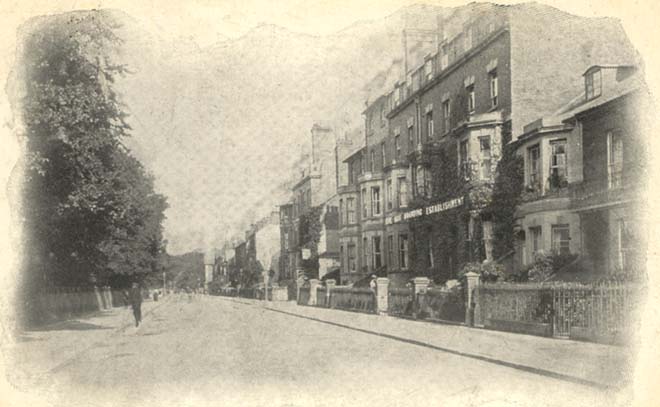
The Isis Boarding Establishment
(later the Tamesis Guest House, and now Tamesis House)
This occupies the present 45, 47, 49, 51, & 53 Iffley Road. It is owned by St Edmund Hall, and today houses 43 of their third-year undergraduates and visiting students.
These five houses were originally called Magdalen Terrace, which was built by 1863 and was hence one of one of the earliest blocks of large houses to be built on the Iffley Road. It has been renumbered twice, and prior to 1892 it was 14, 15, 16, 17 & 18 Iffley Road.
Nos. 51 and 53 (the two houses on the right of the advertising postcard shown below) were the original Isis Boarding House as early as 1894. The house on the left of the picture, No. 49, became part of the establishment in 1899, and by the end of the First World War, Nos. 45 and 47 (not shown here) had been taken in too.

The postcard below shows the whole of the extended “Isis Boarding Establishment” in c.1905.

Tamesis House (the former Isis Boarding House) in 2021
St John the Evangelist Church
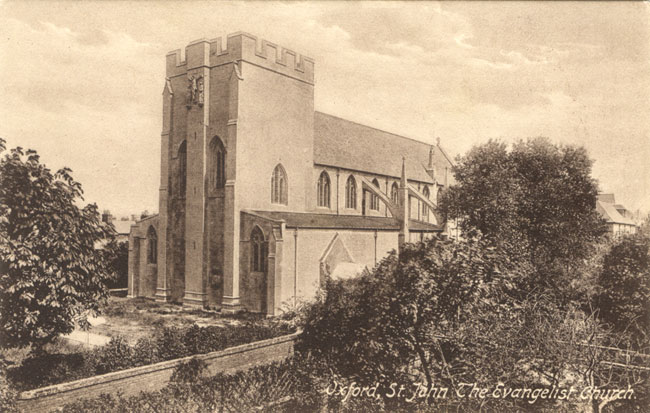
St John the Evangelist Church in the Iffley Road, pictured above in 1905, was built as a mission church of the Society of St John the Evangelist (the Cowley Fathers) in 1894–6 to the designs of G. F. Bodley. The tower was added in 1902 and was originally intended to be higher. The building is Grade I listed.
The church, which is within the parish of SS. Mary and John, was used by the public as well as acting as the college chapel of St Stephen’s House. Since 2012 it has been SJE Arts, an arts and concert venue.
Iffley Road before it was built up
The Oxford Paving Act led to the creation of the Iffley Road. The following notice appeared in Jackson's Oxford Journal of 24 May 1777:
OXFORD PAVING ACT.
NOTICE is hereby given, That if any Person or Persons are willing to contract for making a Road, as staked out by the Surveyor, leading from the East End of Magdalen-Bridge to join the Henley Road, and keeping the same in Repair for a certain Number of Years, and for raising the Ground at the West End of the said Bridge, they are desired to send in their Proposals, sealed up, to one of the Clerks, on or before the next meeting of the Commissioners, to be held at the Council-Chamber in the City of Oxford, on Wednesday the 4th Day of June. The Whole to be compleated under the Directions of Mr. Gwynn. The Materials to be had near the Spot.—For further Particulars enquire at the Town-Clerk's Office.
At this Meeting the Commissioners will take up, at Four and a Half per Cent. the sum of 1000 l. or such Part thereof as shall then be offered, upon the Credit of the Tolls arising by Virtue of this Act.
The present Iffley Road was known as the Henley Road in the first half of the nineteenth century, as it was the turnpike road from Oxford to London via Henley and it was not built up.

The above print entitled “View of Oxford from the Henley Road” was drawn by F. Mackenzie, engraved by J. Le Keux, and published by J. B. Parker of Oxford and C. Tilt of Fleet Street, London on 1 April 1837. The open land on the left is probably Campus Field. The coach, which has probably taken the turnpike road all the way from London to Oxford via Henley, is about to reach the toll gate at The Plain. William Tuckwell wrote in Reminiscences of Oxford (Cassell & Company Ltd, 1900):
It was said in those days [the 1830s] that the approach to Oxford by the Henley road was the most beautiful in the world. Soon after passing Littlemore, you came in sight of, and did not lose again, the sweet city with its dreaming spires, driven along a road now crowded and obscured with dwellings, open then to cornfields on the right, to uninclosed meadows on the left, with an unbroken view of the long line of towers, rising out of foliage less high and veiling than after sixty more years of growth to-day. At once, without suburban interval, you entered the finest quarter of the town, rolling under Magdalen Tower, and past the Magdalen elms, then in full unmutilated luxuriance, till the exquisite curves of the High Street opened on you, as you drew up at the Angel, or passed on to the Mitre and the Star.
Historic England images
Historic England has only one photograph of the Iffley Road, namely this one shown taken by Henry Taunt in 1905 and showing Henley House, now No. 189 (HT 13783):
You can view this photograph full-screen by hovering over the image and then clicking on the symbol at the top right-hand corner.